Thickness grading and chisel dressing (scalpellatura a mano) are the foundational stonemasonry skills that transform raw Apulian calcarenite into functional architectural flagstones. Extracted from open-cast quarries across the Murge plateau and Trani, the limestone is naturally stratified into sedimentary geological beds. Master quarrymen exploit horizontal micro-fissures using iron splitting wedges (cunei) to cleave massive, continuous flagstone slabs along their natural grain. Slabs are systematically graded by thickness: heavy 80–120 mm slabs for ground floors, 50–80 mm for vaulted interiors, and 30–45 mm chiancarelle for roof structures. Stonemasons subsequently hand-dress perimeter borders using mason's picks and chisels to produce tight, orthogonal joinery seams.
At a Glance: Key Takeaways
- Quarry Basins: Murge Plateau (Martina Franca, Ostuni) and Trani (Barletta-Andria-Trani, Puglia)
- Extraction Tooling: Iron splitting wedges (cunei), heavy sledgehammers (mazzetta), and quarry crowbars (pali)
- Thickness Classes: Chianca grossa (80–120 mm), chianca media (50–80 mm), chiancarella (30–45 mm)
- Edge Dressing: Scalpellatura a mano: manual perimeter dressing with mason's pick (subbia) and flat chisel
- Surface Texture: Piano di cava / spacco naturale (natural sedimentary cleft surface showing fossil bivalves)
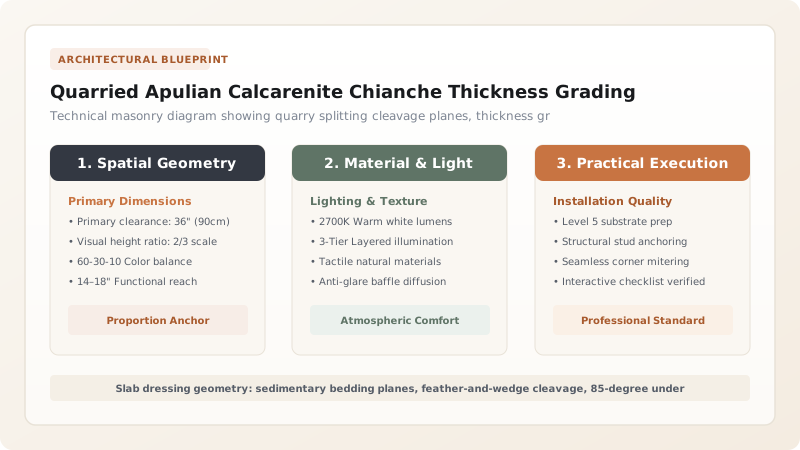
Quarrying the Murge Karst: Stratigraphy & Cleavage
The limestone plateau of the Murge in central Puglia is one of the most distinctive geological regions in the Mediterranean basin. Over tens of millions of years, calcareous sediment deposited on the prehistoric Tethys ocean floor consolidated into thick, stratified sequences of limestone and calcarenite. Unlike un-stratified massive marbles that must be sawed into blocks, Apulian limestone was formed in distinct sedimentary layers separated by paper-thin micro-fissures containing clay or organic matter.
Master quarrymen (cavatori) have exploited these natural horizontal cleavage planes (piani di posa) since ancient Roman times. Working along exposed quarry benches in Martina Franca, Trani, and Apricena, artisans drill short holes along target lines and insert forged iron feathers and wedges. By driving the center wedges with rhythmic, synchronous hammer blows, quarrymen induce controlled horizontal fractures that run along the bedding plane for tens of meters, popping massive continuous flagstone slabs cleanly away from the bedrock without shattering the stone matrix.
The Three Thickness Tiers of Chianche
Once cleaved from the quarry face, raw slabs vary naturally in thickness from thirty millimeters to nearly two hundred millimeters. Proper structural deployment requires rigorous thickness grading. Slabs are sorted into three classical architectural tiers, each corresponding to a specific structural demand within the Apulian building envelope.
The heaviest class is the chianca grossa (80 to 120 millimeters thick). Capable of bearing immense point loads, these heavy slabs were specified for ground-floor masseria halls, grain storage vaults, and outdoor threshing floors (aia). The intermediate class—the chianca mezzana (50 to 80 millimeters)—was the standard residential paving for the vaulted upper floors of palazzi and trulli living quarters, light enough not to overload timber beams or stone barrel vaults while providing solid acoustic dampening. The thinnest tier—the chiancarella (30 to 45 millimeters)—was reserved for exterior drystone trulli cone roofs and lightweight interior mezzanines.
The Art of Scalpellatura a Mano: Chisel Edge Dressing
When slabs arrive from the quarry, their perimeter edges are wild, irregular, and fractured. To assemble these natural shapes into an interlocking, walkable floor with narrow joints, each individual slab must undergo scalpellatura a mano (hand-chisel dressing). Resting the stone upon a sandbag support bench, the stonemason uses a heavy pointed pick (subbia) and a broad flat chisel (scalpello) to square the edges.
The dressing is executed with deliberate geometric subtlety. The mason does not cut a plumb, vertical ninety-degree face. Instead, the edge is cut with an inward undercut—a bevel of approximately eighty-five degrees. This allows the top walking edges of adjacent stones to touch tightly at a precise three-to-five-millimeter joint, while leaving a wide, V-shaped cavity beneath the surface that fills with bedding mortar. The mortar keys into the rough-chiseled stone cheeks, locking adjacent slabs together under lateral friction and preventing individual flagstones from shifting or rocking under foot traffic.
Preserving the Natural Cleft: Spacco Naturale vs Sawn Modernity
In contemporary restoration practice, a severe point of contention is the method used to finish the top surface of the stone. Commercial stone suppliers frequently saw both faces of chianche with industrial diamond gang-saws, producing flat, uniform tiles that are subsequently tumbled or acid-washed to simulate age. Historic conservation architects reject this shortcut completely.
Machine sawing severs fossilized bivalves and cuts through natural calcite crystal grains, leaving open, porous micro-pores that eagerly absorb dirt and stains. Authentic chianche retain their spacco naturale—the natural sedimentary split face created when the stone cleaved along its original prehistoric bedding plane. This cleft face possesses microscopic undulating ridges, fossil shell impressions, and a natural non-slip geological texture that feels warm and sensual to bare feet. When maintained with natural olive oil soaps, the natural cleft surface burnishes to an incomparable satiny luster that no modern machine could ever duplicate.
Grading Specifications & Tooling for Apulian Limestone Chianche
Use this reference table to calculate exact physical dimensions, ratios, and specifications before purchasing:
| Grade Class | Nominal Thickness | Weight per m² | Quarry Extraction Tool | Architectural Role |
|---|---|---|---|---|
| Chianca da Terra (Heavy) | 80–120 mm | 190–260 kg/m² | Heavy wedges & pneumatic splitting plugs | Ground-floor masseria halls, porticoes, and wine cellars |
| Chianca Mezzana (Medium) | 50–80 mm | 120–180 kg/m² | Hand-cleaved feather and wedges | First-floor vaulted rooms, trullo cones, and residential salons |
| Chiancarella (Thin Roof Tile) | 30–45 mm | 70–105 kg/m² | Hand froe and light stone splitting axe | Trulli conical roof coverings and decorative garden paths |
| Chiancato Stradale (Civic) | 120–180 mm | 280–380 kg/m² | Quarry bench cleavage with excavators | Pedestrian piazzas, church parvises, and vehicular courtyards |
| Chianca Calibrata (Modern) | 30–40 mm calibrated | 75–95 kg/m² | Diamond underside milling with cleft top | Contemporary installations with hydronic underfloor radiant heating |
Practical Constraints
Every successful decoration project must account for physical and environmental constraints:
Natural thickness variation along a single continuous cleaved flagstone slab
A single 1-meter-long slab can measure 90 mm on one end and 115 mm on the opposite end. Mitigation: Masons carve individual mortar pockets or hand-adzed depressions in the screed to bed irregular slab bellies.
Fossil pockets and clay veining causing unexpected stone breakage during chisel dressing
A nearly completed hand-chiseled slab can snap along a hidden fossil vein under a heavy hammer blow. Mitigation: Support the slab fully on a damp sandbag bed during dressing and execute light, controlled chisel strokes.
Execution Blueprint & Craftsmanship Sequence
Execute this professional sequence to achieve flawless results without backtracking:
Quarry Bench Stratum Mapping
Inspect open-cast calcarenite quarry faces in the Murge hills, mapping continuous horizontal sedimentation planes that separate dense, workable limestone beds.
Feather & Wedge Cleavage Drilling
Drill vertical pilot holes 15 cm deep spaced 25 cm apart along the cleavage axis, inserting paired steel feathers and driving center splitting wedges with a 5 kg sledgehammer.
Bedding Plane Separation & Prying
Strike the wedges sequentially until a continuous hairline horizontal fracture travels along the bedding plane, prying the slab free using heavy steel crowbars (pali).
Thickness Sorting & Caliper Inspection
Measure slab cross-sections with mechanical gauges, categorizing stones into heavy (80–120 mm), medium (50–80 mm), and light chiancarelle (30–45 mm) storage crates.
Geometric Squaring & Charcoal Scribing
Lay the rough-edged slab onto a wooden mason's bench, snapping charcoal lines to square the corners into clean rectangular or polygonal trapezoidal modules.
Primary Edge Reduction with the Mason's Pick (Subbia)
Spall away excess border rock using a heavy pointed pick (subbia) struck with an iron club mallet, roughing the perimeter down to within 5 mm of the scribed line.
Fine Perimeter Chisel Dressing (Scalpellatura)
Dress the final perimeter joint with a 30 mm wide flat stone chisel (scalpello a lama piatta), undercutting the lower edge slightly to guarantee razor-tight 3 mm surface joints.
Fossil Cortex Cleaning & Palletizing
Scrub the natural cleft surface with stiff bristle brushes and water to remove quarry dust, inspecting fossil shell inclusions before strapping slabs onto transport pallets.
Common Mistakes & Countermeasures
Avoid these costly errors that compromise aesthetics, ergonomics, and budget:
Using modern diamond gang-saws to saw both the top and bottom faces of chianche
Dressing perimeter edges with an outward-flaring bevel instead of an undercut bevel
Mixing slabs of radically differing thicknesses within the same paving bay
Project Execution Checklist
Track your physical progress. Checkboxes persist automatically on this device:
Frequently Asked Questions
What is 'scalpellatura a mano' and why is it superior to machine-sawn edges?
Scalpellatura a mano is the traditional manual edge dressing performed with a mason's chisel and hammer. Machine-sawn edges create straight, clinical joints that look out of place in historic masserie. Hand-chiseled edges exhibit subtle micro-variations that absorb joint movements, hold breathable lime grout permanently, and recreate the authentic organic craftsmanship of antique Italian paving.
Why do masons chisel the edges of chianche with an undercut bevel?
Masons chisel the perimeter with an angle of approximately 85 degrees—sloping inward beneath the stone face. This ensures that the top edges of adjoining slabs can touch tightly to form a narrow 3 mm surface seam, while leaving a wide, flared cavity below that fills completely with bedding mortar to lock the slabs in place.
What are the visible signs of genuine fossiliferous Apulian calcarenite?
Genuine Apulian calcarenite displays a warm straw-yellow or cream background peppered with fossilized sea shells, microscopic foraminifera fragments, and occasional iron-oxide mineral dendrites. It possesses a velvety, sand-textured surface that feels warm to the touch and never becomes icy cold like dense marble.