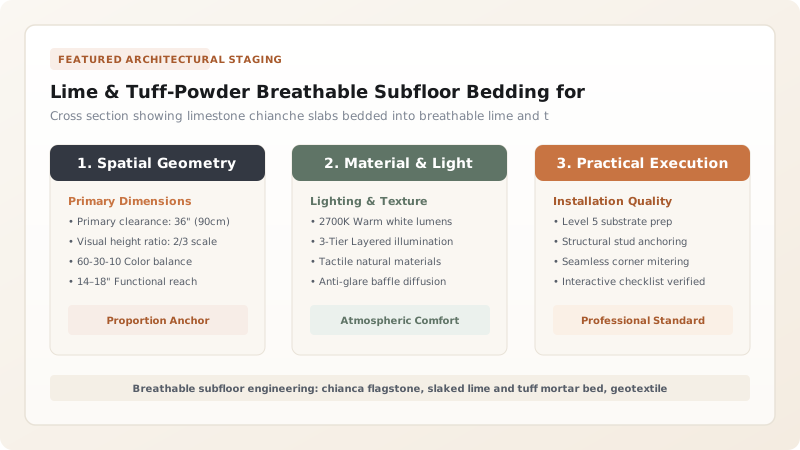
The longevity and moisture balance of traditional Apulian chianche limestone floors rely on a fully breathable, non-hydraulic subfloor bedding assembly. In historic masserie and trulli lacking modern plastic damp-proof membranes, impermeable Portland cement beds trap groundwater beneath the stone, causing destructive rising damp and salt efflorescence (salnitro). Instead, master masons install a ventilated coarse aggregate subgrade (vespaio aerato) topped by a thick, semi-dry mortar bed formulated from slaked fat lime (calce spenta), crushed volcanic or calcareous tuff powder (polvere di tufo), and coarse river sand. This micro-porous matrix provides flexible, high-mass bedding that naturally transpires subterranean humidity while absorbing building settlement without cracking.
At a Glance: Key Takeaways
- Bedding Binder: Slaked fat lime putty (calce spenta / grassello) aged 60+ days or NHL 2/3.5
- Pozzolanic Aggregate: Pulverized calcareous or volcanic tuff powder (polvere di tufo pugliese)
- Sub-Base Structure: Vespaio aerato: 20–30 cm of washed, crushed limestone ballast (40–70 mm ballast)
- Mortar Bed Depth: 40 to 60 mm thick semi-dry screed bed individually calibrated for each slab
- Vapor Performance: 100% breathable (Class I vapor open); eliminates capillary rising damp
The Hygrothermal Dynamics of Historic Apulian Masserie
To understand why traditional Apulian chianche floors must be bedded in lime and tuff rather than modern concrete, one must examine the overall building physics of southern Italian vernacular architecture. A fortified masseria or drystone trullo is essentially a massive, monolithic stone sponge. Built from porous calcarenite blocks without damp-proof membranes, the structure exists in continuous dynamic equilibrium with ground humidity and atmospheric air.
Subterranean moisture naturally migrates upward from the water table through capillary action in the soil. In an authentic historic structure, this moisture is distributed over hundreds of square meters of breathable masonry and evaporates harmlessly into indoor ambient air. If an uninformed modern builder installs an impermeable layer—such as a polyethylene plastic membrane or a rigid Portland cement screed—the rising moisture is blocked beneath the floor. Blocked from evaporating, the water migrates sideways under hydrostatic pressure, forcing its way into the base of perimeter walls where it dissolves subsoil minerals and erupts as destructive white salt efflorescence (salnitro), pulverizing structural stone and destroying historic frescoed walls.
The Vespaio Aerato: Breaking the Capillary Chain
The first line of defense in traditional Apulian subfloor engineering is the vespaio aerato (literally 'ventilated hornet's nest'). Rather than pouring concrete directly onto damp earth, masons excavate down to solid bedrock or compact marl, installing a twenty-to-thirty-centimeter foundation bed of coarse, washed limestone ballast (measuring forty to seventy millimeters in diameter).
The physics of the vespaio is based on capillary pore size: water can only climb through microscopic pores. The large air voids between coarse crushed stones completely break capillary suction, preventing liquid groundwater from rising. Furthermore, masons install small ventilation pipes that connect the stone ballast layer to the exterior building facades. Natural wind pressure differentials establish a continuous, low-velocity airflow through the ballast bed, sweeping away evaporated water vapor and discharging it safely outdoors before it can reach the living spaces above.
Mineral Chemistry: Lime & Polvere di Tufo Pozzolanic Reactivity
Above the ventilated aggregate bed sits the structural bedding mortar. In traditional Puglia, master masons formulated an indigenous hydraulic mortar by combining two locally abundant geological resources: slaked fat lime (calce spenta) and pulverized tuff powder (polvere di tufo).
Pure fat lime is a non-hydraulic binder; it requires contact with atmospheric carbon dioxide (CO₂) to cure. Beneath heavy, one-hundred-kilogram limestone chianche measuring ten centimeters in thickness, air contact is virtually zero; pure lime putty would remain wet and un-carbonated for years. To trigger an internal chemical cure, masons blended the lime with polvere di tufo. Sourced from local volcanic or marly tuff quarries, this powder is rich in amorphous, reactive silica and alumina. In the presence of water, these minerals react chemically with calcium hydroxide in the lime (the classical pozzolanic reaction) to form crystalline calcium silicate hydrates (C-S-H). This generates a gentle, micro-porous hydraulic set that hardens reliably throughout the entire thickness of the mortar bed independently of air exposure.
Screeding, Setting & Joint Grouting Mechanics
The physical installation of chianche into the lime-tuff bed is an art of continuous manual compensation. Because hand-cleaved slabs vary in thickness along their length, the mason cannot simply pour a flat, level screed across the room. The artisan must spread an individual, semi-dry mortar bed (typically forty to sixty millimeters thick) for each specific flagstone.
The mason coats the rough underside of the slab with a thin slurry of pure lime putty (to ensure chemical bonding) and lowers the stone into the wet mortar bed. Using a heavy five-kilogram rubber mallet, the mason beats the stone firmly into place, adjusting its elevation until it aligns with horizontal reference strings. Once the mortar cures for seven to ten days, the narrow joints are grouted with a fluid slurry composed of slaked lime putty and pulverized limestone dust. This ensures that the joints possess an identical chemical composition, thermal expansion coefficient, and vapor permeability to the surrounding flagstones, guaranteeing a unified, non-cracking floor that will endure for generations.
Subfloor Mortar Formulations for Apulian Limestone Paving
Use this reference table to calculate exact physical dimensions, ratios, and specifications before purchasing:
| Mortar Formulation | Binder : Tuff : Sand Ratio | Curing Mechanism | Compressive Strength (28d) | Application Context |
|---|---|---|---|---|
| Traditional Calce e Tufo | 1 part Slaked Lime : 2 parts Tuff : 1 part Sand | Pozzolanic reaction + atmospheric carbonation | 3.5–5.0 MPa (Gentle, ductile) | Authentic restoration of historic masserie, trulli, and historic palazzi |
| Natural Hydraulic Lime (NHL 3.5) | 1 part NHL 3.5 : 2.5 parts Sand/Tuff blend | Hydraulic set + atmospheric carbonation | 5.0–7.5 MPa (Moderate) | High-traffic commercial spaces, historic piazzas, and wet areas |
| Lime-Pozzolana Grout Slurry | 1 part Lime Putty : 1 part Micro-fine Stone Dust | Carbonation with minimal hydraulic set | 2.0–3.0 MPa (Elastic) | Grouting narrow 3–5 mm joints between hand-dressed chianche |
| Modern Portland Cement (Defective) | 1 part Portland : 3 parts Sand | Rigid crystalline silicate hydration | 25–35 MPa (Excessively rigid) | Strictly prohibited; causes salt spalling, damp trapping, and stone failure |
Practical Constraints
Every successful decoration project must account for physical and environmental constraints:
Slow carbonation and pozzolanic curing time of lime-tuff mortars in closed, damp interiors
Floors cannot bear heavy point loads or furniture for several weeks after installation. Mitigation: Provide continuous low-velocity ventilation and protect fresh paving with breathable plywood walk-boards for 14 days.
Variable reactivity of local tuff powders across different quarry regions in Puglia
Tuff with low amorphous silica content yields a slower setting mortar with reduced compressive strength. Mitigation: Perform site slump tests and source high-reactivity volcanic tuff powder from certified regional suppliers.
Execution Blueprint & Craftsmanship Sequence
Execute this professional sequence to achieve flawless results without backtracking:
Subgrade Excavation & Drainage Grading
Excavate the interior floor footprint to 35 cm below finished floor level, sloping the earth base slightly toward exterior foundation drainage trenches.
Vespaio Aerato Ballast Bedding
Fill the excavation with 20 cm of clean, washed 40–70 mm limestone aggregate ballast, establishing cross-ventilated perimeter air intake and exhaust vents in exterior walls.
Geotextile Separation Layer Placement
Roll a high-permeability non-woven polypropylene geotextile fabric over the aggregate ballast to prevent wet mortar from sinking into the stone voids.
Lime-Tuff Mortar Mixing & Hydration
Blend slaked lime putty with pulverized tuff powder and coarse river sand in a paddle mixer for 10 minutes, achieving an earth-moist, workable paste.
Individual Slab Screed Spreading
Trowel a 50 mm thick bed of mortar for an individual slab, buttering the rough underside of the chianca with pure lime slurry to ensure complete adhesion.
Slab Positioning & Mallet Compaction
Lower the heavy slab into place and beat it vigorously with a 5 kg rubber mallet, checking horizontal level and tapping until mortar exudes slightly along borders.
Joint Grouting with Lime-Stone Dust Slurry
After 7 days of mortar set, pour a fluid slurry of slaked lime and pulverized limestone dust into the 3–5 mm seams, striking joints flush with a wooden trowel.
Surface Washing & Moist Curing
Sponge off excess grout residue immediately using clean water, keeping the floor misted with clean water for 5 days to ensure complete lime carbonation.
Common Mistakes & Countermeasures
Avoid these costly errors that compromise aesthetics, ergonomics, and budget:
Laying an impermeable plastic polyethylene vapor barrier beneath the bedding mortar in historic buildings
Adding Portland cement to the lime-tuff mortar to accelerate curing time
Grouting joints between chianche with modern polymer-modified sanded cement grouts
Project Execution Checklist
Track your physical progress. Checkboxes persist automatically on this device:
Frequently Asked Questions
What is 'polvere di tufo' and why is it added to slaked lime mortar?
Polvere di tufo is finely pulverized volcanic or porous calcareous tuff rock abundant throughout southern Italy. When ground into fine powder and blended with slaked lime, the reactive amorphous silica and alumina in the tuff react with calcium hydroxide in the presence of water, forming hydraulic calcium silicate hydrates (C-S-H). This transforms weak non-hydraulic lime into a durable hydraulic mortar that sets reliably beneath thick stone slabs.
How does a 'vespaio aerato' prevent dampness from destroying a chianche floor?
A vespaio aerato is a ventilated gravel crawlspace or cavern created beneath the floor. In southern Italy's humid subsoils, groundwater rises via capillary action through soil particles. The coarse, large-diameter stones in the vespaio eliminate capillary action completely, while perimeter ventilation ducts circulate outdoor air that continuously purges moisture vapor before it can reach the floor.
Can this traditional lime-tuff bedding system accommodate underfloor radiant heating coils?
Yes. While specialized natural hydraulic lime (NHL 3.5) screeds are typically preferred for underfloor heating to optimize thermal transfer around hydronic PEX tubing, the lime-and-tuff mix functions beautifully. Because lime has a lower elastic modulus than cement, it expands and contracts gently with heating cycles without cracking or crushing the tubing.