The signature soft, waxy luster (effetto cera) and amber honey patination of historic Apulian chianche floors is achieved through a centuries-old biochemical maintenance tradition: washing exclusively with natural olive oil Castile soap (sapone all'olio d'oliva / sapone di Marsiglia) and warm water. Unlike synthetic topical sealers that form a plastic film over the stone, natural olive oil soap reacts chemically with the calcium carbonate and free calcium hydroxide in the limestone matrix, precipitating a microscopic, insoluble crystalline barrier of calcium oleate. Over decades of foot traffic and regular soap burnishing, this biological reaction fills surface micro-pores, creates permanent stain resistance against wine and oils, and polishes the stone into a lustrous, slip-resistant satin finish.
At a Glance: Key Takeaways
- Cleaning Medium: Pure natural olive oil Castile soap (sapone all'olio d'oliva / sapone di Marsiglia)
- Chemical Reaction: Saponification: Potassium oleate reacts with calcium carbonate to form insoluble calcium oleate
- Optical Finish: Effetto cera (waxy satin sheen with deep amber-cream color enrichment)
- Stain Protection: Hydrophobic crystalline barrier resisting wine, coffee, and cooking oil penetration
- Maintenance Cadence: Weekly damp mopping with diluted olive oil soap; annual rotary machine burnishing
The Chemistry of the Effetto Cera: Natural Saponification
When travelers enter an ancient masseria in the Valle d'Itria or a centuries-old palazzo in Martina Franca, the tactile quality of the chianche floor is immediately unforgettable. The stone does not feel cold, dusty, or chalky like raw limestone, nor does it look artificial and glossy like modern glazed ceramic tiles. Instead, the floor exhibits the celebrated effetto cera (waxy effect)—a soft, sensual satin luster that glows under raking Mediterranean sunlight.
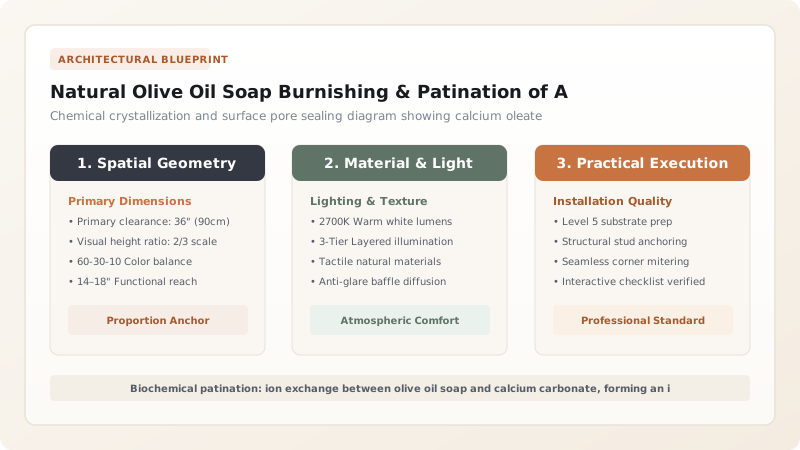
This finish is the direct product of centuries of biochemical saponification. Historically, Apulian households produced their own domestic soap by reacting surplus olive oil (rich in oleic acid, C₁₇H₃₃COOH) with alkaline potassium lye leached from wood ash. When this pure olive oil soap (sapone all'olio d'oliva) is dissolved in warm water and scrubbed across calcium carbonate (CaCO₃) limestone, a permanent ion-exchange reaction occurs: the potassium oleate reacts with calcium ions on the stone surface, precipitating an insoluble, micro-crystalline barrier of calcium oleate. This reaction occurs deep within the stone's microscopic pores rather than forming a topical surface film, creating a permanent, organic, hydrophobic shield.
The Sins of Synthetic Sealers: Acrylics & Polyurethanes
In contemporary restoration projects, well-meaning property owners frequently succumb to the promises of modern chemical manufacturers, applying topical acrylic wet-look sealers, epoxy coatings, or synthetic polyurethane floor varnishes over antique chianche. In historic stone architecture, this practice is catastrophic.
Synthetic topical coatings form an impermeable, non-breathable plastic skin across the stone. Because the underlying masonry envelope lacks modern plastic damp-proof membranes, rising moisture vapor from the ground is trapped directly beneath the plastic coating. Within two to three seasons, the trapped moisture causes the synthetic film to turn a milky, cloudy white, blistering and peeling under foot traffic. Furthermore, dirt and sand tracked from outside become embedded in the soft plastic resin, turning the floor into an unsightly, scratched mess that can only be removed through aggressive, toxic chemical stripping that irreparably damages the historic stone face.
The Burnishing Protocol: Tampico Brushes & Rotary Buffing
Developing the full beauty of a chianche floor requires a disciplined protocol of mechanical and chemical burnishing. Following the mandatory thirty-day carbonation period after mortar bedding, the floor is subjected to its foundational wash. Grated olive oil soap flakes are dissolved in warm water and applied generously to the stone.
The lather is worked into the stone using natural tampico fiber floor brushes or a low-speed rotary floor machine fitted with a medium-stiff brush. The mechanical scrubbing forces the fatty acid molecules deep into the porous calcarenite matrix. Crucially, the floor is not rinsed with clean water afterward; excess dirty lather is squeegeed away, leaving a thin, molecular lubricating film behind. Once bone-dry, the floor is burnished using a high-speed floor machine fitted with a natural white hog's hair pad. The friction heat of the buffer melts and burnishes the calcium oleate crystals, transforming the raw cleft stone into a mirror-smooth satin plane.
Living Patination & The Agronomic Legacy of Puglia
In the final analysis, an Apulian chianche floor is not a static building material; it is an evolving, living organism that matures over generations. With every weekly wash using diluted olive oil soap, and with every step taken across its surface by family members and guests, another molecular layer of calcium oleate is burnished into the stone.
The stone absorbs the ambient sunlight and history of the house, deepening over decades from a pale quarry bone-white into a rich, luminous honey-amber hue reminiscent of Cotswold stone, but imbued with the unique Mediterranean warmth of southern Italy. Resilient against spills, impervious to dampness, and offering an indestructible walking surface that remains slip-resistant and cool in blistering summer heat, the burnished chianche floor stands as the ultimate testament to the harmonious synthesis of Apulian geology, traditional stonemasonry, and rural domestic wisdom.
Finishing & Maintenance Regimes for Apulian Limestone Chianche Floors
Use this reference table to calculate exact physical dimensions, ratios, and specifications before purchasing:
| Finishing Method | Primary Chemical Agent | Surface Luster & Texture | Breathability Profile | Restoration Durability |
|---|---|---|---|---|
| Olive Oil Soap Wash | Pure Castile / Marsiglia Soap (Potassium oleate) | Soft satin waxy sheen (effetto cera) | 100% Breathable; zero film formation | Permanent; improves and hardens with foot traffic over decades |
| Natural Beeswax Paste | Virgin beeswax + boiled linseed oil / turpentine | Warm low-sheen amber matte | High breathability; water-repellent | Requires re-application every 1–2 years in high-traffic areas |
| Micro-Crystalline Wax | Refined petroleum-free micro-crystalline wax | Clear non-yellowing satin gloss | Breathable; high abrasion resistance | Ideal for museum installations and high-traffic historic dining halls |
| Topical Acrylic Sealer (Defective) | Synthetic acrylic / polyurethane resin | Artificial shiny plastic glaze | Impermeable (0% breathable; traps vapor) | Strictly prohibited; turns yellow, peels, and scratches within 3 years |
Practical Constraints
Every successful decoration project must account for physical and environmental constraints:
Slow developmental timeline required to achieve the full antique 'effetto cera' patina
Newly installed chianche floors take months of repeated soap washings to build up the rich waxy finish. Mitigation: Accelerate patination using mechanical rotary floor burnishers and concentrated olive oil soap pastes during commissioning.
Staining risk from high-tannin spills (red Primitivo wine, espresso, balsamic vinegar) on young floors
Unseasoned limestone absorbs dark liquids rapidly, leaving stubborn dark stains in the porous matrix. Mitigation: Blot spills immediately with paper towels and apply a poultice of diatomaceous earth and hydrogen peroxide to lift stains.
Execution Blueprint & Craftsmanship Sequence
Execute this professional sequence to achieve flawless results without backtracking:
Post-Installation Carbonation Period
Allow the newly bedded and grouted chianche floor to cure undisturbed for 30 days, ensuring complete carbonation of the underlying lime mortar bed.
Neutral pH Initial Wash
Scrub the cured floor thoroughly with warm water and a neutral natural fiber brush to dislodge construction dust, vacuuming the slurry with a wet-vac.
Olive Oil Castile Soap Solution Preparation
Dissolve 100 grams of grated pure olive oil Castile soap flakes into 10 liters of hot soft water, stirring until a rich, cloudy, silky liquid soap is formed.
Deep Soap Washing & Pore Impregnation
Mop the soap solution generously over the flagstones, working in 5-square-meter sections and scrubbing with a floor scrubber to drive fatty acids into micro-pores.
Controlled Extraction & Air Drying
Squeegee and mop away puddles of excess dirty water, leaving a thin, uniform lubricating soap sheen across the stone, allowing the floor to dry naturally for 24 hours.
High-Speed Mechanical Rotary Burnishing
Burnish the dry floor using a heavy 175 RPM rotary floor machine equipped with a natural white hog's hair pad, buffing the stone to a soft, silky satin sheen.
Beeswax Paste Accent Dressing (Optional)
In noble salons or master bedrooms, buff a whisper-thin layer of natural virgin beeswax and walnut oil paste over the stone to deepen amber undertones.
Routine Maintenance Protocol Establishment
Establish a weekly damp-mopping routine using a mild dilution of olive oil soap (30 ml per bucket), preserving the hydrophobic calcium oleate barrier perpetually.
Common Mistakes & Countermeasures
Avoid these costly errors that compromise aesthetics, ergonomics, and budget:
Cleaning chianche with modern acidic detergents, vinegar, or muriatic acid descalers
Applying topical acrylic 'wet-look' gloss varnishes or liquid silicone sealers over chianche
Rinsing the floor with cold clean water immediately after applying olive oil soap
Project Execution Checklist
Track your physical progress. Checkboxes persist automatically on this device:
Frequently Asked Questions
How does olive oil soap chemically react with Apulian limestone?
Pure Castile soap is produced by saponifying olive oil (rich in oleic acid) with potassium or sodium hydroxide, yielding potassium oleate. When applied to limestone (calcium carbonate), an ion-exchange reaction occurs: the oleate molecules bond with free calcium ions at the stone surface, precipitating insoluble calcium oleate. This reaction forms an integral crystalline barrier that repels water and stains without coating the stone in plastic.
Can I use commercial dish soap or floor cleaner to wash a chianche floor?
No. Commercial dish soaps and industrial detergents contain synthetic sulfates, chemical degreasers, and artificial surfactants designed to strip oils completely. Using them on chianche will strip away the protective calcium oleate patina, leaving the limestone dry, porous, and vulnerable to deep staining.
Does natural olive oil soap burnishing make the limestone floor slippery?
Remarkably, no. Unlike synthetic waxes or topical lacquers that create a slick, hazardous surface, calcium oleate patination burnishes only the microscopic high points of the stone's crystalline structure. The natural cleft texture (spacco naturale) and fossil grain retain high microscopic friction, providing safe, skid-resistant traction even when damp.