
Fired Terracotta Hexagonal and Olambrilla Tile Borders provide the vital ceramic frame and architectural transition for Andalusian alcatifa gypsum floors. Hand-molded from iron-rich alluvial clay and fired in traditional wood-burning Arab kilns, dense terracotta pavers (ladrillos de tejar) and elongated hexagonal tiles (alfardones) are arranged in geometric perimeter bands. At key focal intersections, master potters insert square polychrome tin-glazed olambrilla tiles decorated with cobalt-blue and manganese arabesques. Bedded in fat lime mortar, this ceramic containment ring absorbs seasonal substrate movement, resists threshold scuffing, and protects the delicate central gypsum carpet from perimeter moisture.
At a Glance: Key Takeaways
- Barro Cocido Terracotta: Hand-pressed alluvial river clay fired over olive pits and pine wood at 950°C.
- Alfardón Hexagonal Geometry: Elongated hexagonal bricks interlocking around square ceramic inserts.
- Tin-Glazed Olambrillas: 70mm x 70mm majolica tiles painted with cobalt, antimony, and copper oxide motifs.
- Fat Slaked Lime Bedding: Non-hydraulic lime mortar allowing flexible movement without cracking tiles.
- Perimeter Vapor Barrier: Ceramic threshold absorbing wear and directing groundwater away from gypsum inlays.
- Harmonic Room Proportion: Scaling border widths mathematically to frame the central gypsum carpet harmoniously.
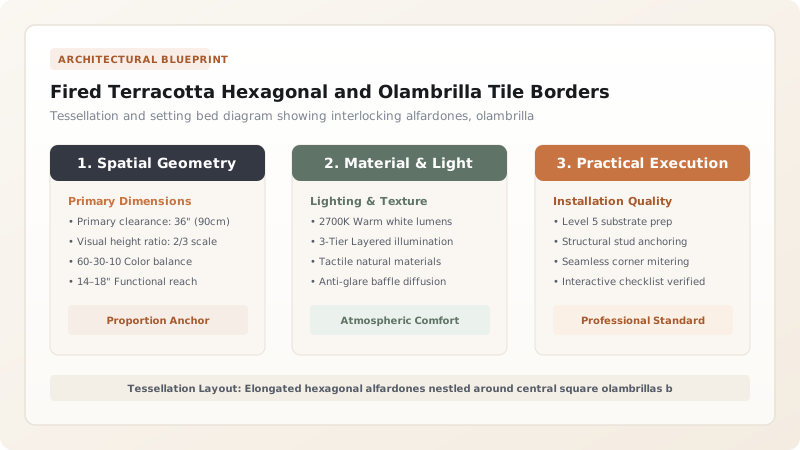
1. Ceramic Fabrication: Barro Cocido in Wood-Fired Hornos Árabes
The terracotta tiles (ladrillos de tejar and olambrillas) that frame an alcatifa floor are not industrial extruded ceramics. They are hand-pressed from rich river clays in Seville (Triana) and Granada, placed into wooden molds dusted with fine ash, and dried slowly in covered drying sheds (secaderos) for up to three weeks.
Fired in traditional wood-burning Arab kilns (hornos árabes) fueled by olive press cake (orujo) and pine brushwood, temperature gradients across the kiln create a magnificent organic palette of warm salmon, deep ochre, and toasted amber. The resulting low-temperature earthenware remains breathable, with open porosity that wicks sub-floor moisture safely to the surface.
2. Majolica Virtuosity: Tin-Glazed Olambrilla Inserts
At the focal joints of the terracotta borders sit the olambrillas (small square tiles, typically 70mm x 70mm or 80mm x 80mm). Introduced by Mudéjar artisans in the 14th century, these miniature ceramic canvases display the height of Hispano-Moresque glazed pottery.
The bisqued tile is dipped into an opaque white tin-lead glaze (esmalte estannífero). Master painters quickly brush mineral pigments onto the unfired powdery glaze using animal hair brushes: cobalt oxide (deep blue), copper carbonate (emerald green), antimony oxide (golden yellow), and manganese dioxide (deep purple-black). When fired a second time at 900°C, the colors fuse permanently into the vitreous white tin enamel, creating jewel-like contrast against the earthy terracotta.
3. Structural Role: Containing Gypsum Expansion and Wear
An alcatifa floor is a composite system of materials with vastly different mechanical properties: high-hardness ceramic tile, porous terracotta brick, and ductile gypsum plaster. The terracotta border serves three vital engineering roles:
- Threshold Wear Resistance: Heavy foot traffic concentrates at doorways and room edges where leather slippers make impact; hard-fired terracotta absorbs this friction effortlessly.
- Expansion Boundary: The lime mortar joints between the terracotta pavers compress slightly, absorbing thermal and hygroscopic expansion of the central gypsum slab.
- Visual Anchoring: By establishing a 30cm to 60cm border around the room perimeter, the central gypsum carpet appears framed like an artwork, centering the furniture arrangement.
Andalusian Ceramic Border Tile Specifications
Use this reference table to calculate exact physical dimensions, ratios, and specifications before purchasing:
| Component | Dimensions (mm) | Clay / Glaze Type | Firing Temp (°C) | Function in Floor |
|---|---|---|---|---|
| Ladrillo de Tejar (Brick) | 280 x 140 x 30 | Iron-rich red alluvial earthenware | 920°C - 960°C | Primary room perimeter curb |
| Alfardón (Hexagonal) | 260 x 120 x 28 | Toasted buff/ochre terra cotta | 940°C - 980°C | Interlocks diagonally around olambrillas |
| Olambrilla (Glazed Square) | 70 x 70 x 20 | Tin-lead glaze over white clay | 900°C second fire | Polychrome decorative junction jewels |
| Bordura de Canto (Edge Curb) | 200 x 50 x 30 | High-fired dark terracotta | 1000°C vitrified | Retaining curb for gypsum pour |
| Lime Joint Mortar | 3mm - 5mm joint | Pure slaked fat lime (CL90-S) + silica sand | Ambient carbonation | Breathable, flexible expansion buffer |
Artisanal & Geometric Constraints
Every successful decoration project must account for physical and environmental constraints:
Irregular Handmade Dimensions
Hand-pressed tiles vary by +/- 4mm in length; masons must modulate joint widths by eye to keep border runs straight.
Glaze Fragility
Modern acid cleaners destroy soft tin-glazes; only pH-neutral vegetable soaps may be used during clean-up.
Protocol for Laying Terracotta and Olambrilla Floor Borders
Execute this professional sequence to achieve flawless results without backtracking:
Sub-Base Verification & Perimeter Chalking
Check sub-floor flatness; snap chalk lines defining the exact width of the outer ceramic border and inner gypsum bay.
Terracotta Tile Pre-Soaking
Submerge porous terracotta tiles in clean water for 30 minutes; drain until surface-damp to prevent robbing moisture from mortar.
Lime Mortar Bedding
Spread a 20mm bed of traditional fat lime mortar (1 part slaked lime putty to 2.5 parts river sand) along the perimeter.
Alfardón and Olambrilla Tessellation
Lay hexagonal alfardón bricks nested around square glazed olambrillas; tap true with rubber mallet; maintain 4mm joints.
Internal Curb Edge Formwork
Erect a vertical straightedge or sacrificial wood batten along the inner border line to serve as the containment form for the gypsum pour.
Lime Slurry Grouting
Grout terracotta joints with creamy slaked lime and stone dust slurry; sponge tiles clean before lime carbonates.
Common Mistakes & Countermeasures
Avoid these costly errors that compromise aesthetics, ergonomics, and budget:
Setting handmade terracotta tiles with rigid Portland cement mortar
Failing to pre-soak terracotta bricks before laying
Project Execution Checklist
Track your physical progress. Checkboxes persist automatically on this device:
Frequently Asked Questions
What is the cultural history of the word 'olambrilla'?
The word 'olambrilla' derives from the Arabic 'al-hambra' (the red palace) or from Andalusian diminutive terminology for decorative insert tiles. During the 15th and 16th centuries, tile guilds in Triana (Seville) produced millions of olambrillas, which were exported across the Spanish Empire from the Alhambra to colonial palaces in Mexico and Peru.
Can broken olambrillas be replaced without damaging the surrounding gypsum floor?
Yes. Because olambrillas are bedded in soft lime mortar, a conservator can carefully drill and chip away a damaged tile, clean the pocket, and set a reproduction tile in fresh lime putty without vibrating or disturbing the adjacent gypsum inlay field.


