
Beeswax-Linseed Saturation and Friction Stone Burnishing is the sacred finishing ritual that petrifies, seals, and illuminates Andalusian alcatifa gypsum floors. Raw gypsum is hygroscopic and fragile; untreated, it stains easily and wears rapidly. Artisans apply a boiling-hot blend of raw cold-pressed linseed oil, pure bleached virgin beeswax, and pine resin. Penetrating 3mm to 5mm into the micro-capillaries of the alabaster matrix, the oils polymerize into a tough, water-repellent linoxyn-wax composite. The surface is then ironed with heated bronze plates and burnished by hand with polished river agates, producing a silky, tactile luster that rivals jade.
At a Glance: Key Takeaways
- Hot Penetrating Wash: Heating raw linseed oil, beeswax, and colophony pine resin to 70°C for deep capillary flow.
- Deep Porosity Saturation: Impregnating 3mm to 5mm beneath the surface to permanently lock out moisture.
- Linoxyn Polymerization: Natural oxidation converting liquid linseed fatty acids into a flexible, tough polymer film.
- Heated Smoothing Irons (Planchas de Bruñir): Ironing hot wax into the floor with 120°C flat bronze irons.
- Agate River-Stone Burnishing: Manually buffing the sealed plaster with ultra-smooth river agates to align wax crystals.
- Silky Tactile Patina: Creating a non-slip, leather-smooth floor finish that deepens in warmth over centuries.
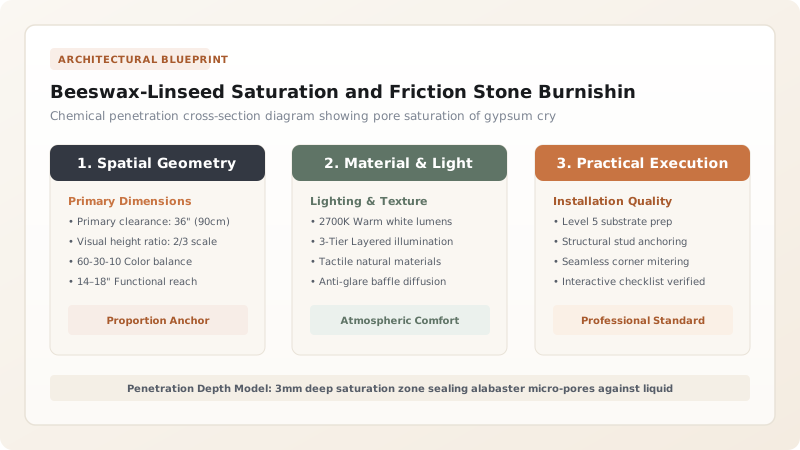
1. Organic Chemistry: The Triad of Linseed, Beeswax, and Colophony
Untreated plaster floors absorb atmospheric moisture, softening the crystalline dihydrate bond and allowing dirt to ground into the pores. The historic Andalusian waterproofing formula is an ingenious blend of three natural lipids:
- Cold-Pressed Raw Linseed Oil: High in linolenic acid, it has an ultra-low molecular viscosity that penetrates deep into sub-micron gypsum capillaries, where it oxidizes over months into tough, flexible linoxyn.
- Virgin Beeswax (Cera Virgen): Rich in cerotic acid and myricyl palmitate, it fills larger voids, repels liquid water, and imparts a silky, non-greasy tactile feel.
- Colophony Pine Resin (Pez Griega): Adds hardness, increases the melting point of the wax, and enhances optical clarity and refractive depth.
2. Thermal Injection: Ironing the Floor with Planchas Calientes
Simply painting wax over cold plaster leaves a superficial greasy film that flakes away under foot friction. Andalusian craftsmen employ thermal injection.
The linseed-beeswax-resin mixture is melted in a double boiler to 70°C–80°C and brushed generously onto the bone-dry floor. Immediately behind the brush, an artisan guides a heavy, polished cast-bronze or iron plate (plancha de bruñir) heated over charcoal to approximately 120°C. The intense heat liquifies the wax completely, expanding trapped air out of the plaster pores and pulling the liquid wax deep into the stone matrix via capillary suction. Excess surface wax is scraped away while warm.
3. Petrographic Polishing: Burnishing with Smooth Agates and Quartz
Once the ironed wax has cooled and consolidated for 48 hours, the final and most physically demanding stage begins: friction stone burnishing (el bruñido a piedra).
Artisans do not use abrasive sandpapers, which would scratch the soft gypsum. Instead, they use ultra-smooth river agates, jasper nodules, or dense quartzite river stones collected from the Darro and Genil rivers. Kneeling on felt pads, the artisan rubs the stones across the surface in tight, overlapping circular patterns with tremendous downward body pressure. The mechanical friction generates localized heat that melts and aligns the wax crystal platelets on a microscopic level, producing a luminous, glass-smooth sheen that deepens the contrast between the white gypsum and colored inlays.
Andalusian Alcatifa Sealing Formulation & Curing Parameters
Use this reference table to calculate exact physical dimensions, ratios, and specifications before purchasing:
| Component / Stage | Material / Tool | Application Temperature | Penetration / Depth | Functional Purpose |
|---|---|---|---|---|
| Primer Wash | Raw linseed oil + turpentine (60/40) | 50°C warm | 3mm - 5mm deep | Deep pore impregnation & capillary priming |
| Primary Wax Body | Virgin beeswax + colophony resin (70/30) | 75°C melted | 2mm - 3mm depth | Water repellency & surface body consolidation |
| Thermal Ironing | Heated flat bronze plancha iron | 110°C - 130°C | Thermal capillary suction | Drives wax into micro-pores; removes air |
| Scraping Pass | Flexible spring steel blade | Ambient (wax warm) | Surface leveling | Removes excess surface wax film |
| Stone Burnishing | Polished natural river agate stones | Friction heated (~40°C) | Microscopic crystal alignment | Produces silky, non-slip, jade-like luster |
| Maintenance Buff | Pure beeswax paste + woolen cloths | Ambient | Surface refresh | Applied annually; buffed with sheep fleece |
Curing & Longevity Constraints
Every successful decoration project must account for physical and environmental constraints:
Prolonged Linseed Curing
Linseed oil requires 3 to 6 weeks to fully cross-link and oxidize; avoid moving heavy furniture across newly finished floors during this period.
Slip Resistance Balance
Unlike synthetic varnishes, stone-burnished beeswax is inherently silky rather than slippery under dry footwear and bare feet.
Master Finisher Protocol for Ironing and Burnishing Alcatifa Floors
Execute this professional sequence to achieve flawless results without backtracking:
Substrate Desiccation Verification
Ensure gypsum floor has cured at least 21 days; confirm moisture content < 2% using moisture meter.
Wax-Oil Formula Preparation
Melt 500g virgin yellow beeswax, 300ml raw cold-pressed linseed oil, and 100g powdered pine colophony in a copper double boiler.
Hot Saturation Mopping
Brush hot liquid wax mixture evenly across the gypsum floor at 75°C; ensure liberal absorption into both white bed and colored inlays.
Bronze Plancha Ironing
Glide heated bronze plancha iron across the waxed floor in slow, deliberate sweeps; watch wax foam slightly and sink deeply into pores.
Excess Wax Scraping
While surface is still warm, scrape away unabsorbed surface wax with a wide steel cabinet scraper; leave zero sticky film.
Agate Stone Friction Burnishing
After 48 hours, rub surface vigorously with smooth river agate stones using full body weight; buff to a brilliant eggshell luster with raw wool.
Common Mistakes & Countermeasures
Avoid these costly errors that compromise aesthetics, ergonomics, and budget:
Applying polyurethane or synthetic acrylic clear sealers over historic gypsum floors
Ironing with an over-heated plancha (> 160°C)
Project Execution Checklist
Track your physical progress. Checkboxes persist automatically on this device:
Frequently Asked Questions
How do you clean and maintain a beeswax-burnished alcatifa floor?
Daily maintenance requires only sweeping with a soft horsehair broom. Spills should be blotted immediately with a dry cloth. Never use wet mops or detergents. Once a year, apply a thin coat of paste wax made from beeswax dissolved in pure gum turpentine, and buff vigorously with a heavy floor polisher fitted with natural wool pads.
Why does river stone burnishing produce a shine without scratch marks?
River agates and quartz stones that have tumbled in fast-flowing mountain streams for millennia develop naturally rounded, micro-smooth contours with Mohs hardness 7. They cannot cut or abrade the soft gypsum (Mohs hardness 2); instead, they compress the surface microscopically, aligning the malleable wax and gypsum crystals into a mirror-like optical plane.


