
Fabricate robust hammerbeam joints by milling 3" thick structural mortise-and-tenon connections into select white oak timbers, securing joints with draw-bored 1" octagonal oak trunnel pegs (1/8" offset). Reinforce high-stress cantilever junctions with custom 3/8" thick hand-forged wrought iron strapping collars, through-bolted with 3/4" Grade 5 carriage bolts and square decorative nuts.
At a Glance: Key Takeaways
- 3-Inch Structural Tenon Cheeks: Milled to 1/3 timber thickness, providing maximum shear resistance against rotational cantilever torque.
- Draw-Boring Clamping Force: Offset peg holes generate over 2,500 lbs of permanent mechanical clamping tension per peg without glue.
- Hand-Forged 3/8-Inch Wrought Iron Straps: Authentic anvil-hammered steel collars wrapping around the beam-post junction.
- Square Black Oxide Structural Nuts: Period-accurate fasteners providing massive bearing surface area to prevent wood fiber crushing.
- Concealed Internal Flitch Plates: 1/2" laser-cut steel plates hidden inside the timber heartwood for high-load seismic engineering codes.
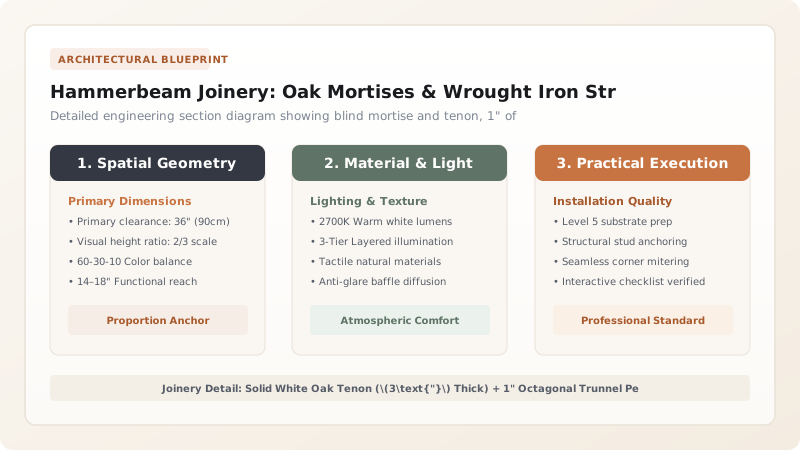
1. Traditional Woodcraft: Draw-Boring Mechanics & Octagonal Trunnel Geometry
Modern carpenters often rely on hidden metal screws that work loose as wood seasons. Traditional timber framers use Draw-Bored Mortise-and-Tenon Joinery that tightens over centuries.
The mortise cheeks are bored with a 1-inch hole. The tenon is inserted, marked, removed, and drilled with an Offset Hole positioned 1/8-inch (3mm) closer to the shoulder. Driving a Hand-Shaved Octagonal White Oak Peg (*Trunnel*) forces the joint together with thousands of pounds of mechanical pressure. As the green oak dries, the wooden peg shrinks at the same rate, locking the joint into a permanent wood-to-wood weld. Master cantilever mechanics in cantilever bracket mechanics.

2. Blacksmith Craft: Wrought Iron Strapping Collars & Concealed Flitch Plates
In high-wind or seismic zones, building codes require secondary mechanical restraints to prevent catastrophic joint pulling under extreme uplift.
Blacksmiths forge 3/8-inch Thick Architectural Wrought Iron Strapping Collars that wrap around the junction of the hammerbeam, rafter, and arch brace. These are secured with 3/4-inch Through-Bolts fitted with Cast Iron Square Washers. For modern minimalist aesthetics where exposed iron is not desired, engineers specify Concealed 1/2-inch Structural Steel Flitch Plates slotted into kerfs cut in the center of the oak beams, through-pinned with hardened steel drift dowels. Review wall corbels in carved pendant posts and corbels and explore hammerbeam trusses.
Timber Framing Fastening Systems Comparison
Use this reference table to calculate exact physical dimensions, ratios, and specifications before purchasing:
| Fastening System | Tensile Pullout Resistance | Wood Shrinkage Accommodation | Visual Historical Authenticity |
|---|---|---|---|
| Draw-Bored Oak Trunnels + Iron Straps (Optimal) | Very High (>18,000 lbs per junction) | Exceptional (Moves naturally with oak fibers) | 5 / 5 (True medieval Gothic masterpiece) |
| Concealed Internal Steel Flitch Plates | Extreme (>35,000 lbs) | High (Slotted holes allow seasonal movement) | 4 / 5 (Crisp wood-only exterior appearance) |
| Surface-Mounted Modern Joist Hangers (Avoid) | Moderate | Poor (Screws shear as wood shrinks) | 1 / 5 (Cheap industrial warehouse aesthetic) |
| Glued Epoxy Threaded Rods | Very High | Poor (Rigid epoxy cracks timber during seasoning) | 2 / 5 (Modern restoration technique) |
Oak Tannic Acid Iron Staining Corrosion
Every successful decoration project must account for physical and environmental constraints:
White Oak Tannic Acid Leaching Black Chemical Stains Across Raw Steel Strapping
White oak contains high concentrations of natural tannic acid; when wet oak contacts unpainted steel, tannic acid reacts with iron to form black iron tannate stains that bleed across the wood and pit the metal; always coat forged iron straps with zinc-rich epoxy primer and apply a beeswax paste barrier to all wood-to-metal contact zones.
How to Execute Mortise-and-Tenon Joinery with Forged Iron Straps
Execute this professional sequence to achieve flawless results without backtracking:
Rout Mortises in White Oak Timbers Using Chain Mortiser
Cut 3" wide × 6" deep mortises into hammerbeams and posts; square mortise corners cleanly with framing chisels.
Cut Matching 3" Tenons with Traditional Timber Saw
Cut tenon cheeks on ends of rafters and arch braces; plane cheeks to a precision sliding friction fit (0.015" tolerance).
Drill 1" Peg Holes Through Mortise Cheeks
Drill 1" diameter hole through center of mortise cheeks using heavy timber boring machine auger.
Insert Tenon and Drill 1/8" Offset Draw-Bore Hole
Insert tenon into mortise; mark center with transfer punch; remove tenon; drill 1" hole offset 1/8" toward shoulder.
Shave Octagonal Tapered Trunnel Pegs from White Oak
Rive straight-grained oak blanks; shave into 8-sided 1" tapered pegs on shaving horse with drawknife.
Drive Trunnels to Lock Joint Air-Tight
Coat peg in beeswax; drive through joint with wooden commander mallet, pulling tenon shoulder air-tight.
Fit Hand-Forged Wrought Iron Straps and Through-Bolts
Wrap 3/8" forged iron collar around joint; drill 13/16" holes through timber; secure with 3/4" Grade 5 bolts and square nuts.
Common Mistakes & Countermeasures
Avoid these costly errors that compromise aesthetics, ergonomics, and budget:
Drilling Draw-Bore Offset Exceeding 3/16-Inch
Project Execution Checklist
Track your physical progress. Checkboxes persist automatically on this device:
Frequently Asked Questions
Why are wooden trunnels octagonal instead of perfectly round dowels?
An 8-sided octagonal peg driven into a 1-inch round hole crushes its corners into the round walls, creating high-friction locking ridges that prevent the peg from ever backing out or spinning.


