
The longevity of Swiss chalets is determined by timber selection: high-altitude European Larch (Larix decidua) and Swiss Stone Pine (Pinus cembra / Arve) harvested between 1,200m and 1,800m elevation during winter sap dormancy. Their tight annual growth rings, high resin content, and dense heartwood provide natural Class 1 biological rot durability without chemical preservatives.
At a Glance: Key Takeaways
- High-Elevation Slow Growth: Minimum 6 to 10 annual rings per centimeter resulting from brief alpine growing seasons.
- Venice Turpentine Resins: High concentrations of natural terpene resins sealing wood cells against moisture and fungal spores.
- Winter Moonwood Harvesting (Mondholz): Felled in late autumn/winter during dormancy when moisture and starch contents are minimal.
- Natural Shade Seasoning: 24 to 36 months of air drying under roofed log piles to eliminate radial tension.
- Arve Essential Oils: Pinosylvin compounds in Swiss Stone Pine emitting aromatic scents that deter moths and lower human heart rates.
1. Silviculture: The Power of Alpine Elevation
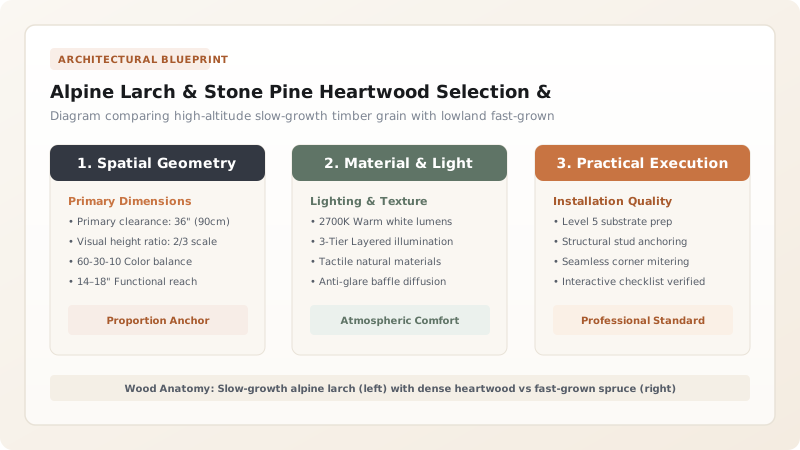
Trees growing at high elevations (1,200 to 1,800 meters) in the Swiss Alps endure brutal winter cold and a brief growing season of merely 90 to 120 days. This slow growth forces the tree to produce extraordinarily dense, narrow annual growth rings (typically 0.8mm to 1.5mm wide), with a high ratio of thick-walled, structural latewood cells to earlywood.
The principal tree of Swiss exterior framing is European Larch (Larix decidua). Larch heartwood contains up to 15% natural water-insoluble arabinogalactan resins, known commercially as Venice turpentine. These resins act as a natural biocide, rendering the wood naturally immune to wood-rotting Basidiomycete fungi and anobiid wood-boring beetles.
2. Arve (Swiss Stone Pine): Interior Queen of the Alps
While larch is the undisputed king of structural exterior logs, Arve or Zirbelkiefer (Pinus cembra) is the revered queen of chalet interiors. Growing up to the extreme tree line at 2,200 meters, stone pine timber is soft, velvety, and easily carved into intricate relief friezes.
Arve contains high levels of pinosylvin, a natural polyphenol stilbene that acts as a potent bactericide and insect repellent. Scientific studies conducted by the Joanneum Research Institute demonstrated that sleeping in an authentic Arve-clad timber room reduces the human heart rate by an average of 3,500 beats per day, promoting deep restorative sleep and vegetative recovery.
3. Mondholz Harvesting & Natural Air-Seasoning
Swiss timber framers adhere to ancient forestry protocols: timber must be felled as Mondholz (moonwood)—harvested strictly in late November, December, or January during the waning moon. At this time, botanical sap flow has completely ceased, and free water within the cell lumina is at its annual minimum.
Following felling, logs are debarked, squared with broadaxes to relieve surface tension, and stacked in covered, well-ventilated drying cribs for 2 to 3 years. Slow natural shade drying avoids the micro-cellular collapse and case-hardening caused by industrial kiln drying, ensuring that timbers can be worked with hand chisels without brittle splintering.
Alpine Timber Species Characteristics for Chalet Construction
Use this reference table to calculate exact physical dimensions, ratios, and specifications before purchasing:
| Wood Species | Density (at 12% MC) | Durability Class (EN 350) | Primary Architectural Application |
|---|---|---|---|
| European Larch (Larix decidua) | 590–650 kg/m³ | Class 2 (Durable, heartwood) | Exterior Blockbau walls, roof shingles, exposed corbel purlins |
| Swiss Stone Pine (Pinus cembra / Arve) | 420–460 kg/m³ | Class 3–4 (Moderately durable) | Interior wall paneling (Stube), ceilings, hand-carved furniture |
| Norway Spruce (Picea abies) | 430–480 kg/m³ | Class 4 (Slightly durable) | Internal floor joists, ceiling rafters, secondary rafters (must stay dry) |
Sourcing & Forestry Constraints
Every successful decoration project must account for physical and environmental constraints:
Log Diameter Availability
Old-growth larch logs yielding 220mm square heartwood require 150+ year old trees; forestry permits must be secured 18 months in advance.
Weight Handling
Green larch timbers weigh over 850 kg/m³; transport on narrow alpine logging roads requires specialized tracked equipment.
Protocol for Seasoning and Grading Blockbau Timber
Execute this professional sequence to achieve flawless results without backtracking:
Winter Forest Marking & Moonwood Felling
Identify mature alpine larch (> 120 years old); fell between late November and January during waning moon.
Immediate Bark Peeling & Sapwood Scribing
Strip outer bark immediately to prevent Ips bark beetle infestation; trim away outer sapwood leaving 90% heartwood.
Broadaxe Rough Squaring (Beilen)
Hew round logs into square Kantholz cross-sections using a broadaxe, following the natural grain curves.
Shaded Air Drying Crib Stacking
Stack squared timbers on granite foundation piers with 40mm dry larch stickers separating every course.
Moisture Monitoring
Monitor core moisture content using electrical resistance probes until reaching stable 12–14% equilibrium.
End-Grain Wax Sealing
Coat log end grains with hot beeswax or breathable paraffin wax to prevent rapid end-grain evaporation checks.
Common Mistakes & Countermeasures
Avoid these costly errors that compromise aesthetics, ergonomics, and budget:
Including excessive outer sapwood in exterior log faces
Kiln drying large-dimension logs rapidly at high heat
Project Execution Checklist
Track your physical progress. Checkboxes persist automatically on this device:
Frequently Asked Questions
Can untreated larch wood really survive outdoors in snow without paint or stain?
Yes. European larch heartwood has been used untreated for centuries on alpine chalets and church spires. The natural resin crystallization seals wood pores, and sun exposure creates a hard oxidized patina that repels moisture naturally.
Why is Swiss Stone Pine (Arve) so expensive compared to regular pine?
Arve grows only at high alpine altitudes under extreme climatic conditions, growing very slowly and taking up to 250 years to reach harvestable size. Its harvesting is strictly regulated by Swiss forestry laws to protect alpine avalanche barrier forests.


