
Design authentic Spanish Colonial Revival estates using genuine two-piece high-barrel Mission clay roof tiles over heavy timber eaves, thick hand-troweled lime-cement stucco (Santa Barbara finish), vibrant hand-painted Talavera ceramic tile stair risers, raw terracotta Saltillo floor pavers, and hand-forged wrought iron *rejas* window grilles.
At a Glance: Key Takeaways
- Authentic Two-Piece Mission Barrel Roof Tiles: True 'pan and cap' high-barrel red clay tiles with irregular hand-molded rustic charm.
- Hand-Troweled Santa Barbara Stucco: Soft, undulating smooth-troweled stucco finish mimicking historic thick adobe masonry walls.
- Hand-Painted Talavera Ceramic Stair Risers: Colorful Mexican majolica glazed tiles adorning grand courtyard staircases.
- Hand-Forged Wrought Iron Window Grilles (*Rejas*): Heavy decorative iron grilles, scrollwork brackets, and Spanish lantern sconces.
- Exposed Timber Beams & Corbel Brackets (*Vigas*): Hand-hewn solid Douglas fir or cedar ceiling beams with carved decorative corbel ends.
In-Depth Guides in this Directory
Explore specialized subtopic blueprints, technical dimensions, and execution checklists:
Mission Clay Tiles: 2-Piece Barrel & Adobe Stucco
Master Spanish Colonial roofing and plaster: authentic two-piece Mission barrel clay tiles (ASTM C1167 Grade 1), mortar boosted eave birdstops, and Santa Barbara smooth lime stucco.
Talavera Stairs: Majolica Risers & Saltillo Pavers
Master Spanish Colonial courtyard masonry: hand-painted Mexican Talavera ceramic stair risers, natural raw Saltillo terracotta pavers, bullnose stair treads, and penetrating sealers.
Spanish Ironwork: Rejas Grilles & Carved Corbel Vigas
Master Spanish Revival iron and timber architectural detailing: hand-forged wrought iron window rejas, scrolled cage balconies, zinc-rich epoxy primers, and carved timber vigas.
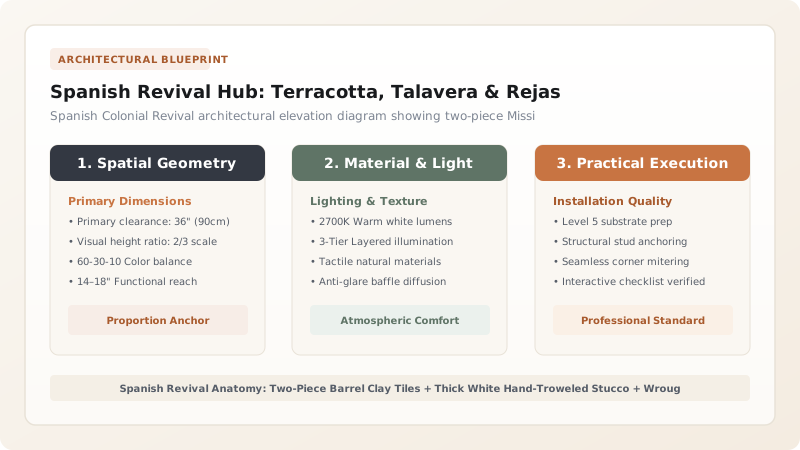
1. Exterior Architecture: Mission Barrel Clay Tiles & Santa Barbara Stucco
Spanish Colonial Revival architecture (popularized by architects George Washington Smith and Bertram Goodhue) evokes the romantic haciendas of Andalusia and early California.
Roofs feature Authentic Two-Piece High-Barrel Clay Tiles ('Pan and Cap') laid with irregular exposure and natural color blends. Walls feature Thick Hand-Troweled Lime-Stucco (*Santa Barbara Smooth Finish*) painted in warm antique whites. Master roof tiles in terracotta roof tiles and adobe stucco and compare with waterproof lime plasters.

2. Ceramic Talavera Risers & Hand-Forged Iron Rejas Grilles
Courtyards and outdoor staircases are adorned with Hand-Painted Majolica Talavera Ceramic Tiles on all stair risers paired with Terracotta Pavers.
Windows are protected by Hand-Forged Wrought Iron Grilles (*Rejas*). Master tile stairs in Talavera ceramic risers and quarry pavers and explore ironwork in wrought-iron rejas and corbel brackets.
Spanish Colonial vs Modern Mediterranean Finishes
Use this reference table to calculate exact physical dimensions, ratios, and specifications before purchasing:
| Architectural Element | Authentic Spanish Colonial Revival | Modern Commercial Mediterranean | Authentic Heritage Value |
|---|---|---|---|
| Roof Tiles (Optimal) | Two-Piece High-Barrel Clay (Pan & Cap) | Flat interlocking concrete 'S' tiles | 5 / 5 (Irregular shadow lines & patina) |
| Wall Stucco Texture | Smooth Hand-Troweled Santa Barbara | Heavy machine spray knockdown texture | 5 / 5 (Soft undulating adobe look) |
| Staircase Risers | Hand-Painted Mexican Talavera Ceramic | Plain concrete / Solid paint | 5 / 5 (Vibrant Spanish artistic jewel) |
| Window Grilles & Hardware | Solid Hand-Forged Wrought Iron | Hollow black painted aluminum | 5 / 5 (Hand-hammered anvil character) |
Concrete S-Tile Machine Look Constraints
Every successful decoration project must account for physical and environmental constraints:
Substituting Flat Interlocking Concrete S-Tiles for Real Barrel Clay Tiles Ruining Spanish Authenticity
Concrete 'S' tiles have flat, mechanical, razor-sharp factory edges that look completely fake on a Spanish Revival home; strictly specify genuine kiln-fired two-piece high-barrel red clay tiles (such as MCA Clay Roof Tile or Redland Clay) installed with boosted eave mortar birdstops.
How to Build an Authentic Spanish Colonial Revival Estate
Execute this professional sequence to achieve flawless results without backtracking:
Frame Heavy Timber Roof Trusses with Exposed Beam Tails
Frame roof rafters with Douglas fir timber; hand-carve decorative scrolled corbel tails on all eave overhangs.
Install Self-Adhering High-Temp Underlayment and Clay Tiles
Lay dual-layer waterproof underlayment; install two-piece Mission clay barrel tiles with mortar birdstops.
Apply Three-Coat Santa Barbara Smooth Stucco Finish
Apply scratch and brown coats; finish with hand-troweled Santa Barbara smooth finish in warm off-white.
Install Hand-Forged Wrought Iron Rejas Window Grilles
Anchor solid hand-hammered wrought iron grilles with decorative scrollwork into exterior window masonry.
Set Saltillo Terracotta Pavers on Courtyard Floor
Lay 12" × 12" handmade Saltillo clay pavers with 1/2" wide sanded mortar joints; seal with penetrating sealer.
Clad Grand Staircase Risers with Hand-Painted Talavera Tiles
Install alternating vibrant geometric and floral Talavera tiles on all stair risers; trim with terracotta bullnose.
Hang Hand-Crafted Spanish Wrought Iron Sconces and Lanterns
Install seeded-glass wrought iron wall lanterns to cast warm ambient romantic glow across stucco walls.
Common Mistakes & Countermeasures
Avoid these costly errors that compromise aesthetics, ergonomics, and budget:
Applying Modern Heavy Acrylic Lace Stucco Texture
Project Execution Checklist
Track your physical progress. Checkboxes persist automatically on this device:
Frequently Asked Questions
What is the origin of the Santa Barbara stucco finish?
Santa Barbara finish stucco was developed in Santa Barbara, California in the 1920s following the rebuilding of the city in authentic Spanish Colonial style. It uses fine sand and slaked lime, hand-floated with a pool trowel to create soft, undulating waves resembling historic adobe.


