
Cantilever Moment Equilibrium and Iron Reinforcement govern the physical survival of monumental Sicilian Baroque balconies. Cantilevering heavy stone slabs and cast consoles up to 1.5 meters from facade walls generates immense overturning rotational moments. Stability depends on the 'tailing-in' depth of the console stone embedded deep into the rubble wall core, counterweighted by overlying masonry. Historically tied with hand-forged wrought iron cramps, modern seismic retrofitting introduces post-tensioned titanium or stainless steel tie rods to resist earthquake accelerations.
At a Glance: Key Takeaways
- Rotational Moment Equilibrium: Overturning moment \(M_o\) resisted by stabilizing dead load moment \(M_s\) of facade masonry.
- The 2:1 Tailing-In Rule: Embedded console tail length must equal at least twice the projecting cantilever overhang.
- Wrought Iron Strap Cramps: Historic forged iron ties anchoring console tails into interior floor joist pockets.
- Rust Jacking Hazard: Corrosion of historic iron cramps expanding 600% and splitting soft calcarenite stone consoles.
- Seismic Post-Tensioned Retrofits: Unobtrusive core-drilled titanium tie rods anchored into interior floor diaphragms.
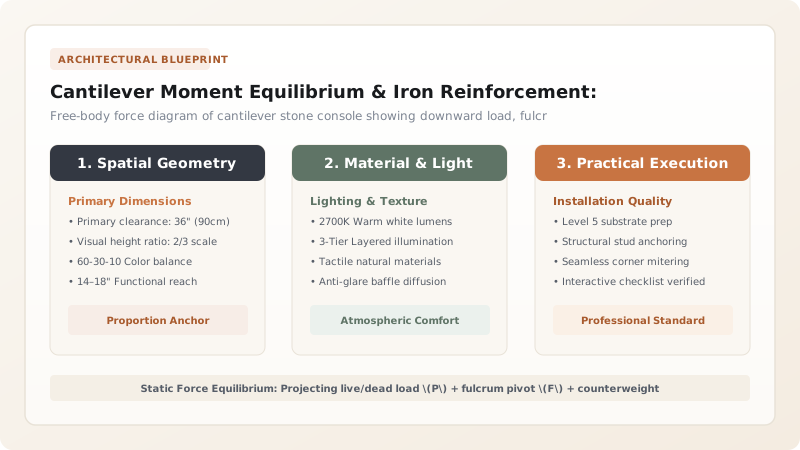
1. Cantilever Mechanics & Fulcrum Overturning Equilibrium
A Sicilian Baroque balcony console acts as a cantilever beam with a fulcrum point at the exterior wall face. The projecting portion carries the dead weight of the console itself (approx. 350 to 600 kg), the stone balcony floor slabs (1,500 to 3,000 kg), the wrought-iron balustrade, and crowded festival live loads (rated to 4.0 kN/m²).
This generates an intense overturning rotational moment (\(M_{overturn}\)):
To prevent the console from rotating out of the wall, the embedded tail of the console (tailing-in stone) must be anchored deep into the wall, counterbalanced by the stabilizing downward gravity load of the overlying multi-story masonry wall (\(W_{wall}\)). The stabilizing factor of safety must satisfy:
2. Historic Wrought Iron Cramps & Rust Jacking Pathology
To provide additional structural security against earthquake tremors, Baroque builders installed hand-forged wrought iron cramps (chiavi di ferro). These heavy iron straps were hot-bent around the tail of the stone console and anchored deep into the interior floor joists.
Over centuries, rainwater infiltrating the soft, porous calcarenite stone reaches the embedded iron. As the iron oxidizes into rust (\(\text{Fe}_2\text{O}_3\cdot\text{H}_2\text{O}\)), its volume expands up to 600%. This rust jacking exerts bursting pressures exceeding 30 MPa inside the stone socket, cleaving the soft calcarenite console in half along horizontal bedding planes.
3. Modern Seismic Retrofitting: Titanium Tie Rods
Following modern Eurocode 8 seismic requirements in earthquake-prone eastern Sicily, historic balconies must be reinforced against seismic horizontal and vertical ground accelerations without altering their aesthetic appearance.
Conservators execute concealed core-drilled tie rod reinforcement:
- Diamond Core-Drilling: A 28mm hole is drilled horizontally through the length of the console stone, extending 1.5m into the interior floor structure.
- Grade 5 Titanium Rods: A 16mm threaded titanium alloy rod (immune to galvanic corrosion) is inserted through the core.
- Lime-Pozzolan Grouting: The annular space is grouted with breathable, salt-free hydraulic lime grout, with the interior rod end anchored to a stainless-steel distributor plate bolted to interior structural floor joists.
Balcony Console Overhang & Counterweight Engineering Guidelines
Use this reference table to calculate exact physical dimensions, ratios, and specifications before purchasing:
| Cantilever Projection (m) | Minimum Stone Depth (mm) | Required Embedded Tail (m) | Minimum Overlying Wall Height |
|---|---|---|---|
| 0.80m - 1.00m | 220mm × 280mm | 1.60m Embedded | 2.5m Masonry Above (1 Story) |
| 1.00m - 1.30m | 260mm × 350mm | 2.20m Embedded | 4.0m Masonry Above (2 Stories) |
| 1.30m - 1.60m | 320mm × 420mm | 2.80m + Iron Tie Strap | 5.5m Heavy Ashlar Wall |
| Monumental Corner (> 1.6m) | 400mm × 500mm Monolith | Through-stone + Titanium Tie | Full Palazzo Facade Mass |
Engineering & Urban Constraints
Every successful decoration project must account for physical and environmental constraints:
Active Public Sidewalk Hazards
Work on exterior balconies directly overhangs public pedestrian sidewalks, requiring certified safety crash decks.
Calcarenite Tensile Fragility
Because calcarenite has very low flexural tensile capacity (< 2 MPa), post-tensioning rods must be torqued with precision to avoid crushing the stone.
Protocol for Structurally Jacking and Retrofitting a Compromised Balcony
Execute this professional sequence to achieve flawless results without backtracking:
Heavy Ground-Supported Shoring
Erect steel falsework tower directly under projecting balcony slabs; install screw jacks to support dead loads fully.
Rusted Iron Cramp Extraction
Core-drill around oxidized historic iron ties; extract expanding rusted iron straps without fracturing calcarenite stone.
Diamond Core-Drilling Through Consoles
Drill 28mm horizontal holes through stone consoles and facade wall using water-cooled diamond coring rigs.
Titanium Tie Rod Insertion
Insert 16mm threaded Grade 5 titanium rods through consoles into interior floor joist anchor plates.
Post-Tensioning & Hydraulic Grouting
Apply 15 kN calibrated post-tensioning torque to tie rods; inject non-shrink hydraulic lime-pozzolan grout into boreholes.
Stone Patching & Falsework Striking
Plug exterior drill ports with matching calcarenite stone plugs (tasselli); strike shoring jacks gradually over 24 hours.
Common Mistakes & Countermeasures
Avoid these costly errors that compromise aesthetics, ergonomics, and budget:
Relying on modern epoxy adhesives alone to glue broken cantilever consoles back together
Removing overlying interior masonry above balcony anchors during floor-plan alterations
Project Execution Checklist
Track your physical progress. Checkboxes persist automatically on this device:
Frequently Asked Questions
How did Baroque builders test if a balcony was safe before letting people on it?
Historic builders conducted load tests by piling hundreds of bags of wet sand or wheat onto the balcony to simulate maximum crowd weight for 48 hours, monitoring whether any stone joints opened or mortar cracked before giving approval to the palazzo owner.
Why are titanium rods preferred over stainless steel for reinforcing historic stone?
Titanium Grade 5 has virtually zero risk of pitting corrosion even in salty marine air, has a thermal expansion coefficient much closer to natural limestone than stainless steel, and provides immense tensile yield strength (over 880 MPa) at half the weight of steel.


