
Sicilian Baroque Carved Tufa Balcony Consoles represent one of the most theatrical expressions of late Baroque architecture in the Mediterranean. Rebuilt following the catastrophic 1693 earthquake in the Val di Noto (including Noto, Ragusa, Modica, and Catania), noble palazzi featured dramatic projecting balconies supported by high-relief carved stone consoles (cagnoli). Sculpted from golden calcarenite stone (pietra giuggiulena or tufa), these consoles depict grotesque theatrical masks, winged cherubs (putti), roaring lions, and monstrous sirens, balancing heavy stone balconies while warding off the evil eye (malocchio).
At a Glance: Key Takeaways
- 1693 Post-Earthquake Rebirth: Theatrical late-Baroque reconstruction of the Val di Noto UNESCO World Heritage cities.
- Golden Honey Calcarenite (Pietra Giuggiulena): Porous, fine-grained bio-calcarenite stone that hardens upon atmospheric exposure.
- Grotesque Sculptural Iconography: Satyric masks, chimera, sirens, and laughing putti carved in deep 3D undercuts.
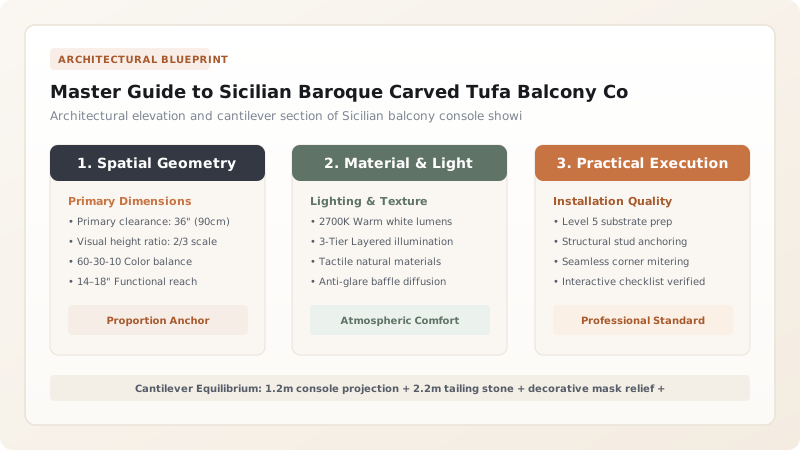
- Cantilever Moment Equilibrium: Monolithic stone consoles embedded 2:1 into rubble masonry to resist balcony live loads.
- Belly-Shaped Wrought Iron Balustrades: Swelling 'goose-breast' (a petto d'oca) grilles accommodating voluminous 18th-century hoop skirts.
In-Depth Guides in this Directory
Explore specialized subtopic blueprints, technical dimensions, and execution checklists:
Grotesque Masks, Putti & Monstrous Caryatid Motifs: The Iconography of Sicilian Baroque Consoles
Art-historical and sculpting manual for Sicilian Baroque balcony consoles: grotesque theatrical masks, winged putti, roaring lions, satyrs, and apotropaic symbolism.
Noto Calcarenite Honey Tufa Porosity & Decay: Petrography, Alveolization & Conservation
Scientific petrography and conservation guide for Noto calcarenite stone: open porosity network, honeycomb alveolization, marine salt sub-florescence, and ethyl silicate consolidation.
Cantilever Moment Equilibrium & Iron Reinforcement: Structural Engineering of Sicilian Balconies
Structural engineering and seismic reinforcement of Sicilian Baroque cantilevered balconies: overturning moments, tailing-in ratios, wrought iron cramps, and modern titanium ties.
1. The 1693 Earthquake & The Val di Noto Baroque Explosion
On January 11, 1693, a massive earthquake of magnitude 7.4 struck south-eastern Sicily, destroying 45 cities and killing over 60,000 people. Out of the devastation arose an unprecedented architectural rebirth: the Sicilian Baroque.
Rebuilding cities like Noto, Ragusa Ibla, Modica, and Scicli under visionary architects such as Rosario Gagliardi and Giovanni Battista Vaccarini, the Sicilian nobility sought to demonstrate wealth, resilience, and spiritual triumph. Palazzi were designed with undulating stone facades dominated by magnificent piano nobile balconies supported by rows of monumental carved stone brackets (cagnoli).
2. Lithological Sourcing: Pietra Giuggiulena & Noto Calcarenite
The medium that made this exuberant carving possible is a local sedimentary rock: Pietra Giuggiulena (also termed Pietra di Noto or golden tufa). Geologically, it is an open-porosity marine calcarenite composed of compacted bioclast fragments (foraminifera, mollusks, and echinoderms) cemented by calcium carbonate.
Freshly extracted from subterranean quarries, the stone is soft, workable with simple carpenter's saws and wood gouges. However, as the stone dries and weathers, atmospheric carbonation causes dissolved calcium bicarbonate to migrate to the surface, creating a hard, golden-honey weathering crust (crosta calcarea) that hardens with age while glowing warmly in late afternoon Mediterranean light.
3. Theatrical Grotesques & Wrought Iron 'Goose-Breast' Railings
The iconography of the consoles reflected both theatrical Baroque drama and Sicilian folk superstition (the malocchio or evil eye). Rather than classical acanthus leaves, consoles were sculpted with:
- Grotesque Theatrical Masks: Grimacing faces, horned satyrs, and laughing devils intended to shock passersby and frighten away evil spirits.
- Winged Putti & Mermaids: Erotic sirens and celestial angels celebrating worldly pleasure and aristocratic fertility.
- Sinuous Iron Grilles: Over the consoles, blacksmiths installed hand-forged wrought iron railings with swelling convex curves termed a petto d'oca (goose-breast). This bellied curvature was engineered specifically to allow noble ladies wearing expansive Spanish crinoline hoop skirts to stand at the balcony railing without crushing their dresses.
Sicilian Console Lithology & Engineering Characteristics
Use this reference table to calculate exact physical dimensions, ratios, and specifications before purchasing:
| Stone Geological Type | Quarry Provenance | Bulk Density (kg/m³) | Compressive Strength (MPa) | Carving Workability |
|---|---|---|---|---|
| Pietra di Noto (Calcarenite) | Noto Antica quarries | 1,750 - 1,900 kg/m³ | 18 - 25 MPa (Soft rock) | Exceptional (Sculpted with wood chisels) |
| Pietra di Modica (Limestone) | Modica / Ragusa Plateau | 2,200 - 2,400 kg/m³ | 45 - 65 MPa (Hard limestone) | High (Crisp classical architectural moldings) |
| Pietra Lavica dell'Etna (Basalt) | Mount Etna volcanic flows | 2,700 - 2,900 kg/m³ | 120 - 160 MPa (Igneous rock) | Very Low (Extremely hard; diamond tooling) |
| Pietra di Siracusa (White Tufa) | Plemmirio quarries | 1,650 - 1,850 kg/m³ | 15 - 22 MPa (Porous calcarenite) | Very High (Rapid weathering outdoors) |
Environmental & Structural Constraints
Every successful decoration project must account for physical and environmental constraints:
Alveolization & Salt Wind Decay
In coastal Sicily, airborne sea salts deposit inside high-porosity tufa, causing 'honeycomb' weathering of delicate facial carvings.
Active Seismic Hazard
South-eastern Sicily remains in a Zone 1 high-risk earthquake belt; balcony anchors must withstand severe lateral seismic accelerations.
Protocol for Sculpting and Anchoring a Baroque Balcony Console
Execute this professional sequence to achieve flawless results without backtracking:
Calcarenite Quarry Extraction
Extract monolithic calcarenite block free from fossil clay nodules and macro-fractures; plane reference top bed.
Clay Bozzetto & Full-Scale Pointing
Model grotesque mask in terracotta clay at 1:1 scale; transfer key 3D anatomical points to stone block with a pointing machine.
Subtractive High-Relief Carving
Rough out mass with tooth chisels (gradine); sculpt deep undercuts behind hair curls and jaws using rasps and round gouges.
Deep Masonry Pocket Trenching
Cut receiving socket in facade rubble wall; ensure embedded tailing length is at least 1.8 times the outward cantilever projection.
Lead-Shimed Bedding
Position console into wall socket using mobile lifting crane; bed in lime-pozzolan mortar over pure sheet-lead leveling shims.
Balcony Slab & Balustrade Setting
Lay monolithic calcarenite balcony floor slab over consoles; anchor wrought-iron goose-breast railing with molten lead caulking.
Common Mistakes & Countermeasures
Avoid these costly errors that compromise aesthetics, ergonomics, and budget:
Pressure washing honey calcarenite stone with high-pressure water (> 20 bar)
Cantilevering stone consoles without adequate masonry counterweight in the wall
Project Execution Checklist
Track your physical progress. Checkboxes persist automatically on this device:
Frequently Asked Questions
Why do Sicilian Baroque balcony consoles feature grotesque monsters?
In 18th-century Sicilian culture, grotesque creatures served a dual purpose: they displayed the eccentric wit and theatrical audacity of the noble family (palazzo), while acting as apotropaic talismans (scaccia-malocchio) believed to ward off evil spirits, envy, and natural disasters like earthquakes.
How does soft calcarenite stone get harder over time?
The stone contains microscopic groundwater and soluble calcium bicarbonate. When exposed to the atmosphere, the water evaporates and carbon dioxide triggers carbonation, precipitating insoluble calcite crystals at the surface to form a hard, weather-resistant natural crust.


