
Always install the bottom shelf of a shower niche with a 1/8-inch downward positive slope (forward pitch) toward the shower stall. A level shelf traps water puddles through surface tension, while a 1/8-inch slope uses gravity to drain 100% of splashing water instantly.
At a Glance: Key Takeaways
- The 1/8" Forward Slope Rule: 1/8-inch drop across a 4-inch deep shelf (approx. 2-degree downward tilt).
- Zero Visual Distortion: 1/8" slope is invisible to the human eye but 100% effective for gravity water runoff.
- Eliminate Reverse Pitch: Even a 1/16" backward tilt directs water into back corners, rotting wall framing.
- Solid Stone Slab Sill: One-piece quartz or granite eliminates horizontal grout seams where mildew thrives.
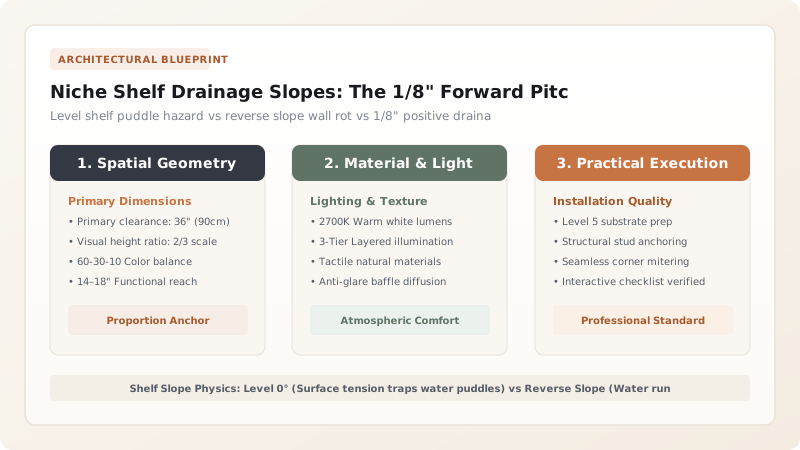
1. Fluid Mechanics: Surface Tension vs Gravity Runoff
Water has high surface tension (\(72.8\text{ mN/m}\)). When water droplets land on a completely level tile shelf, surface tension forces the water to form a flat puddle rather than rolling away. As soap and conditioner residues mix with the puddle, a sticky biofilm develops that breeds Serratia marcescens (pink bacteria) and black mold.
Applying a 1/8-inch downward pitch across the 4-inch depth creates sufficient gravitational shear to overcome water surface tension, causing droplets to coalesce and run off the front edge continuously.

Shower Niche Sill Pitch Angles & Consequences
Use this reference table to calculate exact physical dimensions, ratios, and specifications before purchasing:
| Shelf Slope Angle | Elevation Drop (over 4" depth) | Water Behavior | Long-Term Mold Risk |
|---|---|---|---|
| 1/8" Positive Slope (Optimal) | 0.125" Forward Drop (2.0°) | 100% Instant gravity runoff | 0% (Shelf dries completely in 30 min) |
| 1/16" Slight Slope | 0.062" Forward Drop (1.0°) | Slow runoff; minor droplets remain | Low |
| Dead Level (0.0° Flat) | 0.000" Drop (Flat) | Standing puddle trapped by surface tension | High (Soap scum & pink mold) |
| Reverse Slope (-1.0° Backward) | -0.062" Backward tilt | Water flows into back corners | Catastrophic (Rot & waterproof breach) |
Thick Thin-Set Slumping Constraints
Every successful decoration project must account for physical and environmental constraints:
Sill Slipping Flat While Thin-Set Mortar Dries
Setting a heavy stone sill in wet thin-set can cause it to slump back flat overnight; place 1/8-inch horseshoe shims under the rear edge of the stone sill and secure with blue painter's tape while thin-set cures for 24 hours.
How to Set a Sloped Quartz Niche Sill
Execute this professional sequence to achieve flawless results without backtracking:
Check Waterproof Backer Board
Ensure waterproof backer board inside niche is fully taped and dry.
Apply Wedged Thin-Set Bed
Comb modified thin-set slightly thicker at the rear (3/8") than the front (1/4").
Press Solid Quartz Slab Sill
Press 1-piece quartz sill into thin-set, extending 1/4" past finished wall tile face.
Verify 1/8" Slope with Level
Place digital torpedo level on sill to confirm a solid 1.8° to 2.2° forward pitch.
Tape Securely During Cure
Tape sill firmly in place with heavy painter's tape for 24 hours to prevent shifting.
Common Mistakes & Countermeasures
Avoid these costly errors that compromise aesthetics, ergonomics, and budget:
Setting the Sill Dead-Level with a Standard Bubble Level
Project Execution Checklist
Track your physical progress. Checkboxes persist automatically on this device:
Frequently Asked Questions
Will shampoo bottles slide off a sloped 1/8-inch shelf?
No! A 1/8-inch drop across a 4-inch depth is a gentle 2-degree incline. Shampoo bottles and soap dishes remain 100% stable with zero slipping.


