
Create hyper-realistic 3D marble veining in Scagliola by rolling base selenite dough into flat sheets, dusting with dry mineral pigments, and laying pigment-soaked raw silk threads across the surface. Fold the dough into multi-layered loaves, compress with a wooden roller, and slice into 1/2" thick tiles with a fine steel wire.
At a Glance: Key Takeaways
- Raw Silk Cord Capillarity: Natural silk fibers hold liquid pigment suspensions, releasing thin continuous vein lines under compression.
- Full-Depth Mineral Veining: Unlike painted veins, sliced dough veins penetrate the entire 12mm thickness of the panel.
- Breccia vs Calacatta Veining Recipes: Angular chopped dough clasts mimic Breccia; stretched continuous threads mimic Calacatta.
- Wire Slicing vs Knife Cutting: Piano wire cleanly shears the soft gypsum dough without smearing or blurring delicate vein edges.
- Pigment Dispersion Kinetics: Alcohol-wetted dry oxides produce razor-sharp vein margins without bleeding into white base plaster.
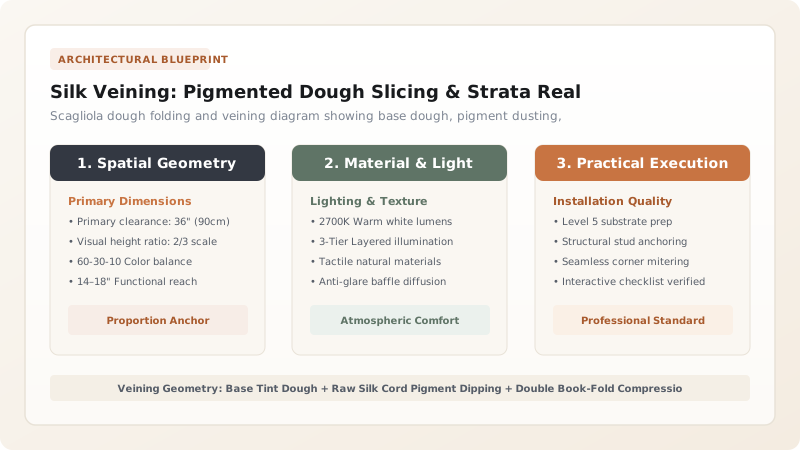
1. Veining Mechanics: Raw Silk Cords & Wire Slicing Kinetics
In classical Italian workshops, master scagliolisti guarded their veining techniques as trade secrets. The key to razor-sharp, feather-like mineral veins is Unspun Raw Silk Threads.
Silk fibers absorb dry mineral oxides suspended in alcohol. When layered between colored dough sheets and compressed, the silk leaves a branching dendritic vein network that extends completely through the stone slab. Learn binder science in hide glue and selenite mineralogy.

2. Dough Loaf Folding & Press-Molding into Armatures
To create the brecciated appearance of volcanic marbles (like Nero Portoro or Rosso Verona), colored dough is chopped into angular chunks (*clasts*) and pressed together with contrasting matrix paste.
Slices are beaten into wooden molds with mallets to expel all air voids. Master polishing in pumice stone polishing and explore Scagliola craftsmanship hub.
Veining Techniques for Historic Marble Types
Use this reference table to calculate exact physical dimensions, ratios, and specifications before purchasing:
| Target Marble Type | Base Dough Color | Veining Method | Pigment Palette |
|---|---|---|---|
| Carrara / Statuario | Translucent Pure White | Stretched continuous silk threads | Vine black, raw umber, graphite |
| Nero Portoro (Black & Gold) | Intense Lamp Black | Chopped angular dough clasts | Cadmium yellow, raw sienna, gold |
| Giallo Siena (Yellow) | Warm Ochre Yellow | Multi-fold silk veining | Burnt sienna, hematite red, white |
| Verde Alpi (Green) | Deep Chromium Green | Dough fragmentation with white matrix | Viridian green, bone black, chalk |
Pigment Smear Bleeding Constraints
Every successful decoration project must account for physical and environmental constraints:
Excess Water in Pigment Slurry Bleeding into White Dough Turning Veins Blurry
Watery pigment bleeds into neighboring white dough, turning razor-sharp veins into muddy gray clouds; disperse mineral pigments in 99% isopropyl alcohol or apply dry pigment powder directly to damp silk threads before pressing.
How to Create Silk Thread Marble Veining in Scagliola
Execute this professional sequence to achieve flawless results without backtracking:
Roll Out White Base Selenite Dough Sheet
Roll out 1/2" thick flat sheet of pure white selenite-glue dough on polished granite table.
Prepare Pigment-Soaked Silk Thread Bundles
Dip raw silk strings in alcohol-pigment slurry (vine black + burnt umber); squeeze out excess liquid.
Arrange Branching Veining Patterns Across Sheet
Lay silk threads in natural diagonal branching tree patterns across the white dough sheet.
Roll Second Dough Sheet and Book-Fold Loaf
Place second tinted dough sheet on top; fold loaf in half and compress with heavy wooden rolling pin.
Slice Loaf into 1/2" Slabs with Tensioned Steel Wire
Draw steel wire through compressed loaf at 45° angle, slicing 1/2" thick veined marble tiles.
Press Slabs into Mold and Beat with Wooden Mallet
Lay veined slices face-down in mold; beat firmly with wooden mallet to bond joints into solid monolithic slab.
Common Mistakes & Countermeasures
Avoid these costly errors that compromise aesthetics, ergonomics, and budget:
Using a Steel Chef's Knife to Slice Dough Loaves
Project Execution Checklist
Track your physical progress. Checkboxes persist automatically on this device:
Frequently Asked Questions
Can Scagliola panels be cast in curved column molds?
Yes! Scagliola dough slices are extremely flexible while wet and can be pressed into semicircular wooden staves to create hollow faux marble column shafts, capitals, and architectural domes.


