
Create authentic Italian Scagliola faux marble by kneading calcined selenite gypsum with warm animal hide glue (*colletta*) and natural mineral pigments into multicolored dough loaves. Fold and slice the dough with pigment-coated silk threads to create 3D marble veining, press into molds or onto walls, and polish through 7 stages of pumice stone, linseed oil, and carnauba wax.
At a Glance: Key Takeaways
- Calcined Selenite Gypsum (*Specchio d'Asino*): Pure translucent crystal gypsum delivers incredible visual depth unmatched by standard plaster.
- Animal Hide Glue Binder (*Colletta*): Retards gypsum setting time from 15 minutes to 4 hours, allowing intricate dough kneading.
- Silk Thread Pigment Veining: Dipping natural silk cords in dry oxide pigments slices realistic mineral veins deep throughout the plaster mass.
- True Three-Dimensional Stone Depth: Unlike painted faux marble, Scagliola veining extends solid through the entire 1/2" material thickness.
- Seven-Stage Water Stone Polishing: Polishing progressively with coarse sandstone to fine pumice and rottenstone creates a mirror reflection.
In-Depth Guides in this Directory
Explore specialized subtopic blueprints, technical dimensions, and execution checklists:
Scagliola Chemistry: Selenite Gypsum & Hide Glue Physics
Master Scagliola material science: calcined selenite gypsum crystal mineralogy, protein hide glue (*colletta*) retardation kinetics, and composite tensile strength.
Silk Veining: Pigmented Dough Slicing & Strata Realism
Master Scagliola marble veining craft: raw silk thread pigment coating, dough loaf folding, wire slicing strata, and replicating Breccia and Portoro marble veins.
Scagliola Polishing: 7-Stage Pumice & Carnauba Wax Mirror Sheen
Master historical Scagliola wet polishing: 7-stage water sandstone grinding, fine Lipari pumice stones, rottenstone buffing, cold-pressed linseed oil, and Carnauba wax mirror finishing.
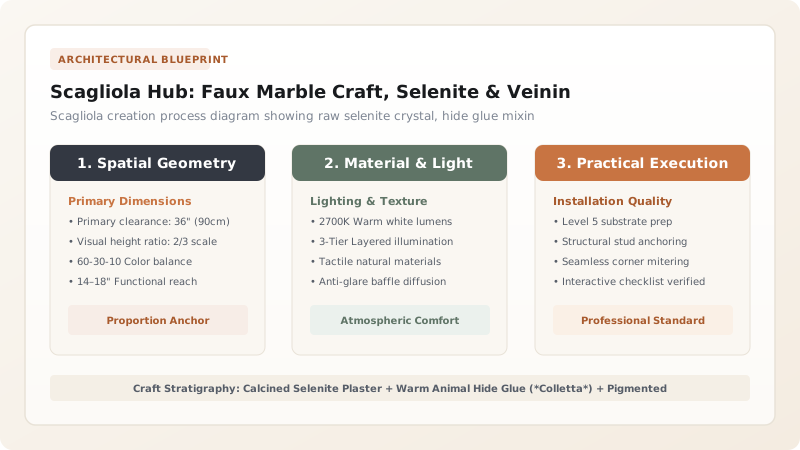
1. Material Mineralogy: Selenite Gypsum & Animal Hide Glue (*Colletta*)
Originating in Carpi, Italy during the late Renaissance, Scagliola was perfected by master craftsmen to mimic rare imported marbles (like Lapis Lazuli, Malachite, and Giallo Siena) for cathedral altars and royal columns.
The core ingredient is Calcined Selenite (*Scaglia* - moonstone gypsum) mixed with warm Animal Hide Glue (*Colletta*), which retards setting and creates a rock-hard composite. Master chemistry in hide glue binder and selenite mineralogy and explore French boiserie and architectural finishes.

2. Silk Thread Veining & Seven-Stage Pumice Stone Polishing
Realistic marble veins are created by coating Raw Silk Threads in Charcoal and Ochre Pigments, embedding them into the dough loaves before slicing.
Learn veining recipes with silk thread veining dough kneading and master the mirror finish in pumice stone and carnauba wax polishing stages.
Authentic Scagliola vs Painted Faux Marble vs Solid Marble
Use this reference table to calculate exact physical dimensions, ratios, and specifications before purchasing:
| Material / Craft | Material Depth | Authenticity & Feel | Weight & Structural Demand |
|---|---|---|---|
| Authentic Scagliola (Optimal) | 1/2" Full-Depth Solid Veining | Cold to touch / Resonant stone ring | Lightweight (1/3 weight of solid stone) |
| Trompe L'Oeil Painted Faux Marble | Surface paint film only (0.01mm) | Looks painted up close / Plastic feel | Negligible weight / Wears off quickly |
| Natural Quarried Marble Slabs | 100% Solid Natural Stone | 100% Authentic Natural Stone | Extremely heavy (450+ lbs per slab) |
| Cultured Polymer Marble (Avoid) | Solid cast resin plastic | Warm synthetic plastic feel / Scratches | Moderate / Chemical off-gassing |
Hide Glue Thermal Gelation Constraints
Every successful decoration project must account for physical and environmental constraints:
Animal Hide Glue Cooling and Gelling Too Fast in Chilly Studio Rooms
Traditional hide glue (*colletta*) gels into gelatin below 65°F (18°C), making plaster dough stiff and un-kneadable; maintain studio temperature at a warm 72°F–75°F, keep the glue pot heated in a warm water double-boiler (bain-marie) at 140°F (60°C).
How to Create and Polish an Authentic Scagliola Panel
Execute this professional sequence to achieve flawless results without backtracking:
Prepare Warm Animal Hide Glue Solution (Colletta)
Soak 60g hide glue pellets in 1 liter water overnight; heat in double-boiler to 140°F (60°C) until fully dissolved.
Mix Pigmented Plaster Dough Batches
Knead calcined selenite plaster with warm hide glue and mineral oxide pigments into colored dough balls.
Lay Silk Veining Threads and Slice Dough Loaves
Dip raw silk strings into dry pigment; press between dough layers; compress into loaf and slice with wire.
Press Sliced Dough into Mold or onto Armature
Press 1/2" thick marbleized slices tightly into mold, beating with wooden mallet to eliminate all air voids.
Allow 72 Hours for Thorough Chemical Cure
Let Scagliola panel cure rock-hard as hide glue bonds and selenite gypsum petrifies over 3 days.
Execute 7-Stage Wet Water Stone and Pumice Polishing
Grind surface flat with coarse sandstone, then polish with 400, 800, 1200 grit pumice stones and water.
Buff with Boiled Linseed Oil and Carnauba Wax
Apply drops of pure linseed oil; buff with rottenstone powder and hard Carnauba wax to mirror gloss.
Common Mistakes & Countermeasures
Avoid these costly errors that compromise aesthetics, ergonomics, and budget:
Using Modern White Plaster of Paris Instead of Calcined Selenite
Project Execution Checklist
Track your physical progress. Checkboxes persist automatically on this device:
Frequently Asked Questions
How long does authentic Scagliola last?
Scagliola is exceptionally durable. Masterpieces created in Italian churches and Bavarian royal palaces during the 1600s remain in pristine condition today, maintaining their high mirror polish for over 400 years.


