
Bochka curved kokoshnik gable roofs and aspen ploughshare shingles (lemekh) comprise the expressive exterior roof architecture of Russian wooden churches. The bochka (literally 'barrel') is an ogee-profile curved gable roof resembling an upturned ship's hull, terminating in a sharp central ridge crowned by an onion dome. Clad with thousands of hand-carved diamond-toothed aspen shingles, these cascading curved gables deflect torrential Arctic rains and heavy snowdrifts while shimmering with silver radiance.
At a Glance: Key Takeaways
- The Bochka Ogee Profile: A compound S-curve with convex lower flanks and a concave upper crest that shoots melting snow clear of horizontal log walls.
- Krestovataya Bochka (Crossed Barrel): Intersecting four-way bochka roofs forming a Greek cross footprint surmounted by central and corner domes.
- Kokoshnik Gable Tiers: Stepped, decorative corbeled gables mimicking traditional Russian women's headdresses, creating vertical visual ascension.
- Lemekh (Ploughshare Shingle): Wedge-shaped aspen shingles hand-split along the grain with stepped or fish-scale serrated tips.
- Trembling Aspen (Populus tremula): Soft wood that carves easily green, seasons without checking, and weathers into a mirror-like platinum silver luster.
- Wooden Juniper Fasteners: Shingles secured with hand-carved rot-resistant juniper or larch wood pegs without rusting iron nails.
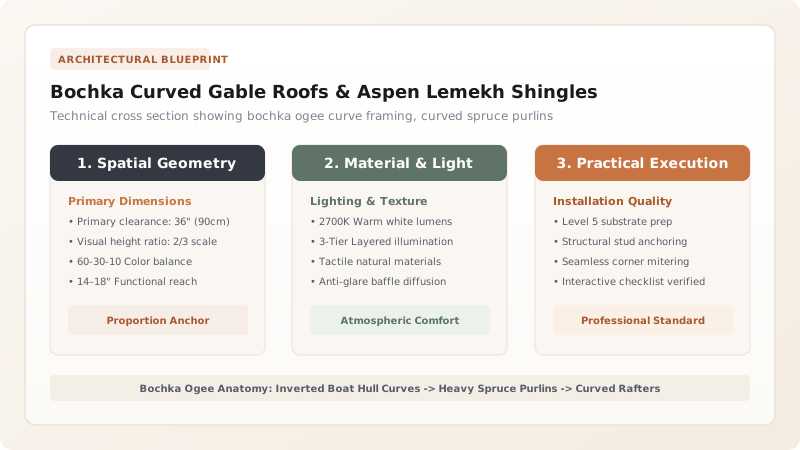
1. Shipwright Origins: The Inverted Keel of the Northern Bochka
The master carpenters of northern Russia were also master shipwrights who built arctic river barges (koch) capable of navigating polar ice packs. When tasked with roofing monumental churches, they adapted naval boatbuilding geometry: the bochka is essentially an inverted, pointed ship's keel resting atop a timber log crib.
The mathematical curve is a true ogee arch (a compound double curve):
- The lower portion swells outward in a broad convex parabola, creating generous interior ceiling volume.
- The upper portion transitions through an inflection point into a steep concave sweep, terminating at a razor-sharp apex ridge.
This aerodynamic profile deflects violent polar wind gusts upward and prevents heavy wet snow from accumulating on the eaves.
2. The Kokoshnik Cascade: Corbeled Timber Hierarchy
To transition visually and structurally from the heavy horizontal srub base to the skyward thrust of onion domes, architects stacked tiers of diminishing decorative gables called kokoshniki (named after the semicircular pearl-encrusted headdress worn by Russian women):
- Each kokoshnik tier corbels outward from the log course below, distributing dome loads diagonally across multiple log tiers.
- By stacking two, three, or four tiers of kokoshniki, the church creates a dynamic pyramidal silhouette that visually bridges the horizontal earth to the celestial dome.
3. The Lemekh Skin: Hand-Carved Aspen Shingles and Weathering
Covering the compound curves of a bochka roof with flat rectangular shakes is impossible; rigid wood cannot bend along compound curvatures. Russian carpenters developed lemekh (so named because its curved shape resembles a farmer's ploughshare):
- Hand-Split Aspen Wedges: Straight-grained aspen logs are rived with froes into \(80\text{ to }100\text{ mm}\) wide wedges tapering from \(15\text{ mm}\) at the butt to \(5\text{ mm}\) at the tip.
- Stepped Diamond Teeth (Zubchiki): The bottom exposure is carved with stepped zigzag notches that break up falling raindrops into fine mist, accelerating runoff drying.
- The Platinum Glow: Exposure to northern sunlight and dew oxidizes the surface cellulose and lignins into an impermeable, light-refracting silver sheen that glints like metal foil under the Aurora Borealis.
Explore the crowning onion domes in multi-faceted onion dome timber carcasses and iron-free fasteners.
Historic Wooden Roof Shingle Comparison
Use this reference table to calculate exact physical dimensions, ratios, and specifications before purchasing:
| Shingle Type | Wood Species | Tip Geometry | Compound Curve Fit | Silver Oxidation Quality | Lifespan on Roof |
|---|---|---|---|---|---|
| Russian Lemekh (Ploughshare) | European Aspen (Populus tremula) | Stepped Diamond Teeth (Zubchiki) | Supreme (Curved Shingle Faces) | Exceptional Mirror Platinum | 40 to 60 Years |
| Scandinavian Stave Church Shingle | Scots Pine Heartwood (Tarred) | Rounded Fish-Scale / Semicircular | Good (Tapered Shakes) | Black (Coated in Wood Tar) | 80 to 100+ Years (Tarred) |
| Western Cedar Shake | Western Red Cedar (Thuja plicata) | Straight Butt Square Cut | Poor (Flat Planes Only) | Dull Ash Gray | 25 to 35 Years |
| Alpine Larch Split Shingle | European Larch (Larix decidua) | Beveled Chiseled Butt | Moderate | Silver-Brown Rustic | 50 to 70 Years |
Practical Constraints
Every successful decoration project must account for physical and environmental constraints:
Aspen Lemekh Rot from Direct Moss and Lichen Colonization
In humid, shaded northern microclimates, damp fallen pine needles and airborne spores establish lichens and green moss inside the stepped teeth of aspen shingles. Lichen acids dissolve the outer silver protective layer, accelerating rot. Historic preservation protocols require annual clearing of forest debris and selective non-toxic spraying with zinc borate biocides.
Extreme Curvature Fitting at Eave Transitions
At the tight inflection point where the convex bochka curve reverses into the concave flare, shingles must bend around a radius under 400mm. Rigid dry aspen will snap across the grain. Shingles must be hand-adzed with a hollowed concave back (grooved scoop) and soaked in boiling water for 30 minutes before nailing to achieve tight radius conformity.
Execution Blueprint & Craftsmanship Sequence
Execute this professional sequence to achieve flawless results without backtracking:
Aspen Timber Selection & Riving
Fell 60-year-old straight-grained trembling aspen logs with zero internal knot whorls. Cleave logs radially into pie-shaped wedge blanks using a froe and wooden maul.
Ploughshare Scoop Adzing & Tooth Carving
Hollow the back of each shingle using an inshave or curved adze so it conforms to the curved roof radius. Carve three stepped diamond teeth (zubchiki) on the exposed bottom tip with a bench chisel.
Curved Bochka Rafter & Batten Framing
Erect curved spruce rafters hewn from naturally arched trees. Nail 30mm x 50mm horizontal spruce battens across rafters at 80mm vertical spacing matching the lemekh exposure.
Lemekh Staggered Laying & Wooden Pegging
Commence shingle installation from the eave line upward. Maintain a three-ply overlap, staggering vertical seams by half a shingle width. Fasten each shingle with two wooden juniper dowels (nagels).
Crest Ridge Sheathing & Lead/Aspen Ridge Cap
Crown the apex of the bochka with overlapping ridge shingles or a hollowed log crest beam (okhlupen) carved with traditional horse-head finials, sealing the central ridge against wind-driven snow.
Common Mistakes & Countermeasures
Avoid these costly errors that compromise aesthetics, ergonomics, and budget:
Applying Modern Synthetic Sealers or Varnish to Aspen Shingles
Sawing Shingles Across the Grain with Power Saws
Project Execution Checklist
Track your physical progress. Checkboxes persist automatically on this device:
Frequently Asked Questions
How long does it take for green aspen shingles to turn silver on a church roof?
Under the high UV exposure of northern summers, fresh white aspen shingles turn light gray within three months and achieve their full lustrous platinum-silver metallic sheen by the end of the second year.
Why do bochka roofs look like upside-down ships?
Northern Russian builders were coastal Pomor sailors and Arctic shipbuilders. The pointed ogee arch of the bochka replicates the exact hydrodynamic lines of a sea-going boat hull, adapted inverted to efficiently shed sub-arctic snow, hail, and torrential rain.


