
Russian wooden zodchestvo is the monumental vernacular timber architecture of the Russian North (Karelia, Arkhangelsk, Vologda), reaching its pinnacle between the 15th and 18th centuries in structures like the 22-domed Church of the Transfiguration at Kizhi Island (UNESCO World Heritage). Built entirely with axes without iron nails or saws, master carpenters (plotniki) interlocked massive Scots pine logs into towering tiered log cribs (srubs), topped by curved barrel-vault roofs (bochkas) and multi-faceted onion domes clad in hand-carved, silver-weathering aspen shingles (lemekh).
At a Glance: Key Takeaways
- Axe-Only Construction Philosophy: Saws were forbidden because saw teeth tear wood fibers and invite rot, whereas razor-sharp axe blows crush and seal tracheid cell ends.
- Srub Pine Log Cribs: Massive slow-growth Scots pine (Pinus sylvestris) logs scribed with longitudinal grooves (paz) and insulated with natural sphagnum moss.
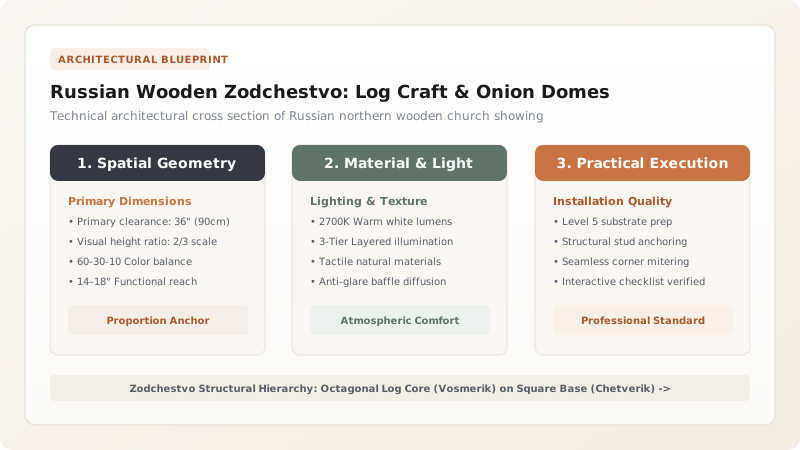
- Chetverik on Vosmerik Geometry: Transitioning a massive square ground-floor log crib (chetverik) into an octagonal upper tower (vosmerik) using corbeled timber squinches.
- Bochka (Curved Barrel Gable): Arched ogee-profile gables resembling an inverted boat hull, directing snowmelt away from vertical log walls.
- Multi-Faceted Onion Dome Carcasses: Intricate internal ribbed timber skeletons (zhuravtsy) holding thirty-ton snow loads without steel brackets.
- Aspen Lemekh Shingles: Hand-carved diamond-toothed shingles made from trembling aspen (Populus tremula) that weather under northern sun into lustrous, mirror-like silver.
In-Depth Guides in this Directory
Explore specialized subtopic blueprints, technical dimensions, and execution checklists:
Log Srub Scribing & Bowl Corner Notching with Axes
Master Russian timber craft manual for log srub construction: cherta compass scribing, semicircular longitudinal paz grooves, v chashu bowl notching, and sphagnum moss bedding.
Bochka Curved Gable Roofs & Aspen Lemekh Shingles
Architectural woodworking guide to Russian bochka roofs: ogee-curved barrel gables, kokoshnik tiers, and hand-carved aspen ploughshare shingles (lemekh).
Onion Dome Timber Carcasses & Iron-Free Fasteners
Engineering manual for Russian wooden onion domes: internal curved zhuravtsy ribs, central veretenitsa spindle, iron-free nagel joinery, and aspen lemekh revetment.
1. The Axe Culture: Metallurgy and Philosophy of the Russian Plotnik
In the vast taiga forests of the Russian North, timber was not merely a construction material—it was the entire cultural medium. Master carpenters—known as plotniki—built soaring cathedrals towering over \(37\text{ meters}\) (\(120\text{ feet}\)) high using solely hand axes, adzes, and wood chisels, completely rejecting the use of crosscut saws or iron nails.
This rejection of saws was not due to technological ignorance, but sophisticated wood anatomy:
- Axe-Sealed Capillary Pores: When a razor-sharp carpenter's broadaxe (topor) severs a pine log, the compressive impact crushes and burnishes the open ends of the wood tracheids, forming a smooth, water-repellent surface.
- Saw Tooth Destruction: A saw blade tears, shreds, and splinters the wood fibers, leaving open porous sponges that absorb rainwater and foster rapid fungal dry rot.
Learn about log scribing in round pine log srub scribing and bowl notching with axes.

2. Structural Crib Geometry: Chetverik and Vosmerik Engineering
The structural core of every Russian wooden church is the srub—a horizontal log crib interlocked at the corners. To achieve monumental heights without internal columns, builders employed a hierarchical structural transition:
- Chetverik (The Four-Sided Base): A massive square log crib providing ground-floor stability against winter blizzards and frost heave.
- Vosmerik (The Eight-Sided Tower): At upper levels, the square crib transitions into an octagon by introducing diagonal corner log ties (korob). The eight-sided geometry presents narrow, aerodynamic facets to arctic gales, reducing wind overturning moments by up to \(40\%\).
Explore curved bochka rooflines in bochka curved kokochnik gable roofs and aspen ploughshare shingles.
3. The Onion Dome: Aerodynamic Snow Physics and Aspen Metallurgy
The iconic Russian onion dome (glava) evolved as a functional solution to harsh northern winters. In regions receiving \(2\text{ meters}\) of annual snowfall, a hemispherical Byzantine dome accumulates crushing snowdrifts that collapse timber roofs. The pointed, bulging onion profile sheds heavy snow continuously under gravity while creating aerodynamic lift that prevents snow from settling.
The domes are framed with curved internal spruce ribs (zhuravtsy) and clad in thousands of hand-carved lemekh shingles made from European aspen (Populus tremula). When newly cut, aspen is pale white; under northern ultraviolet radiation and rain, the tannins oxidize into a lustrous, mirror-like silver patina that rivals polished platinum. Review dome framing in multi-faceted onion dome timber carcasses and iron-free fasteners.
Russian Northern Timber Craft Material Comparison
Use this reference table to calculate exact physical dimensions, ratios, and specifications before purchasing:
| Structural Element | Wood Species | Tooling Method | Joint Engineering | Expected Lifespan | Weathering Characteristics |
|---|---|---|---|---|---|
| Horizontal Srub Log Walls | Scots Pine (Pinus sylvestris) | Hand Hewn with Broadaxe | In-Bowl (V Chashu) Corner Notch | 200 to 300+ Years | Deep Golden Brown -> Weathered Charcoal |
| Curved Dome Ribs (Zhuravtsy) | Norway Spruce (Picea abies) | Naturally Curved Grain Adzing | Mortise-and-Tenon + Oak Pegs | 150 to 250 Years | Protected Internal Framing |
| Lemekh Roof Shingles | European Aspen (Populus tremula) | Hand Carved with Chisel & Drawknife | Concealed Wood Trenail Pin | 40 to 60 Years (Renewable) | Oxidizes to Mirror Platinum Silver |
| Foundation Sleeper Logs | Siberian Larch (Larix sibirica) | Axe Hewn + Charred Surface | Half-Lap Stone Resting Joint | 300+ Years (Rot-Immune) | Dark Dense Petro-Lignin Resin |
Practical Constraints
Every successful decoration project must account for physical and environmental constraints:
Catastrophic Fire Hazard in Remote Taiga Locations
Entire wooden villages and historic multi-domed cathedrals have been reduced to ashes in minutes by lightning strikes or chimney sparks. Modern preservation requires non-staining organosilicate penetrating fire-retardant saturations, early-warning infrared flame detection networks, and high-pressure dry chemical deluge systems installed in church attics.
Log Compression Settling and Differential Creep
A 25-meter high log srub naturally settles by 5% to 8% (up to 1.5 meters) over its first five years as the Scots pine logs dry and compress under self-weight. Any rigid vertical elements (such as interior door frames, vertical stairwells, or chimney stacks) will buckle unless installed inside sliding vertical expansion rebates with 150mm top settling jacks.
Sphagnum Moss Decay in Log Joints
Sphagnum moss (kukushkin lyon) placed between log courses provides natural antibiotic, breathable insulation. However, if exterior caulking fails and standing rainwater enters the groove, prolonged saturation rots the moss and the underside of the pine log. Periodic re-chinking and axe-groove inspection are required every two decades.
Execution Blueprint & Craftsmanship Sequence
Execute this professional sequence to achieve flawless results without backtracking:
Slow-Growth Pine Selection & Winter Felling
Harvest 200-year-old Scots pine logs in midwinter during sub-zero temperatures when trees are dormant and sap content is minimal. Select logs with tight annual growth rings (at least 15 rings per cm).
Bark Stripping & Broadaxe Hewing
Peel pine bark with a drawknife. Hew the four exterior faces slightly flat using a broadaxe, ensuring axe strokes run with the wood grain to close capillary tracheid ends.
Srub Scribing & Semicircular Longitudinal Grooving
Place each log on the course below. Scribe the contour using a forged steel scriber (cherta). Chisel a continuous semicircular hollow groove (paz) along the entire underside of the log.
Bowl Corner Notching (V Chashu) & Moss Bedding
Chisel round concave bowl notches at log intersections. Lay a thick layer of dried antimicrobial sphagnum peat moss along the groove. Seat the log firmly into place with a wooden beetle mallet.
Internal Zhuravtsy Dome Carcass Framing
Assemble curved spruce ribs (zhuravtsy) radiating from a central vertical timber spindle (veretenitsa). Secure ribs with oak trenails (nagels) without metal fasteners.
Aspen Lemekh Shingle Carving & Dome Cladding
Split straight-grained aspen logs into wedge shingles. Carve stepped diamond teeth into each shingle tip. Fasten shingles to the dome ribs in overlapping rows using juniper wood pegs.
Common Mistakes & Countermeasures
Avoid these costly errors that compromise aesthetics, ergonomics, and budget:
Using Crosscut Saws to Cut Log Ends
Securing Aspen Domes with Modern Steel Screws or Nails
Project Execution Checklist
Track your physical progress. Checkboxes persist automatically on this device:
Frequently Asked Questions
How did Kizhi Island builders construct 22 domes without iron nails?
Every junction relied on gravity, friction, and interlocking timber joinery. The massive weight of the upper log tiers compresses the srub courses together, while the dome shingles were pinned with wooden dowels into horizontal spruce battens that interlock directly with the dome ribs.
Why is aspen used specifically for the onion dome shingles?
Aspen (Populus tremula) possesses unique botanical traits: it splits cleanly, carves easily when green, does not crack during seasoning, and most importantly, contains natural waxes that oxidize into a gleaming silver-gray patina that reflects sunlight like metal foil.


