
Subterranean qanat cooling vaults (known as payabs and sardabs) are deep underground architectural chambers built directly over flowing qanat water aqueducts. Located between 6 and 15 meters below ground level where surrounding earth temperatures remain stable at 14°C to 16°C year-round, these brick-vaulted sanctuaries harness flowing glacial mountain runoff to evaporatively cool and humidify incoming dry desert air, creating natural underground refrigerators and summer living retreats.
At a Glance: Key Takeaways
- Stable Geothermal Earth Temperature: Surrounding deep soil acts as an infinite heat sink, maintaining a constant 14°C to 16°C irrespective of surface summer heat.
- Flowing Mountain Runoff: Qanat channels carry melted mountain snowpack over distances of 20 to 70 kilometers, providing fresh running water at 12°C–14°C.
- The Payab Chamber: An access portal with a steep brick staircase descending 40 to 60 steps directly to an open marble basin where the qanat flows.
- Adiabatic Evaporative Chilling: Warm, dry surface air (10% RH, 45°C) passing across the cold water surface drops in sensible temperature to 21°C while humidity rises to 45%.
- Natural Food Preservation: Sardab basement cellars stored perishable fruits, dairy, and meats for months without electric refrigeration.
- Structural Adobe & Baked Brick Vaults: Built with fired baked brick (aajor) set in water-resistant lime-ash mortar (saroj) to withstand groundwater humidity.
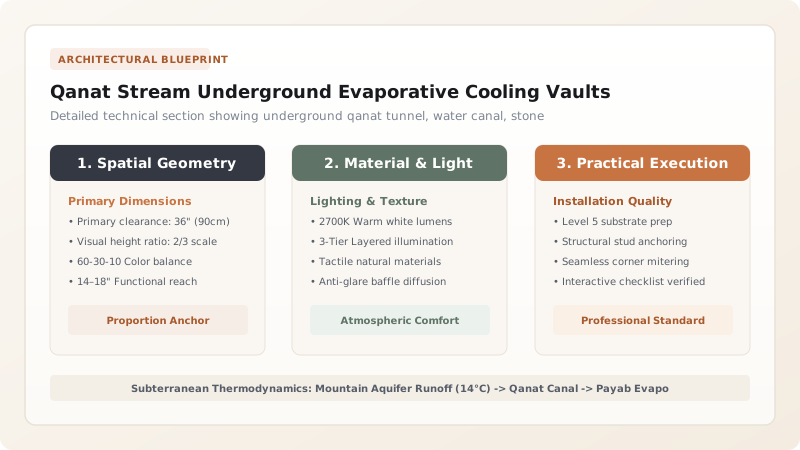
1. Hydro-Geology: The Architecture of the Subterranean Payab
A qanat is a gently sloping subterranean gravity canal that taps into the unconfined aquifer at the alluvial fan of distant mountain ranges, transporting fresh drinking water across dozens of kilometers underground without evaporation losses.
Where the qanat passes beneath residential estates, master architects excavated payabs—steeply descending vaulted staircases leading to underground stone chambers. These chambers feature an open canal (kariz) lined with polished limestone or water-resistant baked brick. Because the chamber is carved \(8\text{ to }15\text{ meters}\) below the desert surface, it is completely shielded from solar radiation and surrounded by subterranean soils maintaining the mean annual earth temperature of \(15^\circ\text{C}\) (\(59^\circ\text{F}\)).
2. Psychrometric Dynamics: Enthalpy and Moisture Transfer
When dry desert air is driven down through the badgir windcatcher and across the running qanat water, an intense psychrometric mass transfer occurs along a constant wet-bulb enthalpy line:
The bone-dry desert air (\(45^\circ\text{C}\) dry-bulb, \(18^\circ\text{C}\) wet-bulb) has tremendous evaporative capacity. As water molecules evaporate into the air stream, the sensible temperature drops precipitously toward the wet-bulb temperature. The exiting airstream enters the living quarters at \(22^\circ\text{C}\) to \(24^\circ\text{C}\) with \(45\%\) relative humidity—the international human thermal comfort gold standard.
3. Material Resilience: The Saroj Hydraulic Mortar Lining
Ordinary lime or mud mortar dissolves and deteriorates rapidly under constant underground water flow. Persian engineers developed saroj—a legendary waterproof hydraulic mortar made from a complex formulation:
- Slaked Lime & Clay: Provides the primary calcium silicate matrix.
- Crushed Wood Ash: Contains reactive silica and potassium that impart strong pozzolanic water-setting properties.
- Egg Whites & Goat Hair / Cattail Fluff (Louee): Organic binders and fibers that prevent micro-cracking and create an impermeable, self-healing hydraulic skin.
Saroj mortars submerged in Yazd qanats over 800 years ago remain completely rock-hard and impermeable today. Learn about sub-grade living chambers in earthen adobe thermal mass shabestan summer sanctuary chambers.
Subterranean Cooling Technology Comparison
Use this reference table to calculate exact physical dimensions, ratios, and specifications before purchasing:
| Cooling Method | Temperature Reduction | Humidity Impact | Water Quality Requirement | Energy Input | Lifespan |
|---|---|---|---|---|---|
| Flowing Qanat Payab Vault | -20°C to -25°C (Extreme) | Increases RH to 40%–50% | Fresh Mountain Snowpack | Zero (Gravity Aqueduct) | Centuries (Self-Sustaining) |
| Subterranean Earth Tubes (Dry) | -8°C to -12°C (Geothermal Only) | Zero Moisture Added | None Required (Air Only) | Low Fan Power | 30 to 50 Years |
| Basement Water Mist Jet | -10°C to -14°C | Increases RH to 75%+ (Over-Wet) | Treated Potable Water | High-Pressure Pump Needed | 10 to 15 Years |
| Modern Ground-Source Heat Pump | -25°C to -30°C | Dehumidifies | Closed Loop Glycol | High Electrical Power | 20 to 25 Years |
Practical Constraints
Every successful decoration project must account for physical and environmental constraints:
Sewage Contamination and Upstream Qanat Pollution
Because a single qanat canal passes beneath hundreds of residential plots, unsealed modern septic tanks or cesspools can leak pathogens into the drinking water stream. In historical practice, severe religious and civic laws prohibited any waste discharge into qanats, designating upstream sections exclusively for drinking and downstream sections for agriculture.
Humidity and Mold Management in Enclosed Subterranean Spaces
If airflow stalls inside a subterranean payab, relative humidity reaches 100%, causing dangerous black mold (Stachybotrys) growth and fungal spore circulation into the home. Continuous stack-effect ventilation through the badgir exhaust flue is essential to prevent vapor stagnation.
Execution Blueprint & Craftsmanship Sequence
Execute this professional sequence to achieve flawless results without backtracking:
Qanat Depth Survey & Geotechnical Soil Boring
Locate the subterranean qanat tunnel axis relative to the house plot. Bore pilot soil cores to determine depth (typically 8 to 12 meters) and verify soil stability.
Excavating the Descending Payab Staircase
Excavate a stepped trench into the native marl earth at a 45° angle. Step down using brick treads laid in lime-sand mortar, reinforcing the tunnel with pointed barrel vaults.
Forming the Subterranean Water Canal (Kariz)
Line the floor and lower walls of the canal with dense fired clay bricks (aajor nezami). Coat all submerged surfaces with 20mm of traditional waterproof saroj mortar.
Badgir Air Shaft Connection & Louvered Plenum
Tunnel a dedicated air supply shaft connecting the windward badgir flue directly to the ceiling of the payab chamber, forcing incoming desert air across the water surface.
Moisture Monitoring & Commissioning
Install digital psychrometric loggers to measure inlet and outlet air temperatures and relative humidity. Adjust bottom exhaust dampers to maintain 45% relative humidity.
Common Mistakes & Countermeasures
Avoid these costly errors that compromise aesthetics, ergonomics, and budget:
Lining Subterranean Water Canals with Standard Portland Cement
Stagnating Airflow in Deep Vaults Without Exhaust Paths
Project Execution Checklist
Track your physical progress. Checkboxes persist automatically on this device:
Frequently Asked Questions
Can modern buildings use the qanat concept without an ancient water canal?
Yes. Modern sustainable architects use 'subterranean labyrinth plenums' or geothermal earth tubes combined with shallow greywater or rainwater reflecting pools to achieve identical evaporative cooling performance with zero energy consumption.
How deep are typical residential payabs in Yazd?
Depending on the slope of the aquifer, payabs in Yazd range from 6 meters (around 20 steps down) to over 20 meters deep (up to 70 steep brick steps), with larger communal payabs descending over 100 steps.


