
Multi-directional badgir wind tower shafts are passive aerodynamic ventilation structures engineered to harvest wind from any compass direction. Built with four, six, or eight vertical flues separated by central cruciform brick walls (teqeh), a badgir exploits positive windward stagnation pressure to force cool upper-level breezes downward into living spaces, while simultaneously utilizing negative leeward suction pressure to pull hot, stale indoor air out of the building.
At a Glance: Key Takeaways
- Aerodynamic Stagnation Pressure: Converts wind kinetic energy into static pressure (+0.6 to +0.8 Cp) on the windward face, driving high-velocity downward drafts.
- Leeward Suction (Bernoulli Effect): Generates negative pressure (-0.3 to -0.5 Cp) on downwind flues, functioning as an induced exhaust chimney.
- Cruciform Dividing Walls (Teqeh): Internal adobe brick cross-walls that isolate adjacent flues, preventing short-circuiting turbulence inside the tower.
- Height Advantage (15m–33m): Captures pristine, dust-free atmospheric winds moving at twice the velocity of ground-level friction-slowed air.
- Optimum Draft Aspect Ratio: Shaft height to hydraulic diameter ratio (H/Dh) calibrated between 8:1 and 12:1 to balance airflow volume against internal wall friction.
- Dovlatabad Palace Record: Home to the world's tallest surviving octagonal badgir in Yazd, towering 33.8 meters above ground with 8 distinct airflow circuits.
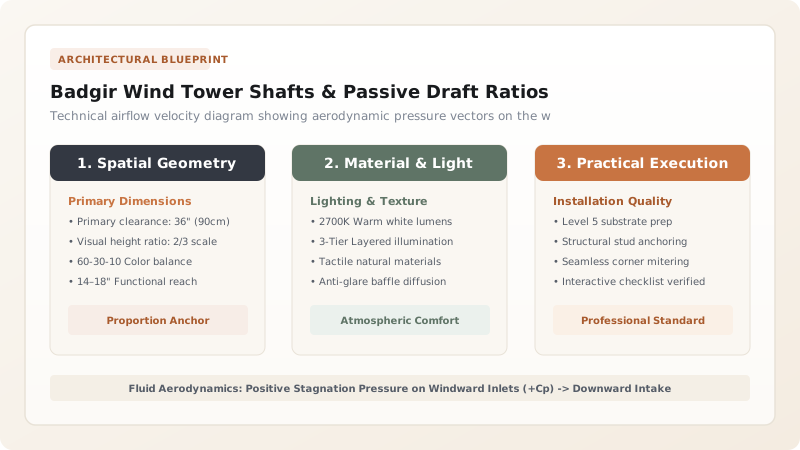
1. Aerodynamic Principles: Pressure Coefficients and Velocity Head
When high-altitude desert wind strikes the elevated top openings of a badgir, it creates a differential pressure field governed by Bernoulli's equation and atmospheric boundary layer physics. The driving ventilation pressure is calculated via:
Where \(\rho_{\text{air}}\) is air density (\(\approx 1.15\text{ kg/m}^3\) at desert elevation), \(V_{\text{wind}}\) is wind velocity at the tower crest, and \(C_p\) is the surface pressure coefficient. Because wind velocity increases with height following the power-law boundary profile \(V(z) = V_{10} \cdot (z/10)^\alpha\), elevating the tower intake \(20\text{ to }30\text{ meters}\) above ground increases velocity head by up to \(80\%\) compared to street level.
2. Internal Anatomy: The Teqeh Cruciform Partition
An undivided hollow masonry chimney would be dysfunctional: incoming wind would swirl chaotically in the top opening, creating turbulent eddies that block downward flow. The genius of the Persian badgir is its internal structural partitioning:
- The Teqeh (Main Cross Wall): A 250mm thick adobe brick cruciform wall running from the top vents down to the ceiling of the ground floor, dividing the square tower into four independent vertical flues.
- Directional Selectivity: Regardless of which direction the wind blows, one or two flues always experience positive stagnation pressure (forcing air down), while the opposite flues experience negative aerodynamic suction (pulling air upward).
- Non-Reversing Airflows: The isolated flues prevent incoming high-pressure cool drafts from being contaminated by rising warm exhaust air.
3. The Draft Ratio: Height-to-Width Hydraulic Optimization
The total airflow volume (\(Q\)) delivered into the residence depends on balancing the windward driving pressure against the frictional resistance of the rough earthen shaft walls:
Where \(f\) is the Darcy-Weisbach friction factor for rough straw-clay plaster (\(\approx 0.035\text{ to }0.045\)), and \(D_h\) is the hydraulic diameter of each flue. If the shaft is too narrow (\(H/D_h > 15\)), wall friction strangles airflow. If the shaft is too wide (\(H/D_h < 5\)), wind reverses inside the top intake. Historical Persian master builders (me'mars) achieved the empirical golden ratio of \(H/D_h \approx 9:1\text{ to }11:1\).
Discover how this airflow couples with subterranean water in subterranean sub-grade qanat stream evaporative cooling vaults.
Badgir Wind Tower Typology & Performance
Use this reference table to calculate exact physical dimensions, ratios, and specifications before purchasing:
| Tower Typology | Number of Flues | Directional Efficiency | Sandstorm Resistance | Structural Complexity | Best Regional Fit |
|---|---|---|---|---|---|
| One-Directional Badgir (Meybod) | 1 Large Flue | Captures Single Breeze Only | Supreme (Faces Away from Dust) | Low (Simple Rectangular Chimney) | Areas with Hostile Dust Winds |
| Four-Directional Badgir (Yazd) | 4 Flues (Cruciform) | 360° Omnidirectional | Moderate (Requires Damper) | Medium (Standard Adobe Vault) | Urban Desert Courtyard Houses |
| Octagonal Monumental (Dovlatabad) | 8 Radial Flues | Exceptional Dynamic Tracking | Low-Moderate | Very High (Octagonal Ribs) | Royal Palaces & Public Cisterns |
| Round Cylindrical Wind Tower | Continuous Spiral Flue | Smooth Omnidirectional Flow | Moderate | High (Curved Brick Masonry) | Coastal Arid Ports (Bandar Abbas) |
Practical Constraints
Every successful decoration project must account for physical and environmental constraints:
Wind Turbulence from Surrounding Modern Multi-Story Buildings
Historical badgirs rely on undisturbed laminar wind flow across the desert roofline. Constructing tall modern multi-story concrete buildings nearby creates wind shadows and turbulent downward vortices, disrupting the intake aerodynamics and rendering the historic wind tower ineffective.
Bird and Pest Infestation in Upper Apertures
Pigeons, owls, and bats naturally roost in the cool, shaded upper flues of badgirs, depositing guano and nesting debris that contaminate indoor air. Modern restorations install fine brass or stainless wire netting behind the upper decorative brick grilles to prevent avian entry without restricting airflow.
Execution Blueprint & Craftsmanship Sequence
Execute this professional sequence to achieve flawless results without backtracking:
Tower Footprint and Flue Sizing Calculation
Calculate total target room ventilation volume (minimum 15 air changes per hour). Determine flue cross-sectional area ensuring internal shaft air speed does not exceed 2.5 m/s during normal 15 km/h breezes.
Structural Plinth & Adobe Base Construction
Build thick foundational adobe brick masonry walls (600mm thick) anchored into the ground-floor vaulting to resist wind overturning moments.
Erecting Cruciform Partition Walls (Teqeh)
Lay the intersecting internal teqeh cross-walls simultaneously with the outer perimeter shell, locking the bricks together at all four corners with stepped interlocking bonds.
Upper Vent Intake Grilles & Timber Tie-Beam Integration
Form the intake openings with decorative open-brickwork grilles (shabaka) that break wind into uniform streams. Embed horizontal timber poles (choubi) through the shafts every 2 meters for seismic cross-bracing.
Interior Surface Smoothing & Damper Commissioning
Render interior flue walls with polished lime-clay plaster to minimize wall friction factor. Install counter-balanced wooden louvers at the basement intake ports.
Common Mistakes & Countermeasures
Avoid these costly errors that compromise aesthetics, ergonomics, and budget:
Omitting the Internal Dividing Cross-Walls (Hollow Tower)
Leaving Interior Shaft Walls Rough and Unplastered
Project Execution Checklist
Track your physical progress. Checkboxes persist automatically on this device:
Frequently Asked Questions
Can a badgir work on completely windless summer days?
Yes. On windless days, the badgir operates purely as a solar thermal chimney. Solar heat warms the masonry at the top of the tower, causing air inside the southern shaft to rise and vent outward, which in turn pulls cool subterranean air from the basement up through the living areas.
How do four-sided badgirs avoid drawing in rainwater during desert downpours?
Desert rainstorms are rare but violent. Badgir intake grilles are recessed under deep projecting brick eaves with outward-sloping sills, and internal collection trays at the shaft base route accidental water into floor drains rather than living quarters.


