
Calculate permeable interlocking concrete pavement (PICP) stormwater storage using the reservoir formula \(V = d \times n\), where \(d\) is aggregate base depth and \(n\) is the void ratio (0.35 to 0.40). A 12-inch open-graded stone base stores 4.8 inches of pure stormwater, absorbing 100-year storm events without surface runoff.
At a Glance: Key Takeaways
- ASTM C1701 Surface Infiltration Rate (>100 to 500 in/hr): Far exceeds maximum recorded natural rainfall intensities (typically <4 in/hr).
- Reservoir Storage Formula (\(V = d \times n\)): 12" open stone base (40% void space) holds 4.8" of standing water underground.
- Subgrade Soil Infiltration Testing (Double-Ring Infiltrometer): Sand/gravel subgrades percolate freely (>1 in/hr); clay soils (<0.1 in/hr) require perforated sub-drain pipes.
- Hydrocarbon & Heavy Metal Bio-Filtration: Crushed limestone aggregates trap motor oils, neutralizing pollutants via natural microbial biofilm digestion.
- Elimination of Retention Ponds: Reclaims valuable real estate by replacing ugly retention ponds with underground stone reservoirs.
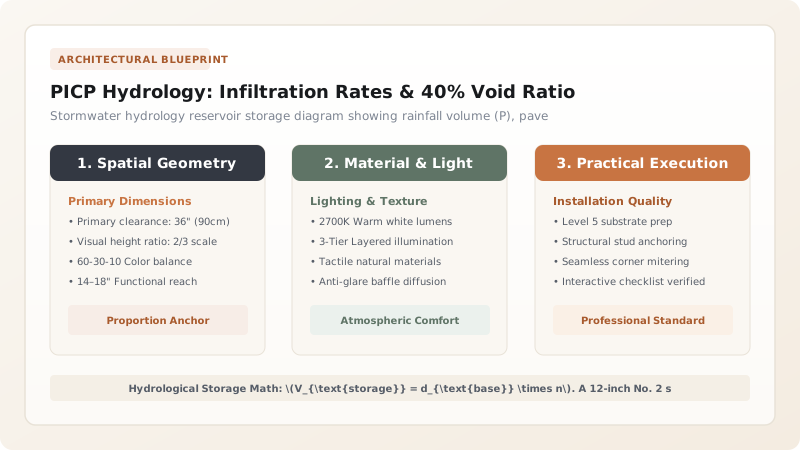
1. Surface Hydrology: ASTM C1701 Ring Infiltration Rates (>100 in/hr)
Civic stormwater ordinances increasingly require zero net runoff on newly paved residential driveways. Permeable Interlocking Concrete Pavers (PICP) provide unmatched surface permeability.
When tested per ASTM C1701 (Standard Test Method for Surface Infiltration Rate of Permeable Unit Pavement), properly installed PICP exhibits infiltration rates of \(100\text{ to } 500+\text{ inches per hour}\). Even the most severe 100-year cloudburst (3 to 4 inches in one hour) drains instantaneously with zero surface ponding. Learn aggregate grading in open-graded aggregate bases.

2. Underground Storage Math (\(V = d \times n\)) & Subgrade Percolation
The open-graded stone base beneath the pavers functions as a Hidden Underground Detention Basin. The water storage capacity (\(V_{\text{storage}}\)) is calculated as:
$$V_{\text{storage}} = d_{\text{base}} \times n$$
Where \(d_{\text{base}}\) is aggregate depth and \(n\) is porosity (\(n = 0.40\) for ASTM No. 2 stone). A 12-inch deep stone reservoir holds \(4.8\text{ inches of standing water}\). Review edge constraints in edge restraints and joint grit maintenance and explore permeable pavers hub.
Subgrade Soil Types vs PICP Drainage Design
Use this reference table to calculate exact physical dimensions, ratios, and specifications before purchasing:
| Native Subgrade Soil | Percolation Rate | PICP System Design | Sub-Drain Pipe Requirement |
|---|---|---|---|
| Sandy Gravel / Loamy Sand | > 1.0 Inch / Hour | Full Infiltration (Zero pipes needed) | No sub-drains required |
| Sandy Clay / Silt Loam | 0.2 to 1.0 Inch / Hour | Partial Infiltration | Perforated overflow drain pipe recommended |
| Dense Heavy Clay / Caliche | < 0.1 Inch / Hour (Impervious) | No Infiltration (Detention tank mode) | Mandatory 4" perforated collector pipe + liner |
| Bedrock / High Groundwater | Zero percolation | Sealed reservoir mode | Mandatory positive pump / gravity storm exit |
Clay Subgrade Softening Rutting Constraints
Every successful decoration project must account for physical and environmental constraints:
Water Ponding on Unprotected Clay Subgrade Turning Soil to Mud Causing Base Rutting
Water stored in the stone reservoir softens uncompacted expansive clay subgrade, causing the heavy stone base to sink into the mud under vehicle loads; line clay subgrades with woven high-modulus stabilization geotextile (such as Mirafi 500X) and install a perforated drain pipe to evacuate stored water within 48 hours.
How to Calculate Reservoir Depth and Test Infiltration
Execute this professional sequence to achieve flawless results without backtracking:
Perform Soil Percolation Test on Excavated Subgrade
Test percolation rate using double-ring infiltrometer to determine native subgrade infiltration rate in inches/hour.
Determine 100-Year 24-Hour Design Storm Rainfall Depth
Lookup local NOAA Atlas 14 storm precipitation value for site (e.g., \(P = 4.5\text{"}\)).
Calculate Required No. 2 Stone Reservoir Thickness
Apply formula \(d = P / 0.40 = 4.5 / 0.40 = 11.25\text{"}\) of ASTM No. 2 stone to hold 100% of storm volume.
Install Perforated Overflow Collector Pipe in Clay Soils
In slow-draining soils (rate < 0.5 in/hr), install 4" perforated SDR-35 pipe 2" above subgrade floor to prevent waterlogging.
Install PICP System per Interlocking Concrete Pavement Institute (ICPI)
Place sub-base, choker, bedding, and pavers; fill joints with ASTM No. 8 washed chips.
Conduct ASTM C1701 Surface Infiltration Verification Test
Seal 12" ring to pavers with plumber's putty; pour 5 gallons water; record time with stopwatch (must pass >100 in/hr).
Common Mistakes & Countermeasures
Avoid these costly errors that compromise aesthetics, ergonomics, and budget:
Allowing Stormwater to Stay Stored in Base for More Than 72 Hours
Project Execution Checklist
Track your physical progress. Checkboxes persist automatically on this device:
Frequently Asked Questions
Can rainwater harvested from permeable paver driveways be reused for landscape irrigation?
Yes! By lining the bottom and sides with an impervious 30-mil EPDM rubber geomembrane, the open-graded stone base becomes a clean underground rainwater cistern. A submerged sump pump can pump the filtered water for lawn irrigation.


