
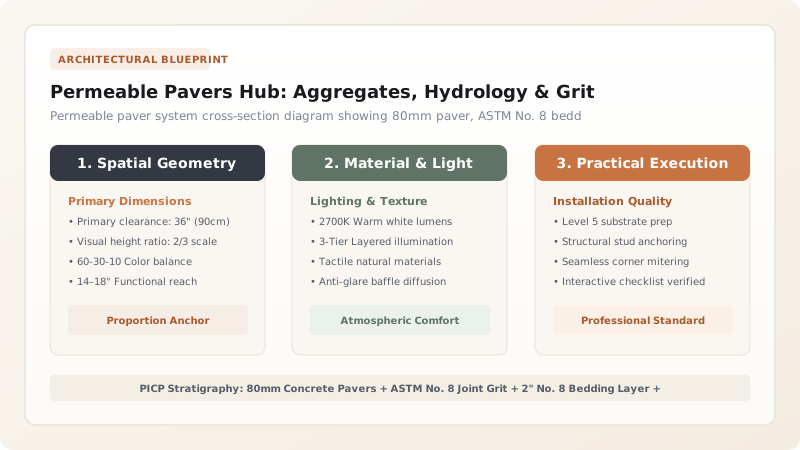
Build permeable interlocking concrete paver (PICP) driveways and plazas using 80mm thick heavy-duty pavers installed over an open-graded stone foundation. Layer 6"–12" of ASTM No. 2 sub-base reservoir stone, 4" of ASTM No. 57 base stone, and a 2" setting bed of ASTM No. 8 washed chips. Fill paver joints with ASTM No. 8 or No. 89 angular grit (zero sand).
At a Glance: Key Takeaways
- Stormwater Infiltration Hydrology (>100 inches/hr): Absorbs 100% of extreme rainfall events with zero standing puddles or stormwater runoff.
- Open-Graded Aggregate Matrix (Zero Sand / Zero Fines): Clean fractured stone contains 30%–40% void space for underground water storage.
- 80mm Heavy-Duty Vehicular Pavers: 3-1/8" thick pavers with integrated side spacer nibs resist heavy SUV wheel turning shear.
- ASTM No. 8 Washed Angular Joint Grit: High-permeability crushed stone chips lock paver joints without washing away into base layers.
- Reinforced Concrete Edge Restraints: Poured concrete curb or anchored heavy steel edging prevents perimeter lateral paver creep under traffic.
In-Depth Guides in this Directory
Explore specialized subtopic blueprints, technical dimensions, and execution checklists:
Permeable Aggregates: ASTM No. 2, 57 & 8 Grading Standards
Master ASTM open-graded aggregate grading science for permeable pavers: ASTM No. 2 sub-base reservoir, ASTM No. 57 choker base, ASTM No. 8 bedding chips, void ratios (35%–40%), and compaction.
PICP Hydrology: Infiltration Rates & 40% Void Ratios
Master permeable pavement stormwater hydrology: ASTM C1701 surface infiltration testing (>100 in/hr), 40% void reservoir storage math (V = d * n), and 100-year storm management.
PICP Maintenance: Edge Restraints & Joint Grit Vacuuming
Master permeable paver structural borders and maintenance: cast-in-place concrete edge curbs, heavy steel edge restraints, regenerative-air vacuum sweeping, and joint grit replenishment.
1. Aggregate Engineering: ASTM No. 2, 57 & No. 8 Stone Layers
Standard paver driveways use dense-graded base (road base with fine sand and clay) and fine bedding sand. In permeable systems, sand clogs voids and creates liquefaction under heavy traffic.
Permeable Interlocking Concrete Pavers (PICP) use strictly Open-Graded Washed Aggregates: ASTM No. 2 Sub-Base (2" to 3" stone) for deep water storage, ASTM No. 57 Base (1/2" to 1" stone) for stability, and ASTM No. 8 Bedding (1/4" chips). Master aggregate sizing in open-graded aggregate base standards and explore Corten steel landscape edging.

2. Infiltration Hydrology Math & Rigid Edge Restraints
The open-graded stone base acts as a Subsurface Stormwater Detention Reservoir with a 35% void ratio.
Calculate rainfall storage in stormwater infiltration and void ratio hydrology and engineer heavy borders in edge restraints and joint grit maintenance.
Permeable Pavers vs Traditional Asphalt vs Solid Concrete
Use this reference table to calculate exact physical dimensions, ratios, and specifications before purchasing:
| Pavement System | Surface Infiltration Rate | Subsurface Stormwater Storage | Freeze-Thaw Pothole Resistance |
|---|---|---|---|
| Permeable Pavers (PICP - Optimal) | >100 Inches / Hour (Zero runoff) | 100% Retained in Stone Reservoir | 100% Immune (No puddles / No frost heaving) |
| Traditional Solid Asphalt | 0.0 Inches / Hour (100% runoff) | Zero (Requires catch basins & detention ponds) | FAILS: Cracks and potholes in winter |
| Poured-in-Place Concrete | 0.0 Inches / Hour | Zero | Moderate (Cracks along control joints) |
| Porous Concrete / Porous Asphalt | High initially | Moderate | FAILS: Pores clog with road dirt in 3 years |
Polymeric Sand Void Clogging Destruction Constraints
Every successful decoration project must account for physical and environmental constraints:
Contractor Sweeping Standard Fine Polymeric Sand into Permeable Paver Joints
Polymeric sand forms a waterproof polymer glue skin that completely seals paver joints, destroying 100% of permeable infiltration capability; strictly use washed angular crushed stone chips (ASTM No. 8 or No. 89) with ZERO fine sand or polymers.
How to Install a Permeable Interlocking Paver Driveway
Execute this professional sequence to achieve flawless results without backtracking:
Excavate Subgrade and Line Trench with Geotextile
Excavate 14" to 18" deep flat trench; line bottom and vertical sidewalls with Class 1 non-woven geotextile.
Install 6" to 12" Layer of ASTM No. 2 Stone Sub-Base
Spread 2"–3" clean fractured stone; compact with 5,000 lb reversible plate compactor in 4" lifts.
Install 4" Layer of ASTM No. 57 Base Stone
Spread 3/4" clean crushed stone; compact with 3 passes of heavy plate compactor to interlock stones.
Screed 2" Uniform Bedding Layer of ASTM No. 8 Chips
Set 1" steel screed pipes; pull aluminum screed bar across ASTM No. 8 washed chips; DO NOT compact bedding yet.
Lay 80mm Permeable Pavers with Integrated Spacers
Place pavers starting from square edge restraint; maintain uniform 6mm–10mm drainage joint gaps.
Sweep ASTM No. 8 Washed Chips into Paver Joints
Spread stone chips across surface; sweep into joints until completely full; sweep excess chips clean.
Compact Pavers with Urethane-Padded Plate Compactor
Run vibratory plate compactor with rubber mat over pavers to seat blocks and vibrate chips into joints.
Common Mistakes & Countermeasures
Avoid these costly errors that compromise aesthetics, ergonomics, and budget:
Compacting Bedding Layer Before Laying Pavers
Project Execution Checklist
Track your physical progress. Checkboxes persist automatically on this device:
Frequently Asked Questions
Do permeable paver driveways need winter salt de-icing?
Permeable pavers require up to 70% LESS salt than asphalt. Because melted snow drains instantly into the stone base, ice sheets cannot form on the surface, virtually eliminating black ice.


