
Point de Hongrie (Hungarian Chevron) parquet differs from standard herringbone because plank ends are mitered at a 45-degree (or 60-degree) angle. When laid, the planks meet point-to-point along a continuous straight centerline arrow that draws the eye down the room's primary axis.
At a Glance: Key Takeaways
- 45° Mitered Plank Ends: Precision CNC milling creates matched 'Left' and 'Right' planks with true continuous center seams.
- Solid French White Oak Standard: 3/4-inch solid French oak (*Quercus robur*) delivers tight, fine annual growth rings.
- Light Axis Alignment: Parquet arrows should ALWAYS point in the direction of the primary natural window daylight source.
- Solid Perimeter Border Plank (*Frise*): Encloses the chevron field with a solid oak border to cleanly terminate cut angles.
- Zero-Bevel Flush Sanding: Sanded dead-flat on site and finished in ultra-matte hardwax oil for historic authenticity.
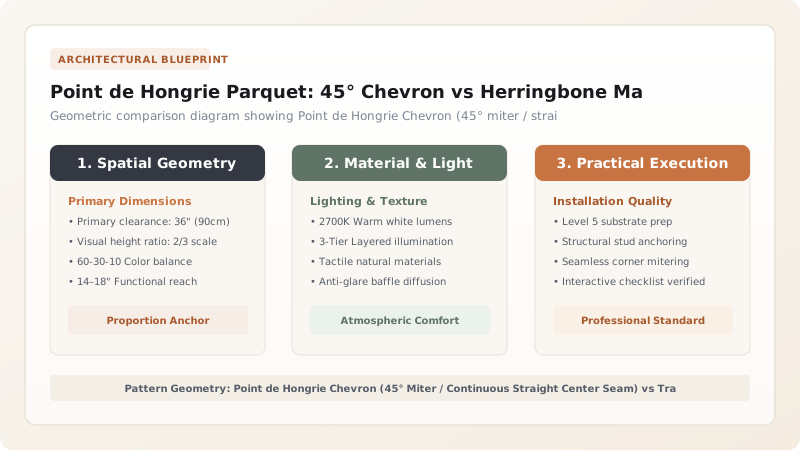
1. Parquet Trigonometry: Point de Hongrie vs Standard Herringbone
While many people use the terms interchangeably, Herringbone (*Bâton Rompu*) and Point de Hongrie (Chevron) are completely different patterns:
- Traditional Herringbone uses rectangular planks with square \(90^{\circ}\) ends that overlap in an alternating staggered step pattern.
- Point de Hongrie cuts both ends of every plank at an exact \(45^{\circ}\) or \(60^{\circ}\) angle. When assembled, the opposing planks meet in a single unbroken, razor-sharp straight line, creating an elegant arrow vector that visually elongates the room.

Point de Hongrie vs Traditional Herringbone Comparison
Use this reference table to calculate exact physical dimensions, ratios, and specifications before purchasing:
| Design Characteristic | Point de Hongrie (Chevron) | Traditional Herringbone | Visual Impression |
|---|---|---|---|
| Plank End Cut Angle | 45° or 60° Mitered Angles | 90° Square Butt Cut | Chevron creates continuous arrow lines |
| Center Joint Line | Continuous Straight Line | Broken Stepped Zig-Zag | Chevron feels more refined & formal |
| Left / Right Milling | Dedicated Left & Right Tongue/Grooves | Single universal plank profile | Chevron requires matched paired boxes |
| Installation Waste Factor | 15% - 18% Miter Scrap | 10% Standard Scrap | Chevron produces more triangular waste |
Subfloor Flatness Lippage Constraints
Every successful decoration project must account for physical and environmental constraints:
Uneven Subfloors Causing Triangular Miter Points to Pop Up (Lippage)
The sharp 45-degree triangular tips of chevron planks will rock and catch feet if the subfloor is wavy; mandate subfloor leveling to within 1/8-inch in 10 feet, and glue down with 100% elastic polyurethane wood adhesive (Bostik Best).
How to Install Point de Hongrie Chevron Flooring
Execute this professional sequence to achieve flawless results without backtracking:
Snap Center Reference Axis with Laser
Project laser line down the center of the room pointing toward primary window light.
Construct Temporary Wooden Starter Wedge
Fasten a 45° triangular plywood starter block along the center axis to guide the first chevron apex.
Trowel Polyurethane Adhesive
Spread elastomeric adhesive using a 1/4" V-notch trowel over a 20 sq ft working section.
Interlock Left and Right Planks
Set matched Left and Right planks, checking that center miter seams stay dead-true to the laser line.
Frame Perimeter with Solid Oak Border
Track-saw the ragged outer edges and frame with a 6-inch solid oak perimeter border (*frise*).
Common Mistakes & Countermeasures
Avoid these costly errors that compromise aesthetics, ergonomics, and budget:
Installing Chevron Arrows Running Perpendicular to Window Light
Project Execution Checklist
Track your physical progress. Checkboxes persist automatically on this device:
Frequently Asked Questions
What is the difference between 45-degree and 60-degree Point de Hongrie?
A 45-degree chevron creates wide, dynamic arrows (the most common French standard). A 60-degree chevron creates narrower, elongated arrows that are ideal for making long, narrow hallways feel wider.


