
Prevent flooding in sunken outdoor lounges by engineering a primary 4" smooth-wall PVC gravity drain line sloping at least 1/4" per foot to a downhill daylight outfall. Where flat terrain prohibits gravity drainage, install a sealed 24" diameter sump pit housing dual alternating 1/2-HP cast iron submersible pumps equipped with an AGM battery-backup inverter system capable of pumping 3,000+ GPH.
At a Glance: Key Takeaways
- 100-Year Storm Calculation: Sump capacity sized to handle peak rainfall rates (up to 4 inches per hour over the lounge catchment footprint).
- Smooth-Wall Schedule 40 PVC: Eliminates corrugated pipe ridges that trap organic leaf debris and cause subterranean clog blockages.
- Dual Alternating Submersible Pumps: Two 1/2-HP commercial pumps operating in lead-lag sequence to prevent mechanical pump burnout.
- Emergency Battery Backup Inverter: Keeps pumps running for up to 48 hours during severe storm electrical power grid failures.
- Hydrostatic Pressure Relief Valves: Spring-loaded floor valves preventing high water tables from floating or cracking the concrete floor slab.
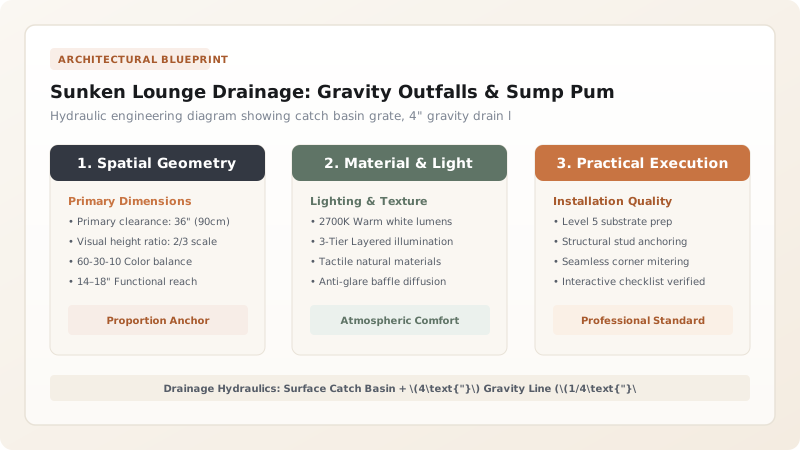
1. Hydraulic Physics: Rainfall Catchment Volumes & Gravity Slope Engineering
A 20-foot diameter circular sunken lounge has a horizontal catchment footprint of roughly 314 Square Feet. During a severe cloudburst dumping 3 inches of rain per hour, this pit collects Nearly 600 Gallons of Water Every Hour.
The most reliable engineering solution is Passive Gravity Drainage. A central heavy-duty cast bronze catch basin is connected to a 4-inch Smooth-Wall Schedule 40 PVC Pipe. The line must maintain a continuous minimum slope of 1/4-inch Per Foot (2% Grade), discharging to a downhill daylight outfall fitted with a rodent gate. Read about the overarching lounge architecture in our sunken fire lounge hub.

2. Mechanical Pumping: Dual Sump Basins & High-Water-Table Relief Valves
On perfectly flat properties where daylight discharge is impossible, mechanical pumping is the only option.
Contractors install a Heavy Structural Polyethylene Basin (24" diameter × 36" deep) embedded in clean No. 57 washed gravel. Inside sit Dual 1/2-HP Cast Iron Submersible Pumps controlled by an intelligent alternating controller. Each pump discharges through its own dedicated 2-inch line equipped with a Silent Spring-Loaded Check Valve. In areas with seasonally high groundwater, masons install Hydrostatic Relief Valves through the concrete floor, relieving upward soil water pressure before it can crack the slab. Explore coping details in cast concrete coping and clearances and review gas manifolds in gas manifolds and lava rock beds.
Sunken Lounge Drainage Systems Comparison
Use this reference table to calculate exact physical dimensions, ratios, and specifications before purchasing:
| Drainage Methodology | Power Dependency | Clogging Resistance | Maintenance Frequency | Reliability |
|---|---|---|---|---|
| 4" PVC Gravity Outfall to Daylight (Optimal) | Zero (100% passive physics) | High (Smooth interior wall resists debris) | Annual inspection only | Exceptional (Cannot fail during power outages) |
| Dual Sump Pump with Battery Backup | High (Requires electric inverter) | Very High (Gasketed basin screen) | Bi-annual pump/battery check | Very High (With battery redundancy) |
| Single Sump Pump without Backup (Danger) | Extreme (Fails instantly when grid drops) | Moderate | High | FAILS: Floods during first thunderstorm |
| Drywell / Infiltration Trench Alone | Zero | Poor (Saturates during heavy ground soak) | High (Silt silts up gravel pores) | Low (Backs up during prolonged rains) |
Frozen Outfall Pipe Ice Damming
Every successful decoration project must account for physical and environmental constraints:
Freezing Winter Rains Freezing the Exposed Daylight Pipe End Blocking Water Flow
In freezing climates, snow and ice accumulate over the daylight discharge grate, forming a solid ice dam that backs up water into the sunken lounge; always install self-regulating low-voltage de-icing heat cable inside the final 10 feet of the discharge pipe, terminating into an open bubbler pot fitted with a pop-up relief valve.
How to Install a Redundant Sump Pump System for a Sunken Lounge
Execute this professional sequence to achieve flawless results without backtracking:
Excavate Sump Basin Pit 48 Inches Below Floor Level
Dig pit outside the primary seating footprint; line with non-woven geotextile fabric and 6" of crushed washed rock.
Install 24" × 36" Perforated Heavy Poly Basin
Set basin plumb; backfill perimeter with clean 3/4" stone to allow surrounding groundwater to enter basin freely.
Plumb Dual 1/2-HP Cast Iron Pumps with Independent Check Valves
Assemble dual pumps with solid 2" schedule 40 PVC discharge pipes; install silent rubber check valves on both lines.
Mount Solid-State Electronic Float Switches
Position primary switch 12" from bottom; mount secondary high-water alarm switch 6" higher to activate second pump.
Install Marine AGM Battery Backup Inverter Cabinet
Mount 1,500W pure sine-wave inverter and two 100Ah AGM deep-cycle batteries in adjacent weatherproof bench cabinet.
Pour Monolithic Floor Slab Sloping 1/8" per Foot to Basin
Pitch concrete floor uniformly toward the brass collection drain, connecting drain pipe directly into the sump basin.
Test System by Flooding Basin with 50 Gallons of Water
Fill basin with garden hose; verify pump 1 engages smoothly; disconnect AC main power to test battery backup pump cycle.
Common Mistakes & Countermeasures
Avoid these costly errors that compromise aesthetics, ergonomics, and budget:
Using Perforated Corrugated Pipe for the Main Gravity Drain
Project Execution Checklist
Track your physical progress. Checkboxes persist automatically on this device:
Frequently Asked Questions
What happens if leaves blow into the sunken lounge drain grate?
A high-capacity cast bronze atrium grate (a raised domed grate) should be installed. Because the grate is dome-shaped, leaves settle around the bottom edge while water continues to flow through the top slots freely.


