
Regeneration zones function as soil-free hydroponic reed beds where water flows upward through 24 to 36 inches of stratified volcanic lava rock and clinoptilolite zeolite. Aquatic plants (Phragmites, Typha, Iris) develop extensive root rhizomes that pump oxygen into the gravel bed, supporting trillions of aerobic bacteria that strip nitrogen and lock up phosphorus.
At a Glance: Key Takeaways
- Soil-Free Hydroponic Bed: Plants are planted bare-root directly into washed gravel; soil or potting mix is strictly prohibited to prevent nutrient dumping.
- Three-Tier Gravel Stratigraphy: Graded layers from 2-inch basal drainage rock to 1/4-inch surface gravel provide immense biological surface area (>1,500 m²/m³).
- Rhizosphere Oxygenation: Wetland plant roots pump atmospheric oxygen down into the gravel matrix, creating alternating aerobic and anoxic micro-niches.
- High-Capacity Zeolite Interlayer: Natural clinoptilolite zeolite chemically adsorbs ammonium ions (\(NH_4^+\)), preventing early ammonia spikes.
- Sub-Surface Upflow Dynamics: Water enters from the bottom and percolates upward, preventing surface clogging and mosquito breeding.
1. Botanical Biochemistry: Root Rhizosphere Mechanics & Nutrient Stripping
Aquatic macrophytes planted in a natural swimming pond do not rely on soil for nourishment; they operate in a pure Hydroponic Wetland Environment. Their roots extend deep into the void spaces between washed gravel stones, absorbing dissolved chemical ions directly from the passing water stream.
The botanical secret of wetland plants (such as Phragmites australis, Typha latifolia, and Iris pseudacorus) is their internal Aerenchyma Tissue—hollow, sponge-like air channels that run continuously from the foliage down to the root tips:
The roots pump atmospheric oxygen outward into the surrounding gravel, creating an oxygen-rich Oxidized Rhizosphere Envelope. This allows aerobic nitrifying bacteria to thrive even deep inside submerged gravel beds. Inches away from the root tips, where oxygen is depleted, anaerobic bacteria perform denitrification, converting nitrates into harmless nitrogen gas (\(\text{N}_2\)) that vents into the atmosphere. Learn more about overall pond design in our natural swimming ponds hub.
2. Mineral Stratigraphy: Volcanic Basalt, Clinoptilolite Zeolite & Quartz
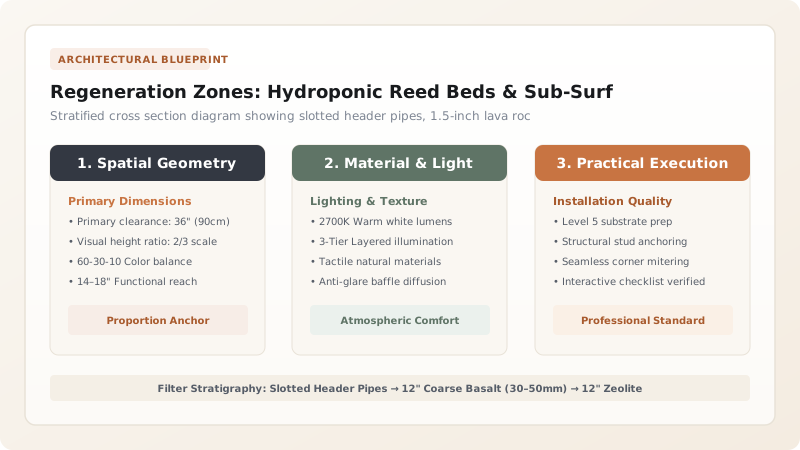
The mechanical core of the regeneration zone is a precision-engineered Three-Tier Mineral Filter Bed with an overall depth of 30 to 36 inches:
- Bottom Drainage Layer (12 Inches): Coarse washed basalt or granite ballast (\(30 \text{ to } 50 \text{ mm}\) / 1.5\"–2\"). Houses the slotted PVC distribution pipe manifolds and provides unrestricted hydraulic flow with zero friction clogging.
- Middle Bioactive Layer (12 Inches): High-purity Clinoptilolite Zeolite and Porous Volcanic Lava Rock (\(8 \text{ to } 16 \text{ mm}\)). Zeolite is a natural aluminosilicate mineral featuring a honeycomb lattice with a massive specific surface area (\(>25 \text{ m}^2/\text{g}\)). Its negative surface charge traps positively charged ammonium ions (\(\text{NH}_4^+\)) via cation exchange, preventing algae bloom triggers.
- Top Rooting Layer (6 Inches): Smooth, rounded washed quartz pea gravel (\(4 \text{ to } 8 \text{ mm}\)). Anchors plant rhizomes and provides a comfortable walking surface during seasonal pruning.
Explore aeration hardware in our guide on submerged aeration matrices and biofilms.
3. Plant Zonation: Deep Water, Emergent & Marginal Macrophytes
An effective regeneration zone utilizes three distinct botanical tiers matching water depths:
| Zone / Water Depth | Botanical Species | Primary Ecological Function |
|---|---|---|
| Deep Zone (24\" to 36\" depth) | Nymphaea alba (Water Lily), Ceratophyllum demersum | Surface shading to block solar heating; submerged oxygenation |
| Emergent Reed Zone (12\" to 24\" depth) | Phragmites australis, Typha angustifolia, Schoenoplectus lacustris | Heavy nitrogen and phosphorus consumption; deep root anchoring |
| Marginal Shelf (2\" to 12\" depth) | Iris pseudacorus, Caltha palustris, Mentha aquatica | Aesthetic flowering; root absorption of floating surface nutrients |
Discover liner and stone construction in our guide to EPDM liners and granite masonry.
4. Nutrient Harvesting: Autumn Pruning & Backwashing Protocols
A natural wetland filter locks nutrients inside plant tissues. If dead reeds are allowed to rot and decay in the water in winter, all the absorbed nitrogen and phosphorus dissolves right back into the pond, creating an algae nightmare the following spring.
In late autumn (after the first hard frost), the entire emergent reed bed is subjected to Nutrient Harvesting. Gardeners cut all reed stems back to 3 inches above the water level using specialized hedge trimmers and haul the biomass to an upland compost pile completely away from the pond. This physically removes pounds of locked phosphorus from the water cycle each year. Contrast with formal garden trellising in our guide to formal espalier architecture.
Regeneration Zones: Hydroponic Reed Beds & Sub-Surface Gravel Filters Architectural Decision Matrix
Use this reference table to calculate exact physical dimensions, ratios, and specifications before purchasing:
| Architectural Factor | Professional Recommendation | Significance |
|---|---|---|
| Bed Stratigraphy Depth | 30 to 36 inches (760mm to 915mm) total media | 12" Coarse Basalt + 12" Zeolite/Lava + 6" Quartz Pea Gravel |
| Plant Density | 6 to 8 bare-root plants per square yard (sq meter) | Rapid canopy closure suppresses water weeds within 60 days of planting |
| Plant Delivery Condition | 100% Bare-root or washed rhizomes (Zero soil) | Completely prevents commercial potting soil from leaching phosphates into pond |
| Gravel Chemical Purity | Acid-washed non-calcareous aggregate (pH neutral) | Effervescence test with 10% HCl confirms zero calcium carbonate content |
Execution Blueprint & Craftsmanship Sequence
Execute this professional sequence to achieve flawless results without backtracking:
Phase 1: Header Pipe Manifold Assembly
Lay 4" Schedule 40 slotted PVC header pipes across filter bed floor with cleanout risers (Benchmark: Pipes leveled ±1/8"; cleanouts extend 6" above finished water surface for flushing)
Phase 2: Coarse Drainage Stone Placement
Deposit 12" of washed 1.5"–2" basalt gravel over pipes using conveyor boom (Benchmark: Gravel placed gently without tearing underlying EPDM liner; pipes fully bedded)
Phase 3: Zeolite / Lava Rock Layering
Install 12" of graded 8–16mm clinoptilolite zeolite mixed 50/50 with crushed volcanic lava rock (Benchmark: Layer raked to uniform thickness; specific gravity verified > 2.1 to prevent floating)
Phase 4: Pea Gravel Topping & Water Fill
Spread 6" of rounded quartz pea gravel, fill bed with water, and run backwash pump to clear fines (Benchmark: Backwash effluent runs crystal clear with turbidity under 2.0 NTU)
Phase 5: Bare-Root Planting
Push bare-root Iris, Typha, and Phragmites rhizomes 4" deep into top pea gravel layer (Benchmark: Rhizomes firmly anchored against water currents; spaced on 12" triangular grid)
Common Mistakes & Countermeasures
Avoid these costly errors that compromise aesthetics, ergonomics, and budget:
Planting Aquatic Plants in Commercial Potting Soil Baskets
Using Unsorted Pit-Run Gravel with High Clay Content
Neglecting Late-Autumn Plant Biomass Harvesting
Omitting Pipe Manifold Cleanout Risers
Project Execution Checklist
Track your physical progress. Checkboxes persist automatically on this device:
Frequently Asked Questions
Can I walk on the gravel regeneration bed to prune plants?
Yes. The top 6-inch layer of rounded quartz pea gravel provides a firm, stable walking surface. However, stepping repeatedly directly onto plant crowns should be avoided. Many architectural designs incorporate floating timber stepping stone boardwalks or cantilevered hardwood docks over the reed bed.
Do wetland filter plants survive freezing winter temperatures?
Yes. Native temperate aquatic plants (such as *Phragmites*, *Typha*, *Iris pseudacorus*, and *Scirpus*) are extremely cold-hardy (Zones 3–9). Their roots survive under winter ice in the insulated gravel bed, re-sprouting vigorously each spring.
How often does the volcanic gravel filter need to be replaced?
A properly maintained upflow gravel bed with annual plant harvesting and periodic hydraulic backwashing never needs replacement. The biological biofilm continuously regenerates, and gravel stones last indefinitely.


