
Building permanent natural swimming ponds requires 45-mil (1.14mm) fish-grade EPDM geomembrane liners installed over an 8 oz/sq yd non-woven polypropylene cushion geotextile. Submerged granite entry steps and separation walls are constructed directly over the liner using double sacrificial rubber buffer pads and non-toxic hydraulic lime or Type S mortar, ensuring 50+ year watertight containment.
At a Glance: Key Takeaways
- 45-Mil Fish-Grade EPDM: Uncured ethylene propylene diene monomer rubber provides 300% elongation, accommodating soil settlement without puncture.
- 8 oz Non-Woven Geotextile: Needle-punched synthetic felt underlayment protects the rubber liner from sharp stones and root penetration.
- Double Sacrificial Cushion Pads: 1/4-inch thick recycled rubber pads placed under heavy granite blocks prevent point-load liner tearing.
- Non-Toxic Masonry Mortar: Low-alkali, non-leaching hydraulic lime or specialized underwater masonry cement prevents water pH spikes.
- Split-Face Granite Steps: Naturally textured granitic stone provides a slip-resistant, organic staircase for graceful bather entry into the swimming basin.
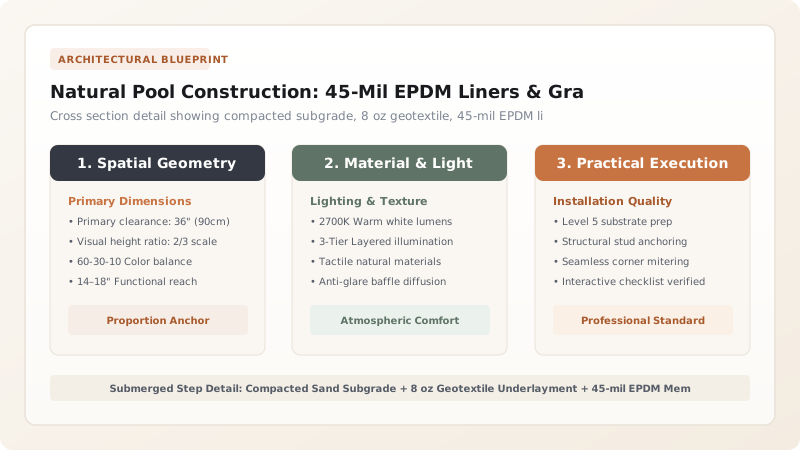
1. Polymer Mechanics: 45-Mil Fish-Grade EPDM vs PVC and HDPE
Selecting the containment membrane is the single most critical structural decision in natural pond construction. Standard commercial roofing EPDM contains toxic fire retardants and zinc biocide chemicals that will leach into the water, killing biological filter biofilms.
Specifications mandate Certified Fish-Grade 45-Mil (1.14mm) EPDM Geomembranes (e.g., Firestone PondGard or Carlisle GeoGard). EPDM outperforms PVC and rigid HDPE in every performance metric:
- Elongation at Break (ASTM D412): Exceeds \(300\%\). When surrounding clay soil heaves during winter frost cycles or settles under tons of water weight, the flexible EPDM rubber stretches without tearing.
- Sub-Zero Flexibility: Remains fully flexible down to \(-49^\circ\text{F}\) (\(-45^\circ\text{C}\)), eliminating the cold-weather brittle cracking that destroys rigid PVC liners.
- UV Resistance: Extremely stable against solar radiation; life expectancy in submerged architectural ponds exceeds 50 years.
Learn about biological filtration in our guide on hydroponic reed bed filtration.
2. Subgrade Geotechnics: Sand Beds & 8 oz Geotextiles
An EPDM liner is only as durable as the earth supporting it. A single sharp chert stone, broken tree root, or buried piece of shale can puncture an unbuffered membrane under the immense hydrostatic pressure of 8 feet of water (\(P \approx 500 \text{ psf}\)).
The excavated earth basin undergoes rigorous geotechnical prep:
- Raking & Sand Screeding: Soil is raked free of all rocks over 1/4-inch diameter, then covered with a 2-inch thick layer of compacted mason's sand.
- Heavy Geotextile Underlayment: A continuous layer of \(8 \text{ oz/sq yd}\) (\(270 \text{ g/m}^2\)) Non-Woven Needle-Punched Polypropylene Geotextile Fabric is rolled across the entire excavation. Geotextile provides extreme puncture resistance (ASTM D4833 puncture resistance \(>130 \text{ lbf}\)), distributing point loads safely across the subgrade.
Explore aeration design in our guide to submerged aeration matrices.
3. Submerged Masonry: Granite Entry Stairs & Sacrificial Buffers
Nothing defines the luxury aesthetic of a natural pool more than swimming down a grand staircase of Solid Split-Face Granite Blocks. However, a 400-pound granite step resting on a microscopic stone particle can pinch and puncture the underlying EPDM liner.
To ensure 100% puncture protection, masons install a Multi-Layer Cushioning Envelope beneath every masonry element:
- The primary 45-mil EPDM liner is installed over the 8 oz geotextile.
- Directly on top of the EPDM, a secondary Sacrificial Scrap Layer of 45-mil EPDM is laid.
- Above the sacrificial EPDM, a 1/4-inch High-Density Recycled Rubber Paver Pad is positioned to absorb point-load compressive stress.
- Granite riser blocks (typically 7\" rise × 14\" tread × 48\" width) are dry-stacked or bedded on low-alkali mortar directly over the rubber pads. The immense dead weight of the stone locks the staircase permanently into place without needing mechanical fasteners that would penetrate the liner.
Check out our natural swimming ponds hub.
4. Seaming Technology: EPDM QuickSeam Splices & Anchor Trenches
Large ponds require seaming multiple master rolls of EPDM. Standard contact glues or silicone sealants fail within seasons when submerged. Professional liner seams utilize EPDM Primer & Double-Sided Butyl QuickSeam Tape.
The rubber surfaces are scrubbed with QuickPrime Plus to strip factory talc and chemically activate the polymer bonds. A 3-inch wide double-sided extruded butyl adhesive tape is rolled between the overlapping sheets and consolidated using a heavy steel hand roller at \(100 \text{ psi}\). The butyl chemically vulcanizes the two sheets into an inseparable, waterproof molecular weld.
At the pond perimeter, the liner extends over the coping bank and is anchored in a 12\" × 12\" Anchor Trench backfilled with compacted crushed gravel, completely locking the membrane against tensile pullout. Contrast with stone retaining walls in our guide to sunken English walled gardens.
Natural Pool Construction: 45-Mil EPDM Liners & Granite Masonry Architectural Decision Matrix
Use this reference table to calculate exact physical dimensions, ratios, and specifications before purchasing:
| Architectural Factor | Professional Recommendation | Significance |
|---|---|---|
| Membrane Specification | 45-mil (1.14mm) Fish-Grade EPDM (Certified non-toxic) | Tensile strength > 1,300 psi; elongation > 300%; 50-year service life |
| Underlayment Cushion | 8 oz/sq yd Non-woven needle-punched polypropylene geotextile | ASTM D4833 puncture resistance > 130 lbf; distributes subgrade stress |
| Masonry Cushion Pad | Sacrificial EPDM layer + 1/4" recycled rubber pad | Absorbs point loads up to 2,000 psf beneath heavy granite steps |
| Seaming Method | QuickPrime Plus + 3" double-sided vulcanizing butyl tape | Shear strength > 50 lbs/in; certified for 100% continuous submersion |
Execution Blueprint & Craftsmanship Sequence
Execute this professional sequence to achieve flawless results without backtracking:
Phase 1: Excavation & Mason's Sand Bedding
Hand-rake excavated basin, eliminate sharp stones, and spread 2" compacted mason's sand on shelves (Benchmark: Subgrade uniform and free of sharp edges; verified by bare hand sweep)
Phase 2: 8 oz Geotextile Fabric Rolling
Roll 8 oz non-woven geotextile across basin, overlapping all seams by minimum 12 inches (Benchmark: Geotextile loose-laid without tension bridges; seams pinned with landscape staples)
Phase 3: EPDM Liner Unfolding & Accordion Pleating
Unfold 45-mil EPDM master sheet over geotextile, allow 2 hours in sun to relax, and pleat neatly (Benchmark: Liner relaxed and soft; zero bridging across step transitions; 24" excess at borders)
Phase 4: Sacrificial Cushioning & Granite Step Setting
Lay sacrificial EPDM and 1/4" rubber pads; set split-face granite stair blocks using crane hoist (Benchmark: Steps level within 1/16"; granite dead weight locks steps firmly with zero liner pinch)
Phase 5: Perimeter Anchor Trench Backfill
Fold liner into 12" deep trench behind coping, backfill with 3/4" crushed stone, and compact (Benchmark: Trench locked; liner resists 200 lb outward pull test without slippage)
Common Mistakes & Countermeasures
Avoid these costly errors that compromise aesthetics, ergonomics, and budget:
Using Roofing-Grade EPDM Liners
Placing Heavy Granite Directly on Unprotected Liner
Stretching the Liner Tight Across Internal Corners
Using Standard Polyurethane Caulks to Seam EPDM
Project Execution Checklist
Track your physical progress. Checkboxes persist automatically on this device:
Frequently Asked Questions
Can dogs or wildlife puncture a 45-mil EPDM pond liner with their claws?
Fish-grade 45-mil EPDM rubber is extraordinarily tough and elastomeric; dog claws and deer hooves will not puncture the smooth membrane. Furthermore, all entry zones and shallow shelves should be armored with submerged granite steps, river boulders, or flagstones, protecting the liner from direct claw contact.
How do you detect and patch an underground leak in an EPDM pond liner?
If water loss exceeds normal evaporation (approx. 1/4" per day), let the water level drop until it stops; the leak is located along that exact waterline perimeter. Inspect for punctures, clean the rubber with QuickPrime, and apply an EPDM self-adhesive patch rolled with a steel roller.
Will tree roots grow through an EPDM pond liner?
Tree roots cannot pierce non-punctured 45-mil EPDM rubber. However, roots can push against the liner from underneath. The heavy 8 oz non-woven geotextile fabric acts as a deflection shield, deflecting growing root tips away from the membrane.


