
Natural swimming ponds (NSPs) purify water without chemical chlorine or salt generators by establishing an engineered biological wetland filtration ecosystem. Designed with a 50/50 balance between the swimming zone and regeneration zone, water circulates through graded volcanic gravel beds planted with aquatic macrophytes (reeds, rushes, and sedges) where beneficial biofilms consume nutrients, starving algae.
At a Glance: Key Takeaways
- 50/50 Surface Area Ratio: Requires roughly equal surface area between the deep swimming basin and the shallow planted regeneration wetland.
- Sub-Surface Gravel Filtration: Water is pumped up through 24 to 36 inches of graded volcanic lava gravel, where nitrifying biofilms consume phosphorus.
- Nutrient Starvation Physics: By stripping orthophosphates below 0.010 mg/L, single-celled green algae cannot reproduce, maintaining gin-clear water.
- 45-Mil EPDM Geomembrane: Heavy-duty fish-grade rubber liner underlain by 8 oz non-woven geotextile provides 50+ year puncture-proof containment.
- Submerged Granitic Walls: Submerged dry-stacked granite or mortared stone walls separate swimmers from plants while allowing water to skim across.
In-Depth Guides in this Directory
Explore specialized subtopic blueprints, technical dimensions, and execution checklists:
Regeneration Zones: Hydroponic Reed Beds & Sub-Surface Gravel Filters
Engineer biological swimming pond filters: volcanic gravel stratigraphy, Phragmites and Typha nutrient uptake, and bottom-up sub-surface fluid mechanics.
Pond Aeration & Biofilms: Nitrosomonas & Nitrobacter Cycling
Design sub-surface pond aeration: micro-bubble ceramic diffusers, dissolved oxygen saturation (>8 mg/L), and complete ammonium-to-nitrate nitrification cycling.
Natural Pool Construction: 45-Mil EPDM Liners & Granite Masonry
Construct durable natural swimming pools: 45-mil fish-grade EPDM geomembranes, non-woven geotextiles, submerged dry-stacked granite stairs, and underwater walls.
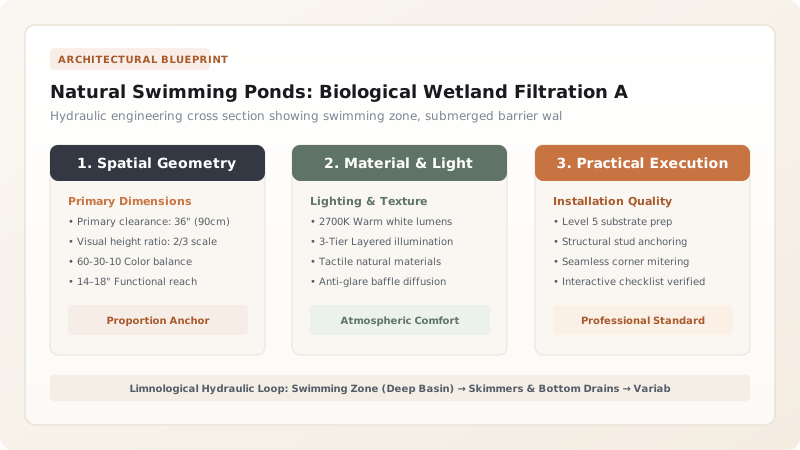
1. Limnological Ecology: Liebig's Law & Phosphorus Starvation
Traditional swimming pools kill all aquatic life using toxic chlorine, ozone, or copper ionization. In contrast, an Architectural Natural Swimming Pond (NSP) relies on natural limnological ecology governed by Liebig's Law of the Minimum.
Algae requires three primary nutrients to bloom: Carbon, Nitrogen, and Phosphorus. In freshwater ecosystems, Orthophosphate (\(\text{PO}_4^{3-}\)) is the limiting nutrient:
When dissolved phosphorus drops below 10 parts per billion, single-celled phytoplankton (green water algae) and filamentous string algae physically starve and die. In an engineered regeneration zone, specialized porous Volcanic Zeolite and Lava Gravels chemically bind free phosphates, while vast colonies of nitrifying bacteria and deep-rooted aquatic plants absorb remaining nutrients, locking them safely inside plant biomass. Learn about plant selection in our guide to hydroponic reed bed filtration.

2. Hydraulic Engineering: Flow Dynamics & Turnover Times
Water stagnation is fatal to a natural pond. To maintain uniform dissolved oxygen levels and deliver nutrients to the biological filter, water must circulate continuously.
The hydraulic system is engineered for a Total Water Volume Turnover of 4 to 6 Hours:
- Surface Skimmers: High-volume floating weir skimmers remove windblown pollen, leaves, and insect debris before they sink to the bottom and decompose into algae-feeding nutrients.
- Sub-Surface Upflow Distribution: Water drawn from skimmers and bottom drains passes through a low-energy external variable-speed pump, then enters perforated 4-inch Schedule 40 PVC header manifolds installed at the bottom of the gravel bed.
- Fluid Velocity: Water percolates vertically upward through the gravel at a gentle interstitial velocity of \(1.0 \text{ to } 2.5 \text{ FPM}\) (0.3 to 0.75 m/hr), giving biofilms ample contact time to strip ammonium and phosphates from the water stream.
Master aeration and biological cycling in our guide on submerged aeration matrices and biofilms.
3. Structural Architecture: Submerged Stone Walls & Swimming Basins
Swimmers should not brush against aquatic plants or step in gravel beds while swimming. The pool is divided into two distinct zones using a Submerged Retaining Wall.
The swimming zone is excavated to a deep 6 to 9 feet, enclosed by vertical walls constructed of Dry-Stacked Granite Blocks, Solid Concrete Masonry Units (CMU) Filled with Grout, or Cross-Laminated Timber (CLT). The top of the dividing wall sits exactly 2 to 4 inches below the finished water surface.
This allows surface water to flow seamlessly across the entire pond surface like an unbroken infinity mirror, while physically isolating swimmers from the shallow (18 to 24-inch deep) regeneration reed bed. Explore liner containment in our guide to EPDM liners and granite steps.
4. Thermal Physics: Sun Warming & Dissolved Oxygen Balance
A natural swimming pond warms up significantly faster than a conventional deep blue chemical pool. The shallow regeneration zone acts as a massive Solar Thermal Collector, absorbing sunlight across its shallow dark gravel beds and returning heated water to the swimming basin.
However, warmer water holds less dissolved oxygen. If bottom water drops below \(5.0 \text{ mg/L} \text{ DO}\), anaerobic bacteria take over, producing sulfurous rotten-egg odors and releasing bound phosphorus back into the water column. Bottom-mounted ceramic micro-bubble air diffusers run continuously, maintaining oxygen saturation above \(8.0 \text{ mg/L}\) from surface to floor. Contrast with formal garden design in our guide to Japanese dry landscape gardens.
Natural Swimming Ponds: Biological Wetland Filtration Architecture Architectural Decision Matrix
Use this reference table to calculate exact physical dimensions, ratios, and specifications before purchasing:
| Architectural Factor | Professional Recommendation | Significance |
|---|---|---|
| Regeneration Ratio | Minimum 40% to 50% of total pond surface area | Balances nutrient assimilation capacity against total swimmer bather load |
| Gravel Filter Media | Washed volcanic zeolite and rounded quartzite gravel | Specific surface area > 1,500 m²/m³; phosphate adsorption capacity > 500 mg/kg |
| Pond Liner Material | 45-mil (1.14mm) Fish-Grade EPDM Geomembrane | ASTM D6184 puncture resistance > 120 lbf; zero toxic plasticizer leaching |
| Hydraulic Turnover | Complete turnover every 4 to 6 hours | Low-pressure variable-speed magnetic pumps consuming < 350 Watts |
Execution Blueprint & Craftsmanship Sequence
Execute this professional sequence to achieve flawless results without backtracking:
Phase 1: Excavation & Geotechnical Grading
Excavate deep swimming basin and shallow regeneration shelves; grade stepped terraces with 2:1 slopes (Benchmark: Sub-grade compacted; sharp stones and tree roots raked and removed completely)
Phase 2: Geotextile & 45-Mil EPDM Liner Installation
Lay 8 oz/sq yd non-woven polypropylene cushion geotextile, then unroll single-sheet 45-mil EPDM membrane (Benchmark: Liner pleated neatly in corners; zero tension bridges over steps; anchored in perimeter trench)
Phase 3: Submerged Granite Separation Wall Construction
Build structural submerged wall on liner protection pads, leaving top 3" below water line (Benchmark: Wall verified level with laser transit; mortar cure 28 days with zero lime leaching)
Phase 4: Distribution Plumbing & Gravel Stratigraphy
Lay slotted Schedule 40 PVC manifolds; install 12" coarse gravel, 12" zeolite, and 6" fine gravel (Benchmark: All gravel triple-washed to eliminate silt; distribution tested with clean water flush)
Phase 5: Aquatic Planting & Biological Seeding
Plant bare-root reeds, rushes, and water lilies into gravel; inoculate with nitrifying bacteria culture (Benchmark: Pond filled with untreated well water; system cycled for 3 weeks prior to initial swimming)
Common Mistakes & Countermeasures
Avoid these costly errors that compromise aesthetics, ergonomics, and budget:
Adding Algicides or Chlorine Shock to a Natural Pond
Undersizing the Regeneration Zone (< 30% Area)
Using Unwashed Limestone Gravel
Stocking Fish (Koi or Goldfish) in a Swimming Pond
Project Execution Checklist
Track your physical progress. Checkboxes persist automatically on this device:
Frequently Asked Questions
Are natural swimming ponds safe from harmful bacteria like E. coli?
Yes. European water quality testing across thousands of public and private natural swimming pools shows that healthy biological regeneration zones cultivate vast populations of natural protozoa, rotifers, and Daphnia that naturally graze on and eliminate coliform bacteria, comfortably meeting EU Bathing Water Directive standards.
Do natural swimming ponds breed millions of mosquitoes?
No. Mosquitoes require stagnant, predator-free water to breed. Because natural swimming ponds circulate continuously and host beneficial aquatic predators (such as dragonflies, damselfly nymphs, water striders, and diving beetles), mosquito larvae are consumed within minutes of hatching.
What maintenance is required on a natural swimming pond?
Maintenance is seasonal: empty leaf skimmer baskets weekly, run an automated robotic suction pool cleaner across the swimming basin floor once a week to remove sediment dust, cut back dead aquatic plant foliage in late autumn, and backwash gravel beds annually.


