
Moroccan Gypsum Plaster Formulation and Gauffrage Layout represent the foundational chemistry and sacred geometry of geb plasterwork. Formulated from raw selenite and alabaster gypsum rock calcined in wood-fired artisanal kilns, the plaster is slaked with lime-infused water to extend open workability for up to 36 hours. Once troweled flat on the wall, master artisans execute gauffrage (stamping and scribing)—using heavy brass and iron compasses, straightedges, and perforated templates to transfer complex Euclidean geometric networks directly into the soft plaster.
At a Glance: Key Takeaways
- Artisanal Kiln Calcination: Wood-fired burning at 130°C-150°C preserving natural slow-setting dihydrate fractions.
- Lime-Water Retarder: Gauging plaster with slaked lime water to delay needle crystallization without loss of hardness.
- Gauffrage Scribing: Direct geometric drafting onto damp plaster using iron compasses (birkhar) and steel scoring blades.
- Zero Surface Crusting: Formulated to remain evenly pliable throughout its full 40mm thickness for 36 hours.
- Euclidean Star Tessellation: Scribing 8, 12, 16, and 24-point radiating nodal grids without measuring tapes.
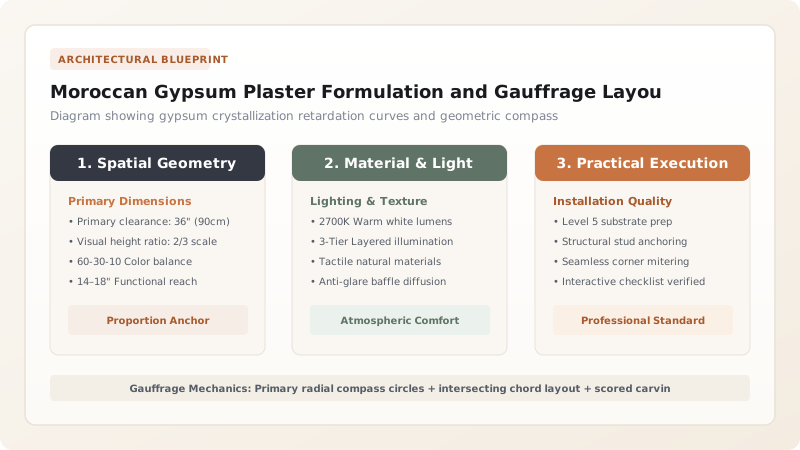
1. Sourcing Raw Gypsum and Traditional Kiln Calcination
The unique performance of Moroccan carving plaster begins at the quarry. In regions like Safi, Asilah, and the foothills of the High Atlas, artisans quarry high-purity natural gypsum rock (CaSO4·2H2O). Unlike modern industrial flash-calcining rotary kilns that operate at 180°C to produce fast-setting beta-hemihydrate, traditional Moroccan kilns are low-temperature, wood-fired stone ovens.
The gypsum rock is calcined gently at 120°C to 140°C for 24 hours. This gentle thermal transformation yields a heterogeneous mixture of hemihydrate and uncalcined dihydrate micro-seeds. This natural mineral variation slows crystal nucleation, providing the generous open working window vital for carving.
2. The Maalem's Mixing Secret: Lime Water and Organic Retarders
To achieve a 36-hour working window, the maalem blends the plaster with specialized mixing water. Pure fresh water would still set the gypsum in under an hour.
Instead, the gauging liquid is prepared with calcium hydroxide water (eau de chaux) drained from aged lime-slaking pits, occasionally supplemented with dilute marshmallow root mucilage or proteinaceous animal glue. The calcium ions and organic colloidal molecules adhere to the growing gypsum crystal tips, temporarily blocking new crystal growth. The mortar attains a silky, buttery texture that carves cleanly without tearing.
3. The Gauffrage Protocol: Iron Compass Geometry
Once the 40mm thick plaster bed has been screeded flat and leveled with an iron toothed float, the surface must be mapped before carving begins. This process is called gauffrage.
Working while the plaster has the firmness of hard cheese, the maalem uses a heavy, hand-forged iron compass called a birkhar. Starting from a central master point, the artisan scribes concentric circles, tangent arcs, and intersecting rays. Because Euclidean geometry relies on pure proportions rather than metric units, the entire complex star network unfolds with mathematical perfection across the damp wall.
Moroccan Gypsum Carving Mortar Mix Proportions
Use this reference table to calculate exact physical dimensions, ratios, and specifications before purchasing:
| Component / Material | Proportion by Weight (%) | Chemical / Physical Role | Impact on Carving Performance |
|---|---|---|---|
| Artisanal Rock Gypsum (Safi) | 72% - 76% | Primary calcium sulfate hemihydrate binder | Smooth chalk-white carveable body |
| Aged Pit-Lime Water (pH 12) | 20% - 24% | Gauging liquid & crystal growth retarder | Extends working time to 24-36 hours |
| Natural Bone / Hide Gelatin | 0.2% - 0.5% | Colloidal setting retarder & plasticizer | Prevents surface skin crusting |
| Washed Fine Silica Sand | 3% - 5% | Micro-aggregate stabilizing dimensional shrink | Eliminates shrinkage micro-fissuring |
Climate & Workshop Constraints
Every successful decoration project must account for physical and environmental constraints:
Hot Desert Winds (Chergui)
Dry desert winds can suck moisture out of the wall in hours, ruining the extended open time; work areas must be enclosed with damp tarps.
Water Quality Sensitivity
Mineral-heavy or saline well water accelerates gypsum setting uncontrollably; only pure potable water should be used.
Protocol for Gauging Gypsum Mortar and Scribing Gauffrage Patterns
Execute this professional sequence to achieve flawless results without backtracking:
Lime-Water Retarder Preparation
Decant clear, saturated calcium hydroxide water from aged lime pit; dissolve 0.3% hide glue powder in warm water and blend.
Batch Kneading in Wooden Troughs
Sift calcined rock gypsum into wooden trough; add retarder liquid; knead vigorously by hand for 8 minutes to eliminate air bubbles.
Wall Application & Toothed Floating
Trowel 40mm plaster bed onto dampened brick masonry; level with wooden float; comb surface with toothed scraper.
Surface Smoothing & Moisture Check
Smooth surface with polished steel float; allow plaster to firm until finger pressure leaves a shallow, non-sticky indentation.
Birkhar Compass Circle Scribing
Anchor iron compass center point; scribe concentric circles and radial division arcs deeply into plaster surface.
Chalk-Dust Highlight Transfer
Rub dry red ochre or charcoal powder across scored lines to make geometric guide incisions instantly visible for carving.
Common Mistakes & Countermeasures
Avoid these costly errors that compromise aesthetics, ergonomics, and budget:
Adding chemical citric acid retarder in excessive concentrations
Scribing gauffrage lines onto plaster that is still too wet and liquid
Project Execution Checklist
Track your physical progress. Checkboxes persist automatically on this device:
Frequently Asked Questions
How can you tell authentic hand-carved geb from modern cast plaster moldings?
Cast moldings have smooth, mechanical, repetitive surfaces with rounded mold-release corners. Hand-carved geb displays subtle microscopic chisel marks, sharp undercut draft angles, unique organic variations, and deep shadow channels that molds cannot replicate.
Can geb plaster be applied directly onto modern drywall or drywall plasterboard?
No. Modern drywall studs cannot support the heavy dead load of 40mm thick wet gypsum plaster (approx. 45 kg/m²), and paper-faced gypsum board will blister under the moisture; geb requires solid brick, terracotta block, or stone masonry backing.


