
Moroccan Geb Plaster Hand-Chisel Sculpting and Deep Relief Chamfering is the physical act of carving three-dimensional lace from solid stone-like plaster. Working directly on the vertical wall while the plaster remains damp and cheese-soft, master carvers (maalems) use specialized iron gouges and scrapers to hollow out negative voids down to depths of 25mm. By cutting reverse chamfers and undercut bevels along all decorative ribs, artisans create deep recesses of impenetrable black shadow, transforming flat architectural planes into dazzling, light-filtering lace diaphragms.
At a Glance: Key Takeaways
- In-Situ Subtractive Carving: Sculpting every relief facet directly on the wall with hand chisels.
- Deep Reverse Chamfering: Undercutting leaf edges at 35° to 45° angles to produce crisp, pitch-black shadow cavities.
- Negative Field Clearing: Scooping away background plaster down to 25mm depth to isolate delicate lace ribs.
- Specialized Iron Gouges: Hand-forged dweira, toko, and chisels sharpened continuously on oilstones.
- Micro-Piercing (Al-Kharq): Piercing entirely through raised plaster ribs to create openwork fretwork screens.
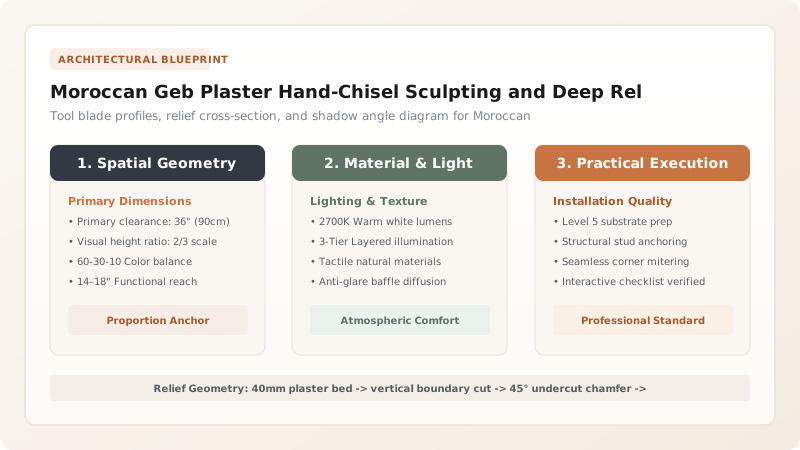
1. The Maalem's Tool Array: Forged Iron Gouges and Scrapers
Unlike Western woodcarving chisels, which are struck with wooden mallets, Moroccan geb tools are manipulated purely by direct two-handed muscle pressure. Because the damp plaster is soft like hard cheese, mallets would deliver uncontrolled shocks that fracture fragile gypsum bridges.
The carver's arsenal includes:
- El-Manqash: A sharp, double-edged iron knife used to slice vertical boundary incisions along scribed guidelines.
- El-Dweira: A curved, U-shaped hollow gouge used to scoop out rounded negative cavities in vegetal arabesques.
- El-Toko: A pointed triangular scraper with beveled cheeks used to cut sharp internal corners and reverse chamfers.
- El-Khadama: A flat chisel blade used to scrape background voids down to a uniform, velvety plane.
2. Shadow Engineering: The 45-Degree Reverse Chamfer
The visual magic of geb relies not on color, but on shadow manipulation (chiaroscuro). If a plaster rib is carved with vertical 90° sides, ambient daylight washes down the wall, illuminating the sides and making the pattern appear flat and indistinct.
The maalem solves this by cutting a reverse chamfer (undercut) at an angle of 35° to 45° behind the front face of each ribbon and leaf. Direct overhead light cannot penetrate this undercut cavity. The result is a crisp, pitch-black shadow outline that makes the snow-white plaster face leap forward in high relief.
3. Micro-Piercing (Al-Kharq) for Lace Screens
In window transoms, upper clerestories, and hanging muqarnas corbels, craftsmen employ the ultimate geb technique: al-kharq (pierced openwork).
Instead of merely clearing background pockets, the artisan drills and carves completely through the plaster layer, creating a perforated screen. When sunlight or lantern light shines through from behind, the carved gypsum glows with warm luminescence, projecting animated lace shadows across the tiled floors of the riad.
Geb Plaster Carving Depth & Relief Classification
Use this reference table to calculate exact physical dimensions, ratios, and specifications before purchasing:
| Relief Category | Carving Depth (mm) | Undercut Angle (°) | Typical Tool Used | Visual Shadow Effect |
|---|---|---|---|---|
| Bas-Relief (Khafīf) | 5mm - 8mm | 15° - 20° Soft Chamfer | Pointed knife (Manqash) | Subtle delicate texture in private alcoves |
| Haut-Relief (Ghalīz) | 15mm - 25mm | 35° - 45° Deep Undercut | Hollow gouge (Dweira) | Dramatic black-line shadow contrast |
| Monumental Cornice | 30mm - 45mm | 45° - 60° Reverse Bevel | Heavy flat scraper (Khadama) | Bold architectural articulation under eaves |
| Openwork Pierced (Kharq) | Full 40mm Thru-Cut | Perpendicular to wall | Twist auger & fretwork knife | Translucent light-filtering lace screen |
Physical & Technical Constraints
Every successful decoration project must account for physical and environmental constraints:
Severe Hand and Wrist Fatigue
Carving resistant plaster for 10 hours daily induces carpal tunnel strain; maalems alternate hands and tool grips.
Unrecoverable Over-Cuts
If an artisan slips and cuts through a delicate 3mm plaster rib, it cannot be glued back; the section must be hollowed and patched.
Protocol for Hand-Carving Deep Relief Moroccan Geb Plaster
Execute this professional sequence to achieve flawless results without backtracking:
Plaster Firmness Assessment
Check plaster set; when a knife blade enters smoothly without water bleeding or crumb tearing, begin primary cutting.
Primary Boundary Vertical Incising
Trace all gauffrage guidelines with double-edged manqash knife held at 90°, cutting 20mm deep into the plaster bed.
Negative Field Rough Scooping
Scoop out background plaster fields between decorative ribs using curved dweira gouge, establishing rough depth.
Depth-Gauge Leveling
Level the floor of all negative cavities using flat khadama scraper; check uniform 20mm depth with marked brass depth pin.
Undercut Chamfer Sculpting
Angle toko triangular scraper at 40° under decorative ribs; shave reverse bevel along all leaf and star contours.
Fine Foliate Veining & Cleanout
Score delicate micro-veins on leaf surfaces with fine V-gouge; whisk away all loose plaster crumbs with dry horsehair brush.
Common Mistakes & Countermeasures
Avoid these costly errors that compromise aesthetics, ergonomics, and budget:
Striking carving tools with a wooden mallet or hammer
Leaving loose plaster crumbs inside deep undercut cavities
Project Execution Checklist
Track your physical progress. Checkboxes persist automatically on this device:
Frequently Asked Questions
How do artisans repair a broken rib while carving geb plaster?
If a delicate rib snaps, the maalem hollows out the damaged area into a dovetailed pocket, wets the cavity with lime water, presses in fresh gypsum putty, lets it firm for 2 hours, and re-carves the missing detail seamlessly.
Does hand-carved geb plaster harden as it ages?
Yes. While cheese-soft during the first 24 to 48 hours of carving, the gypsum crystals continue to interlock and desiccate over the following 60 days, eventually attaining the permanent hardness and durability of soft limestone rock.


