
Radial octagram and star-polygon courtyard fountains are the pinnacle of Moorish hydraulic architecture and zellij craft. Centered on an 8-pointed star (khatam) constructed from two interlaced squares rotated by 45 degrees, the fountain expands radially through concentric mathematical orbits of geometric tile tesserae. Cladding complex lobed and scalloped curved masonry basins, these fountains integrate continuous underwater waterproofing, quiet central water bubblers, and acoustic splash soundscaping.
At a Glance: Key Takeaways
- The 8-Fold Khatam Star: Formed by the intersection of two congruent squares rotated by 45°, symbolizing the eight angels supporting the celestial throne in Islamic cosmology.
- Quasicrystalline Tessellation: Radial tiling that maintains translational and rotational order without spatial distortion across curved water basins.
- Waterproof Hydraulic Lime Lining: Multi-layered NHL 5 hydraulic lime and crushed pozzolana mortar rendering providing 100% watertight hydrostatic containment.
- Lobed & Scalloped Rim Geometry: Basins curved with 8, 12, or 16 semicircular lobes requiring curved, custom-molded zellij revetment panels.
- Acoustic Water Jet Mechanics: Low-pressure central bubbling nozzle generating gentle laminar ripples that enhance acoustic courtyard tranquility.
- Gravity Overflow Weirs: Perimeter concealed overflow slots maintaining a constant meniscus water level flush with the top tile border.
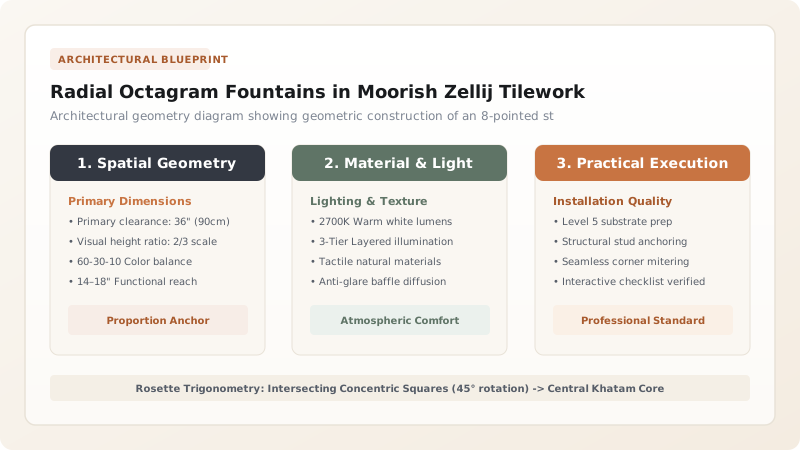
1. Sacred Geometry: The Trigonometry of the 8-Pointed Khatam
The geometric core of the Moorish courtyard fountain is the khatam—the 8-pointed star polygon generated by two mutually perpendicular squares rotated by \(45^\circ\). In Euclidean terms, the outer vertex angle of each star point is exactly \(45^\circ\), while the inner acute angle between adjacent star points is \(90^\circ\):
From this primary octave, the pattern expands outward into the taj (crown), sayf (saber), and mteqba (diamond) orbits. By maintaining exact proportional ratios based on the silver ratio (\(\delta_S = 1 + \sqrt{2} \approx 2.414\)), the pattern tiles the flat basin floor and expands continuously up the vertical and curved basin walls without geometric distortion.
2. Cladding the Curve: Prefabricating Scalloped Rim Segments
While basin floors are flat, fountain walls feature intricate scalloped or lobed profiles with compound curves. Installing thousands of microscopic tile pieces directly onto a vertical curved stone wall in wet mortar would cause tiles to slide and warp.
Artisans prefabricate curved zellij panels using concave and convex timber casting forms:
- The sand bed is shaped to match the radius of the fountain rim.
- Chiseled pieces are pressed face-down into the curved sand mold.
- A flexible fiberglass or stainless wire grid is placed over the backs, followed by a \(35\text{ mm}\) pour of hydraulic lime and pozzolana mortar.
- Once cured, the pre-curved segments are erected onto the masonry core like precision arch voussoirs. Read more on mortar casting in face-down jigsaw mosaic assembly and lime backing matrices.
3. Submerged Hydrodynamics: Water Circulation and Acoustic Soundscapes
Traditional Moorish fountains are designed for contemplative auditory ambiance rather than high-pressure theatrical water sprays. High jets create splashing that erodes terracotta glazes and creates disruptive wind drift.
Instead, a low-pressure central brass nozzle discharges water in a gentle bubbling boil (fawara). The water rolls over the glazed zellij rosette in smooth laminar sheets, creating a reflective mirror that amplifies the brilliant cobalt and copper hues below. Water overflows silently through concealed perimeter weir troughs beneath the outer tile coping, circulating through sand filtration before returning to the fountain basin.
Courtyard Fountain Design & Basin Comparison
Use this reference table to calculate exact physical dimensions, ratios, and specifications before purchasing:
| Fountain Configuration | Geometric Symmetry | Revetment Difficulty | Hydrostatic Water Head | Acoustic Splash Signature | Maintenance Intensity |
|---|---|---|---|---|---|
| Radial Octagram Khatam Basin | 8-Fold Rotational | Very High (Compound Curves) | 300mm to 450mm Depth | Gentle Ripple Lapping (35 dBA) | Moderate (Weekly Skim) |
| Hexagonal Decagram Basin | 6-Fold / 12-Fold | High (Planar Facets) | 400mm Depth | Crisp Corner Trickle (40 dBA) | Low-Moderate |
| Scalloped 16-Lobed Cupola Basin | 16-Fold Radial | Extreme (Multi-Radius Casting) | 250mm Depth (Shallow) | Soft Bubbling Murmur (30 dBA) | High (Algae Inspection) |
| Modern Minimalist Flush Basin | Square / Rectangular | Low (Standard Flat Panels) | 100mm Depth (Reflecting) | Silent Sheet Flow (25 dBA) | Very Low |
Practical Constraints
Every successful decoration project must account for physical and environmental constraints:
Continuous Hydrostatic Osmotic Pressure Delamination
Continuous water submersion creates hydrostatic osmotic pressure on the terracotta-glaze interface. If water penetrates behind the tiles through cracks in the basin mortar, osmotic vapor pressure can push the glaze layer off the terracotta. The basin concrete core must receive a crystalline waterproofing slurry and two coats of elastomeric hydraulic lime rendering before panel setting.
Algae Growth and Biofilm Remediation
Warm courtyard water exposed to direct sunlight fosters rapid green and black algae growth inside hairline zellij tile seams. Chlorine bleach or acidic algicides must never be used, as they chemically corrode lead-tin glazes and dissolve lime joints. Biofilm must be controlled using copper ionization systems and UV-C inline sterilizers.
Execution Blueprint & Craftsmanship Sequence
Execute this professional sequence to achieve flawless results without backtracking:
Structural Concrete Basin Casting & Waterproof Core
Pour a reinforced concrete fountain shell in the required 8-point star or lobed footprint. Apply two coats of crystalline waterproofing slurry (penetrating capillary seal) and allow a 14-day cure.
Curved Rim & Flat Basin Zellij Panel Prefabrication
Cast flat floor star rosettes and curved rim coping panels face-down in sand molds using NHL 3.5 lime and pozzolana mortar reinforced with 316 stainless steel wire mesh.
Panel Setting & Radial Alignment
Bed the pre-cast zellij panels onto the concrete basin using waterproof hydraulic lime thin-set mortar. Align the radial star axes with laser guide levels to maintain exact geometric continuity.
Hairline Joint Grouting & Crystalline Sealing
Grout hairline inter-panel seams with pure slaked lime paste blended with fine marble flour. Sponge clean immediately to prevent haze. Apply a breathable siloxane fluoropolymer impregnating sealer.
Plumbing Commissioning & Laminar Flow Tuning
Connect the central brass fawara nozzle to a variable-speed circulation pump equipped with UV-C disinfection. Adjust flow rate until water bubbles gently without breaking surface tension or splashing.
Common Mistakes & Countermeasures
Avoid these costly errors that compromise aesthetics, ergonomics, and budget:
Treating Fountain Water with Harsh Chlorine Bleach
Omitting Submerged Hydrostatic Expansion Joints
Project Execution Checklist
Track your physical progress. Checkboxes persist automatically on this device:
Frequently Asked Questions
Can a Moorish zellij fountain operate during winter freezes?
No. In climates with winter freezing temperatures, the fountain must be drained completely via bottom gravity valves, lines blown dry with compressed air, and the basin covered with an insulated protective dome to prevent frost heave.
What is the traditional glaze recipe for the brilliant cobalt blue in zellij fountains?
Traditional Fez cobalt blue (known as 'Zerwali Blue') is formulated by grinding mineral cobalt oxide with silica quartz sand and a lead-tin fritted flux, producing an intense, light-refracting sapphire hue that does not fade over centuries.


