
Biscotto chiseling with the menqash hammer is the foundational craft technique of Moorish zellij tile making. Operating without rotary saws, the artisan rests a twice-fired glazed terracotta tile on a rounded anvil stone and strikes scribed geometric lines using a heavy, double-beveled forged iron hammer (menqash). By striking at a precise 55° to 60° angle, the artisan fractures the porous terracotta core beneath the glaze, forming an undercut bevel that allows adjacent tiles to mate with zero surface grout joint.
At a Glance: Key Takeaways
- The Menqash Hammer: 1.2 kg to 1.8 kg hand-forged high-carbon steel hammer with twin wide axe-like cutting blades hardened to 52 HRC.
- The Anvil Stone (Al-Mkhaddah): A dense river basalt cobble or lead-capped timber stump providing rigid kinetic rebound without splintering tile backs.
- The 60° Undercut Angle: Removes terracotta from the bottom face so only razor-thin enamel lines make contact on the finished decorative plane.
- Fracture Line Propagation: Relies on tensile shear failure through soft porous Fez terracotta while the hard glaze cleaves cleanly without edge-chipping.
- Geometric Furmah Types: Craftsmen memorize over 360 unique shapes including mteqba, sayf (saber), janna (wing), and khatam (star points).
- Tool Dressing Routine: Artisans hone the menqash blade on oil-lubricated sandstone twice daily to maintain a crisp, non-chattering cutting arris.
1. Anatomy of the Menqash: Weight, Balance, and Edge Dynamics
The menqash (often transliterated as manqash) is a uniquely balanced traditional stonemason's hammer. Weighing between \(1.2\text{ and }1.8\text{ kg}\), it features a short wooden olive or ash handle (\(200\text{ to }250\text{ mm}\)) that places the craftsman's hand immediately behind the center of mass:
- Dual Cutting Faces: Both ends terminate in wide, sharp chisel edges (\(60\text{ to }80\text{ mm}\) wide), allowing the artisan to alternate between cutting straight segments and nipping acute star corners.
- Differential Hardening: The forged iron body is soft and ductile to absorb vibration, while the high-carbon cutting bits are fire-welded and quenched to \(50\text{ to }54\text{ HRC}\), holding an edge against abrasive quartz terracotta without becoming brittle enough to shatter.
2. Fracture Mechanics: Controlled Cleavage of the Biscotto Core
When cutting brittle materials, surface stresses dictate the crack path. If a tile is struck squarely at \(90^\circ\), tensile shockwaves propagate horizontally across the glaze, causing severe spalling and jagged 'scalloping' along the surface enamel.
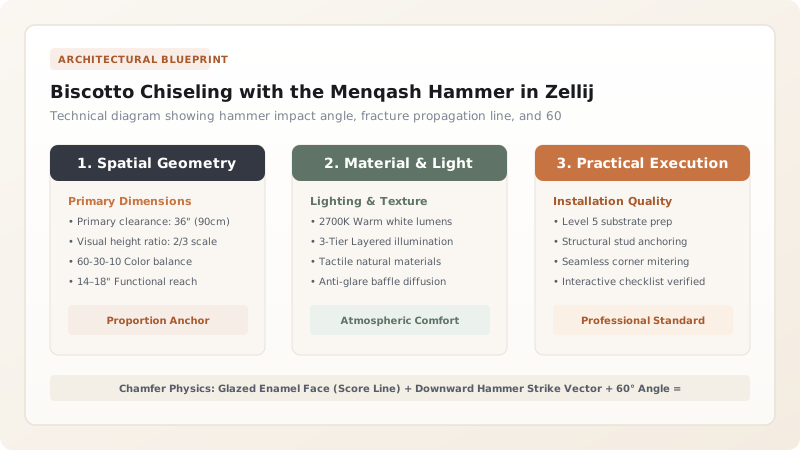
The zellij maalem avoids this by angling the menqash at \(60^\circ\) to the surface normal. The impact generates a concentrated shear plane that drives directly downward and inward into the softer terracotta body:
Because the glaze is under localized compression at the strike line, it severs with razor-blade sharpness, while the porous terracotta behind it breaks away in a smooth conical chamfer. Learn how these pieces fit together in face-down jigsaw mosaic assembly and lime backing matrices.
3. The Furmah Catalog: Standardized Chiseled Geometries
A single zellij courtyard may contain over 50,000 individual tiles cut into dozens of distinct shapes (furmah):
- Mteqba (Hexagon/Diamond Core): The foundational diamond-shaped spacer that separates star points.
- Sayf (The Saber/Blade): Elongated trapezoidal tesserae that form the expanding outer spokes of radial rosettes.
- Khatam (Star Centerpiece): The central 8-pointed star polygon cut from a single tile with 16 precise menqash blows.
A seasoned artisan chips between 800 and 1,200 finished pieces per workday with less than 5% scrap loss. Explore how these shapes generate radial star fountains in radial octagram and star polygon interlocking courtyard fountains.
Biscotto Tile Shaping Methodologies
Use this reference table to calculate exact physical dimensions, ratios, and specifications before purchasing:
| Cutting Method | Production Speed | Edge Chamfer Quality | Enamel Micro-Cracking | Visual Authenticity | Equipment Cost |
|---|---|---|---|---|---|
| Hand Menqash Hammer | 100–150 pcs/hour | Flawless 60° Bevel | Zero Micro-Cracks | Supreme Historic Character | Low (Hand Tools Only) |
| Diamond Wet Saw | 40–60 pcs/hour | Requires Manual Tilting | Edge Chipping & Water Stains | Rigid Machine Appearance | Medium-High |
| CNC Waterjet Cutting | 300+ pcs/hour | Vertical 90° Only (No Chamfer) | Glaze Delamination Risk | Clinical Modern Uniformity | Very High |
| Tile Nippers / Pliers | 30–50 pcs/hour | Rough Irregular Gouges | Severe Glaze Spalling | Crude Rustic Finish | Very Low |
Practical Constraints
Every successful decoration project must account for physical and environmental constraints:
Repetitive Strain and Artisan Ergonomics
Swinging a 1.5 kg iron hammer thousands of times daily from a squatting posture causes severe tendonitis and carpal tunnel syndrome if improper technique is used. Master artisans rest their striking forearm against the inner thigh, using wrist snap rather than full shoulder swings to generate kinetic velocity.
Airborne Quartz Dust & Silicosis Protection
Continuous dry chipping of quartz-rich terracotta generates respirable crystalline silica (RCS) dust. Workshops must provide cross-ventilation, misting dust suppressants, or HEPA exhaust hoods to protect artisans from chronic pulmonary silicosis.
Execution Blueprint & Craftsmanship Sequence
Execute this professional sequence to achieve flawless results without backtracking:
Biscotto Tile Selection & Thickness Grading
Sort twice-fired glazed tiles for flat surfaces and uniform 12mm thickness. Reject warped or severely concave tiles that rock on the anvil.
Zinc Template Scribing on Glazed Enamel
Hold a zinc or brass geometric template firmly against the glazed tile face. Scribe around the template with a carbide stylus, cutting a clean scratch line through the glaze layer.
Anvil Positioning & Wrist Alignment
Seat the scored tile on the rounded river rock anvil so the score line overhangs the rock edge by 2mm. Grip the menqash handle firmly with the striking blade angled at 60°.
The Decisive Cleaving Blow
Deliver a swift, sharp wrist strike along the scribed line. The scrap piece drops cleanly away, leaving a razor-sharp glazed arris and a smooth 60° undercut terracotta bevel.
Corner Nipping & Furmah Sorting
Use the secondary edge of the menqash to nip away acute corner burrs. Deposit finished pieces into wicker sorting baskets divided by color and geometric shape.
Common Mistakes & Countermeasures
Avoid these costly errors that compromise aesthetics, ergonomics, and budget:
Striking the Tile at a 90-Degree Right Angle
Attempting to Chisel High-Fired Modern Porcelain Tiles
Project Execution Checklist
Track your physical progress. Checkboxes persist automatically on this device:
Frequently Asked Questions
How long does it take for an apprentice to master the menqash hammer?
Traditional Moroccan guild apprentices spend two to three years solely learning to chip simple rectangular and triangular furmah shapes with uniform bevels before being allowed to cut complex star centers (khatam) and curved rosettes.
Can broken menqash hammer edges be resharpened on a bench grinder?
Yes, but grinding must be slow with frequent water quenching. Overheating the edge on a high-speed dry abrasive wheel anneals the high-carbon steel, destroying its hardness and causing the blade to mushroom rapidly.


