
Burnish Marmorino Venetian plaster by dressing a trapezoidal INOX surgical stainless steel trowel with 1000-grit wet sandpaper to bevel all razor edges. Apply plaster at a shallow 15-degree angle, level at 25 degrees, and burnish during the 'leather-hard' drying stage at a 30 to 45-degree angle using firm, sweeping arc strokes.
At a Glance: Key Takeaways
- Trapezoidal Rounded-Corner Trowel Geometry: Prevents sharp 90° corners from gouging grooves into wet plaster coats.
- INOX Surgical Stainless Steel (0.6mm Blade Thickness): Resists lime corrosion and provides optimal spring flexibility under pressure.
- 1000-Grit Wet Sandpaper Edge Dressing: Rounds micro-burrs from factory blades to eliminate black metallic friction scuffs.
- The 3-Phase Angle Progression: 15° Application \(\to\) 25° Compression \(\to\) 35°–45° Final Burnish Sheen.
- Leather-Hard Timing Window: Plaster must be firm to the touch (thumb leaves no indentation) but cool with residual moisture.
- Thermal Friction Sheen Generation: Heavy blade pressure aligns surface calcite crystals to reflect light specularly.
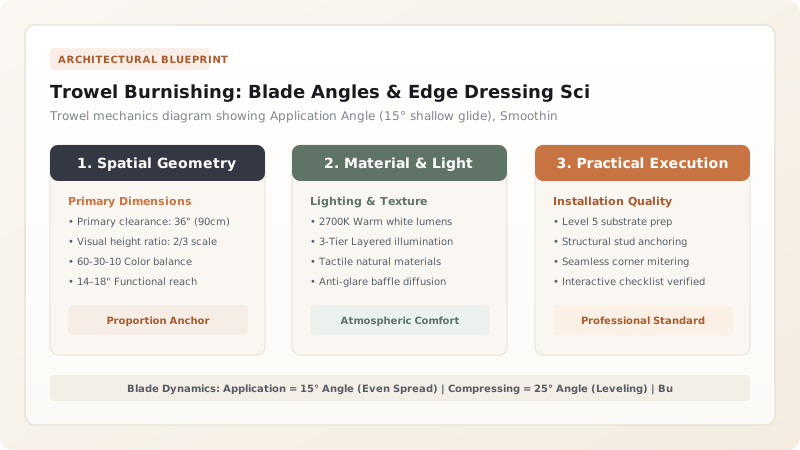
1. Tool Metallurgy: INOX Stainless Steel & Hand Edge Dressing
Brand-new factory trowels have sharp, square-stamped edges that gouge wet plaster and deposit black carbon scuffs. Master plasterers dress their blades before touching a wall.
Using 400-grit, 800-grit, then 1000-Grit Silicon Carbide Wet Sandpaper wrapped around a wood sanding block, bevel all four perimeter edges to a Smooth 45-Degree Chamfer with Softly Rounded Radius Corners. Learn material ratios in slaked lime putty aging.

2. Angular Mechanics: The 15°–25°–35° Rule & Leather-Hard Timing
Trowel angle controls whether you are depositing material or polishing it:
- 15° Application Angle: Spreads plaster in an even 1mm thickness without scraping.
- 25° Compression Angle: Levels high spots and drives aggregates tight.
- 35° to 45° Burnishing Angle: Swept across the wall with firm circular pressure during the leather-hard stage, generating frictional heat that aligns calcium carbonate crystals into a rich satin stone sheen. Review chemical curing in lime carbonation chemistry.
Trowel Blade Angles vs Plaster Surface Effect
Use this reference table to calculate exact physical dimensions, ratios, and specifications before purchasing:
| Blade Angle | Applied Force | Surface Action | Resulting Surface Finish |
|---|---|---|---|
| 15° Shallow Angle | Light (2–3 lbs) | Spreading & Depositing Paste | Uniform 1mm wet base layer |
| 25° Moderate Angle | Medium (5–8 lbs) | Compacting Marble Aggregates | Flat, closed mineral texture |
| 35° to 45° Steep Angle (Optimal) | Firm (15–20 lbs) | Frictional Crystal Burnishing | Smooth satin stone marble sheen |
| >60° Vertical Angle (Avoid) | Heavy scrape | Gouging / Scraping plaster off | FAILS: Ruins plaster surface |
Premature Wet Burnishing Water Blister Constraints
Every successful decoration project must account for physical and environmental constraints:
Burnishing Plaster While Too Wet Pulling Slaked Lime Cream to Surface Blistering
Applying heavy 35° blade pressure to soft wet plaster draws watery lime cream to the surface, creating milky blotches and blisters; wait until the wall reaches the 'leather-hard' stage where the surface is matte, non-sticky, and firm to the finger.
How to Dress a Venetian Trowel and Execute Burnishing Strokes
Execute this professional sequence to achieve flawless results without backtracking:
Bevel Factory Trowel Edges with 400-Grit Sandpaper
Rub blade edges at 45° angle along 400-grit wet sandpaper to remove stamped metal flash burrs.
Polish Edges with 800 and 1000-Grit Paper to Mirror Finish
Sand until edges feel glass-smooth to fingertips; round the four corner tips to 1/4" radius.
Apply Finish Coat at 15° Angle in Cross-Hatch Pattern
Spread ultra-thin skim coat using short arcing strokes, holding blade at shallow 15° angle.
Wait for Leather-Hard Stage (15–30 Minutes)
Monitor wall as wet gloss turns to dead-matte; test with clean dry knuckle (must not stick).
Wipe Trowel Blade Completely Clean and Dry
Wipe blade with damp microfiber cloth to remove all dried crust; dry thoroughly with towel.
Execute 35° Sweeping Burnish Passes Across Wall
Hold blade firmly at 35°–45° angle; sweep across plaster in continuous overlapping figure-8 arcs.
Common Mistakes & Countermeasures
Avoid these costly errors that compromise aesthetics, ergonomics, and budget:
Burnishing with a Dirty Trowel Blade Containing Dried Crust
Project Execution Checklist
Track your physical progress. Checkboxes persist automatically on this device:
Frequently Asked Questions
What is the difference between a Venetian plaster trowel and a drywall trowel?
Venetian plaster trowels feature trapezoidal blades (narrower top, wider base), rounded corners, precision beveled edges, and ultra-flexible 0.6mm mirror-polished INOX stainless steel, whereas drywall trowels have sharp 90-degree corners and stiff carbon steel blades.


