
Execute authentic Italian Marmorino plaster by mixing aged slaked lime putty (*grassello di calce*) with graded Carrara marble dust (0.3mm–0.8mm aggregate grain). Apply two to three coats using a rounded stainless steel Venetian trowel held at a 30-degree angle, compressing the mineral grain to achieve a tactile stone-like sheen through natural calcium carbonate curing.
At a Glance: Key Takeaways
- Classical Roman Formulation: 1 Part Aged Slaked Lime Putty (\(\text{Ca(OH)}_2\)) to 2–2.5 Parts Graded Carrara Marble Aggregates.
- Travertino Dragged Grain Texture: Stippling and horizontal blade dragging creates authentic porous volcanic travertine fissures.
- Natural High-pH Antimicrobial Defense: High alkaline pH (12–13) naturally prevents toxic black mold and mildew without biocides.
- True Breathable Vapor Permeability: Micro-porous limestone structure breathes water vapor, preventing peeling and trapped moisture.
- Trapezoidal Venetian Trowel Edge Dressing: Precision beveled rounded-corner blades eliminate dark metal burnish friction drag marks.
In-Depth Guides in this Directory
Explore specialized subtopic blueprints, technical dimensions, and execution checklists:
Lime Putty Aging: Grassello Science & Marble Dust Ratios
Master authentic Italian slaked lime putty chemistry: 24-month grassello di calce aging, micro-crystalline hexagonal platelet bonding, and Carrara marble dust grading ratios.
Trowel Burnishing: Blade Angles & Edge Dressing Science
Master Venetian plaster trowel mechanics: INOX stainless steel trapezoidal blades, 30° to 45° burnishing angles, 1000-grit wet sandpaper edge dressing, and eliminating metal scuff marks.
Lime Carbonation: Anti-Mold Alkalinity (pH 12) Chemistry
Master the chemical carbonation cycle of lime plaster: absorption of carbon dioxide (CO2), calcium carbonate stone petrification, high alkaline pH (12–13) mold immunity, and vapor permeability.
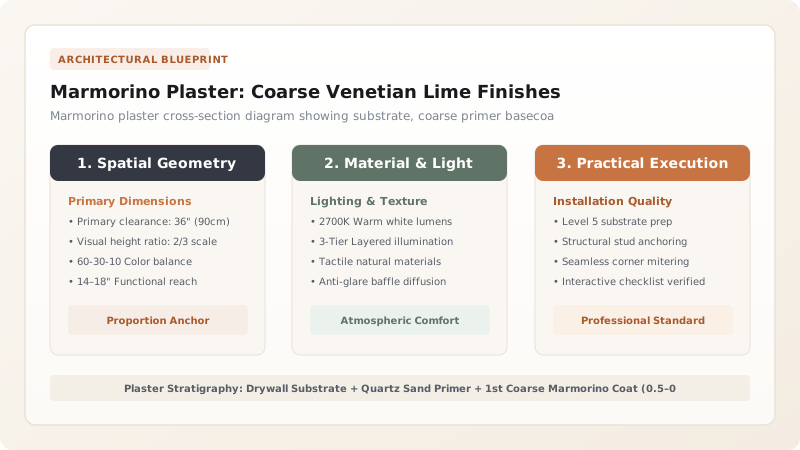
1. Mineral Science: Slaked Lime Putty & Carrara Marble Aggregates
Unlike synthetic acrylic 'faux' plasters that look like shiny plastic paint, authentic Marmorino and Travertino Plasters are pure mineral formulations originating in classical Rome and revived during the Venetian Renaissance by Andrea Palladio.
The binder is Non-Hydraulic Slaked Lime Putty (*Grassello di Calce*) aged for 24+ months, blended with Coarse Graded Carrara Marble Sands (0.3mm to 0.8mm grain size). Master mixing formulas in slaked lime putty aging and marble dust ratios and compare with Venetian plaster techniques.

2. Venetian Trowel Burnishing Angles & Chemical Carbonation
The distinctive satin-stone sheen of Marmorino is not achieved with topical varnishes, but through mechanical blade compression.
Master blade angles with Venetian trowel edge dressing and burnishing angles and explore the chemistry in lime carbonation and natural anti-mold alkalinity.
Marmorino vs Grassello vs Synthetic Acrylic Plaster
Use this reference table to calculate exact physical dimensions, ratios, and specifications before purchasing:
| Plaster Type | Binder Composition | Aggregate Grain Size | Breathability & Mold Resistance |
|---|---|---|---|
| Marmorino Coarse (Optimal) | Aged Slaked Lime (Grassello) | Coarse 0.3mm–0.8mm Marble Sand | 100% Breathable (pH 12–13 / Mold immune) |
| Grassello / Stucco Veneziano | Aged Slaked Lime Putty | Ultra-Fine 0.05mm Micro-Dust | 100% Breathable (Glass-smooth mirror sheen) |
| Travertino Heavy Grain | Hydrated Lime + Pozzolan | Coarse 0.8mm–1.2mm Quartz/Marble | High Breathability (Deep pitted stone) |
| Acrylic Synthetic Plaster (Avoid) | Petrochemical Acrylic Resin | Silica sand / Calcium carbonate | FAILS: Non-breathable plastic film / Traps moisture |
Black Metal Drag Friction Mark Constraints
Every successful decoration project must account for physical and environmental constraints:
Carbon Steel Trowel Blades Leaving Black Metallic Friction Scuffs on White Marmorino
Standard hardware store carbon steel trowels rub off microscopic metal shavings under heavy compression, leaving permanent black streaks; use strictly mirror-polished INOX surgical stainless steel Venetian trowels with factory-beveled rounded corners, dressed with 1000-grit wet sandpaper.
How to Apply and Burnish Authentic Italian Marmorino Plaster
Execute this professional sequence to achieve flawless results without backtracking:
Apply Coarse Quartz Sand Primer
Roll high-adhesion silica quartz primer over Level 4 drywall; let dry 12 hours to establish mechanical tooth.
Trowel First Basecoat of Coarse Marmorino
Using stainless Venetian trowel at 15° angle, apply uniform 1mm basecoat; let dry 24 hours.
Apply Second Intermediate Texture Coat
Trowel second coat across surface; create subtle pits or dragged stone texture with trowel edge.
Apply Third Tight Skim Coat While Damp (Wet-on-Wet)
While second coat is firm but damp (leather-hard), apply razor-thin finishing skim to fill low spots.
Burnish with Clean Stainless Trowel at 30° Angle
Hold clean blade at 30° angle; sweep across plaster with firm circular pressure to compress marble grain.
Apply Marseille Olive Oil Soap Sealer
Buff natural olive oil potassium soap or Carnauba wax into warm plaster with microfiber cloth for water repellency.
Common Mistakes & Countermeasures
Avoid these costly errors that compromise aesthetics, ergonomics, and budget:
Applying Plaster Over Smooth Un-Primed Drywall
Project Execution Checklist
Track your physical progress. Checkboxes persist automatically on this device:
Frequently Asked Questions
Can Marmorino Venetian plaster be used in bathrooms and shower areas?
Marmorino is excellent for bathroom walls because its natural high pH prevents mold. For wet shower stalls, specify waterproof Moroccan Tadelakt lime plaster sealed with olive oil black soap instead.


