
Lime plaster cures through carbonation, absorbing atmospheric carbon dioxide (\(\text{CO}_2\)) to chemically revert from calcium hydroxide back into solid calcium carbonate limestone (\(\text{Ca(OH)}_2 + \text{CO}_2 \to \text{CaCO}_3 + \text{H}_2\text{O}\)). During this process, the plaster maintains a natural pH of 12 to 13, creating an inhospitable environment where mold, mildew, and bacteria cannot survive.
At a Glance: Key Takeaways
- Chemical Carbonation Reversible Reaction: \(\text{Ca(OH)}_2 + \text{CO}_2 \to \text{CaCO}_3 + \text{H}_2\text{O}\) permanently petrifies the wall into stone.
- Natural High-pH Antimicrobial Shield (pH 12–13): Toxic black mold (*Stachybotrys*) requires pH 5–8; it is physically impossible for mold to grow on lime.
- Vapor-Permeable Breathability (SD-Value < 0.05m): Allows interior humidity to diffuse freely through wall assemblies without blistering.
- Carbon Dioxide Sequestration: Absorbs up to 50% of its own weight in atmospheric \(\text{CO}_2\) during the first 12 months of curing.
- Self-Healing Micro-Fissures: Rainwater dissolving soluble calcium ions re-crystallizes in micro-cracks, naturally healing small hairline fractures.
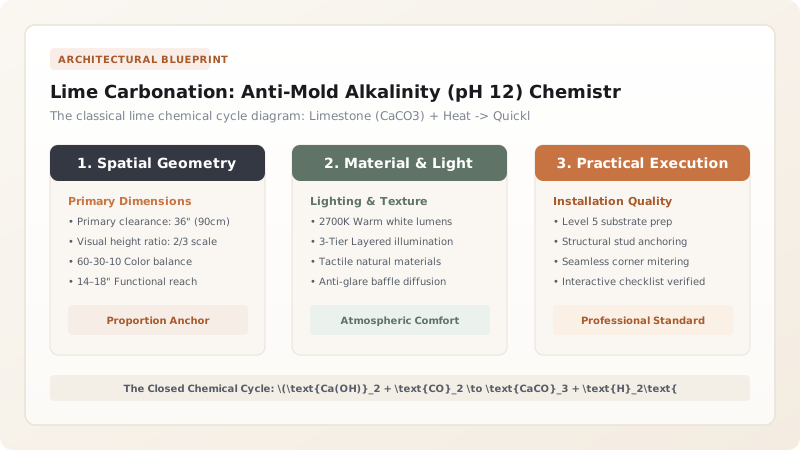
1. Chemical Physics: Carbonation Kinetics & Stone Petrification
Unlike modern gypsum plasters that cure by water crystallization or acrylic paints that dry by plastic film coalescence, authentic lime plaster cures by Chemical Carbonation.
As water slowly evaporates, Calcium Hydroxide (\(\text{Ca(OH)}_2\)) reacts with atmospheric Carbon Dioxide (\(\text{CO}_2\)) to form interlocking crystals of Pure Calcite Limestone (\(\text{CaCO}_3\)):
$$\text{Ca(OH)}_2 + \text{CO}_2 \to \text{CaCO}_3 + \text{H}_2\text{O}$$
The wall literally turns back into the limestone rock from which it was quarried. Explore putty formulation in slaked lime putty aging.

2. High Alkaline Antimicrobial Shield & Vapor Permeability
Black mold (*Stachybotrys chartarum*) requires an organic food source and a neutral pH of 5.5 to 7.5. Because cured lime retains a High Alkaline pH of 12.0 to 12.5 for decades, fungal spores cannot survive.
Furthermore, its Micro-Porous Open Structure allows water vapor to pass freely (Vapor Permeability \(\mu = 10\)), regulating room humidity. Review tool burnishing in trowel burnishing angles and explore Marmorino plaster hub.
Lime Plaster vs Gypsum Drywall vs Acrylic Paint
Use this reference table to calculate exact physical dimensions, ratios, and specifications before purchasing:
| Wall Finish Material | Curing Mechanism | Material pH Level | Mold & Mildew Resistance |
|---|---|---|---|
| Aged Lime Plaster / Marmorino (Optimal) | CO2 Carbonation (Turns to stone) | pH 12.0 to 13.0 (High alkaline) | 100% Bio-Static (Immune to mold) |
| Gypsum Drywall with Paper Facing | Hydration Crystallization | pH 6.5 to 7.0 (Neutral) | FAILS: Paper feeds black mold |
| Acrylic Latex Paint Film | Water Evaporation Polymer Film | pH 7.0 to 8.0 (Neutral) | Prone to mildew without chemical biocides |
| Cement Stucco Basecoat | Hydraulic Silicate Curing | pH 11.5 to 12.0 | High mold resistance / Low workability |
Rapid Forced Drying Carbonation Halt Constraints
Every successful decoration project must account for physical and environmental constraints:
Using High-Heat Forced Air Fans Halting Chemical Carbonation Creating Chalky Plaster
Carbonation requires moisture to dissolve CO2 gas into carbonic acid; if heaters or fans dry the plaster in under 4 hours, carbonation stops, leaving the plaster soft, dusty, and chalky; keep room at 60°F–75°F with 50% relative humidity, misting drying walls lightly with clean water if necessary.
How to Cure and Carbonate Lime Plaster for Maximum Hardness
Execute this professional sequence to achieve flawless results without backtracking:
Maintain Room Temperature Between 55°F and 75°F
Ensure space is enclosed and heated to minimum 55°F (13°C); avoid temperatures below 50°F or above 90°F.
Provide Moderate Air Circulation for CO2 Delivery
Allow gentle fresh airflow to supply fresh atmospheric CO2 gas required for calcium carbonate chemical bonding.
Avoid High-Velocity Fans or Direct Space Heaters
Never blow direct hot air on fresh lime plaster, which evaporates moisture before carbonation can occur.
Lightly Mist Wall with Water in Arid Climates
In hot/dry climates (RH < 30%), spray a fine mist of clean water over plaster 24 hours after application.
Allow 28 Days for 90% Carbonation Completion
Plaster reaches handling hardness in 48 hours but continues absorbing CO2 and hardening rock-solid over 28 days.
Verify High-pH Curing with Phenolphthalein Test
Touch drop of phenolphthalein solution to scrap sample; intense purple color confirms active alkaline pH.
Common Mistakes & Countermeasures
Avoid these costly errors that compromise aesthetics, ergonomics, and budget:
Sealing Fresh Lime Plaster with Non-Breathable Polyurethane Clear Coat
Project Execution Checklist
Track your physical progress. Checkboxes persist automatically on this device:
Frequently Asked Questions
How long does it take for Venetian lime plaster to fully cure?
Lime plaster dries to the touch in 24 hours and achieves 75% carbonation hardness within 28 days. However, lime continues to absorb microscopic amounts of atmospheric CO2 and harden progressively over several decades.


