
Select wall grazing when highlighting textured surfaces (split-face stone, brick, rough lime plaster) by placing linear LED reveals 2 to 4 inches from the wall with a narrow 15°–20° asymmetric beam. Select wall washing for flat drywall, murals, or art by placing channels 18 to 24 inches from the wall with wide 60° optics for uniform illumination.
At a Glance: Key Takeaways
- Wall Grazing (2"–4" Setback): Casts steep, acute-angle photon rays down the surface to sculpt dramatic high-contrast micro-shadows.
- Wall Washing (18"–24" Setback): Distributes wide, uniform illumination across smooth walls to minimize surface imperfections and display art.
- Asymmetric Extrusion Geometry: 15° tilted internal LED mounting channels direct 90% of luminous output toward the vertical surface.
- Deep Concealed Baffles (Glare Cutoff): 45° visual cutoff prevents direct diode glare when walking down the hallway.
- Lumen Output Density: Wall grazing requires 400–600 lm/ft (high punch), while wall washing requires 250–350 lm/ft (soft fill).
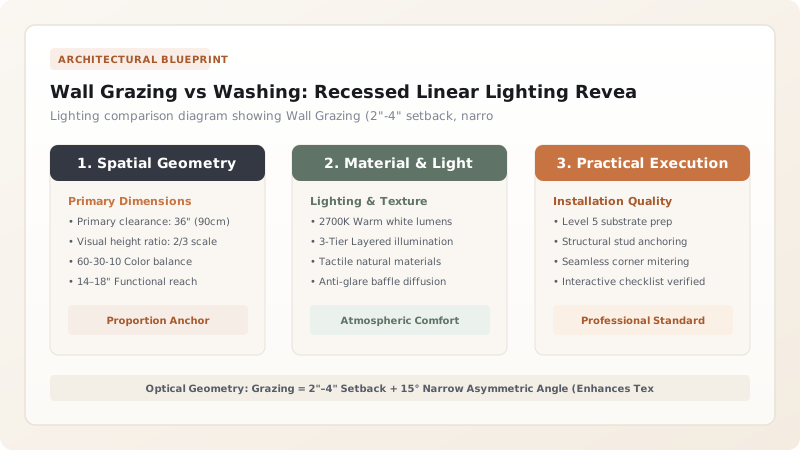
1. Optical Geometry: Setback Ratios & Asymmetric Beam Angles
The fundamental distinction between Wall Grazing and Wall Washing is the distance of the light source from the vertical plane and the optical angle of incidence.
Wall Grazing positions the light 2 to 4 inches (50–100mm) from the wall with a narrow 15° Asymmetric Lens. The steep angle skims across high points, casting micro-shadows behind every groove. Review taping techniques in mud-in flange taping and compare with under-cabinet millwork lighting.

2. Framing Architectural Pocket Reveals & Gypsum Knife-Edge Details
To keep the fixture invisible, architects frame a Knife-Edge Plaster Pocket at the perimeter ceiling.
The ceiling drywall extends within 3 inches of the wall, terminating in an aluminum J-bead with an integrated LED channel tilted 15° toward the wall. Pair with dotless diffusion lenses.
Wall Grazing vs Wall Washing Technical Comparison
Use this reference table to calculate exact physical dimensions, ratios, and specifications before purchasing:
| Design Parameter | Wall Grazing (Texture Emphasis) | Wall Washing (Uniform Flat Tone) | Architectural Intent |
|---|---|---|---|
| Setback Distance from Wall | 2 to 4 Inches (50–100mm) | 18 to 24 Inches (450–600mm) | Determines angle of photon incidence |
| Beam Spread Angle | Narrow 15° to 20° Asymmetric | Wide 60° to 90° Diffuse Wash | Controls shadow contrast depth |
| Best Surface Textures | Rough stone, brick, coarse plaster | Smooth drywall, art murals, wood veneer | Surface interaction physics |
| Drywall Tolerance Requirement | FAILS on standard drywall (Shows tape bumps) | Excellent (Hides drywall imperfections) | Drywall Level 5 requirement |
Raking Light Exposing Drywall Flaws Constraints
Every successful decoration project must account for physical and environmental constraints:
Wall Grazing Over Standard Drywall Highlighting Minor Taping Bumps and Dents
Acute grazing light magnifies microscopic 1/32" drywall imperfections into huge dark shadows; never graze standard Level 4 drywall; reserve grazing strictly for intentional masonry/wood textures or walls skimmed to absolute Level 5 perfection.
How to Frame and Install a Perimeter Ceiling Wall Grazing Slot
Execute this professional sequence to achieve flawless results without backtracking:
Frame Perimeter Ceiling Drop with 3" Wall Offset
Frame ceiling joists leaving a continuous 3-inch gap between drywall edge and textured accent wall.
Install Aluminum Asymmetric Grazing Channel
Fasten extruded aluminum mud-in channel with 15° angled LED mounting bed flush along drywall edge.
Tape and Plaster Knife-Edge Ceiling Reveal
Tape perforated flange with fiberglass mesh; skim compound to form razor-sharp knife edge.
Adhere High-Output 500 lm/ft LED Strip Tape
Install 24V 95+ CRI LED strip tape (5W–6W/ft) onto angled aluminum heat sink floor.
Snap In Asymmetric 15° Micro-Louver Diffuser
Install optical lens with internal micro-prisms directing light down and back toward wall surface.
Connect 0-10V Dimming Driver and Calibrate
Wire to dimmable electronic driver; tune dimming curve to eliminate flicker at low night levels.
Common Mistakes & Countermeasures
Avoid these costly errors that compromise aesthetics, ergonomics, and budget:
Mounting Wall Grazing Channels 12 Inches from the Wall
Project Execution Checklist
Track your physical progress. Checkboxes persist automatically on this device:
Frequently Asked Questions
Can wall grazing be installed vertically in wall corners?
Yes! Vertical plaster-in corner channels can graze horizontal wood slat walls, brick accents, or decorative metal mesh from floor to ceiling, creating dramatic corner-to-corner illumination.


