
Achieve 100% dotless, uniform linear LED lighting by ensuring the channel depth (D) equals or exceeds the LED diode pitch spacing (P), satisfying the formula \(D/P \ge 1.0\). Pair this with high-transmission satin opal polycarbonate lenses (70%–75% visible light transmission) or specify 24V Chip-on-Board (COB) continuous phosphor LED strips.
At a Glance: Key Takeaways
- The Dotless Geometric Criterion: Diode cones (120° beam angle) must overlap at least 30% before reaching the diffuser lens surface.
- Opal vs Frosted Polycarbonate: Opal lenses provide 100% lamp masking with 72% light transmission; frosted lenses reveal hotspots with 85% transmission.
- COB (Chip-on-Board) Continuous Phosphor: Eliminates discrete surface-mount diodes, producing a seamless yellow phosphor line that never shows dots.
- Polycarbonate vs PMMA Acrylic: Polycarbonate offers superior impact resistance and higher heat tolerance without warping.
- UV Inhibitor Chemistry: Prevents plastic lenses from turning yellow and brittle under continuous 4000K LED illumination.
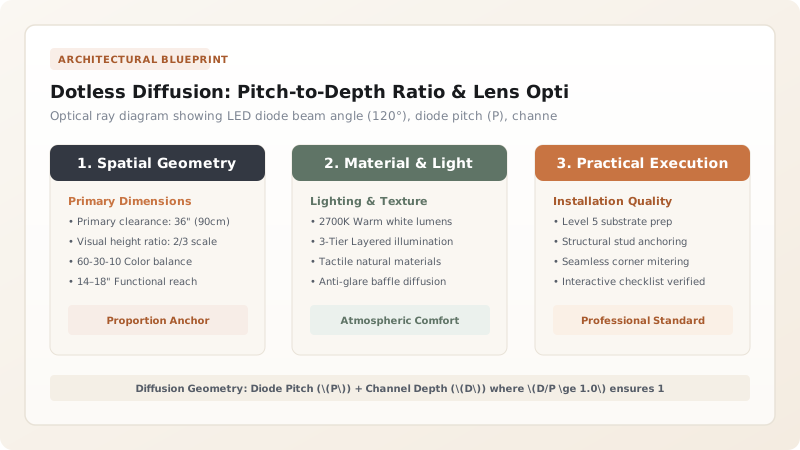
1. Optical Physics: Pitch-to-Depth Ratio (\(D/P \ge 1.0\)) Trigonometry
When looking at an illuminated linear LED channel, seeing individual bright dots (known in architectural lighting as diode pixilation) makes an expensive installation look cheap and amateurish.
For standard SMD 2835 LED strips with a 120° beam angle, true dotless diffusion is achieved when the Internal Channel Depth (\(D\)) is greater than or equal to the Diode Center-to-Center Pitch Distance (\(P\)):
$$\frac{D}{P} \ge 1.0$$
If a profile has an internal depth of \(10\text{mm}\), the diode pitch must be \(10\text{mm}\) or tighter (minimum 120 LEDs/meter). Learn plaster integration in plaster-in LED profiles.

2. Lens Chemistry: Satin Opal Polycarbonate vs Frosted Acrylic
The diffuser lens must scatter photons omnidirectionally while allowing maximum luminous flux to escape.
Satin Opal Polycarbonate incorporates microscopic titanium dioxide scattering particles that disperse light with 72%–75% optical transmission and zero hotspots. For dramatic wall effects, explore recessed wall grazing reveals.
Diffuser Lens Optical Characteristics Comparison
Use this reference table to calculate exact physical dimensions, ratios, and specifications before purchasing:
| Lens Material / Type | Visible Light Transmission | Diode Hotspot Masking | Heat & Impact Resistance |
|---|---|---|---|
| Satin Opal Polycarbonate (Optimal) | 72% to 75% Transmission | 100% Uniform (Zero dots) | High Impact / 240°F (115°C) Heat Limit |
| Frosted Polycarbonate | 82% to 85% Transmission | Partial Masking (Shows soft dots) | High Impact Resistance |
| Clear Transparent Lens | 92% to 95% Transmission | 0% Masking (Blinding bare diodes) | Direct glare / Utility only |
| Black Smoked Architectural Lens | 30% to 35% Transmission | 100% Masking (Dramatic dark look) | Low efficiency / High aesthetic contrast |
Diffuser Thermal Shrinkage Gap Constraints
Every successful decoration project must account for physical and environmental constraints:
Long 10ft Diffuser Polycarbonate Lenses Shrinking Leaving Light Leaks at Ends
Polycarbonate diffusers expand when heated by LEDs and shrink when cooled; cutting diffusers flush at room temperature causes 1/4" light gaps at corners in winter; cut continuous diffusers 1/8" longer than track, compress into channel, and lap joints with 45° scarf miters.
How to Select and Install Dotless LED Extrusion Lenses
Execute this professional sequence to achieve flawless results without backtracking:
Measure Channel Internal Depth (D)
Measure clearance from bottom of aluminum channel to bottom surface of lens seat with digital caliper.
Select LED Strip with Matching Pitch (P)
Specify 24V COB strip (continuous phosphor) or high-density SMD strip with pitch \(P \le D\).
Clean Channel with Isopropyl Alcohol
Wipe raw aluminum floor with 99% alcohol to ensure 3M VHB thermal adhesive tape bonds permanently.
Adhere LED Tape Flat Centered in Channel
Peel backing and press LED tape firmly down center of channel with rubber roller to ensure heat transfer.
Cut Opal Polycarbonate Lens to Length
Cut diffuser with fine-tooth 80-tooth circular saw blade or sharp anvil shears; leave 1/8" compression excess.
Snap Lens Into Channel Extrusion
Press lens into one corner until it clicks into retention groove; roll thumb along length to seat fully.
Common Mistakes & Countermeasures
Avoid these costly errors that compromise aesthetics, ergonomics, and budget:
Using 60-LED/Meter Strips in Shallow 10mm Channels
Project Execution Checklist
Track your physical progress. Checkboxes persist automatically on this device:
Frequently Asked Questions
What is the lumen loss when using an opal diffuser lens?
High-quality architectural opal polycarbonate lenses absorb approximately 25% to 28% of total raw LED lumens. To achieve a desired target output of 300 lumens/foot, specify an LED tape rated for 400 to 420 raw lumens/foot.


