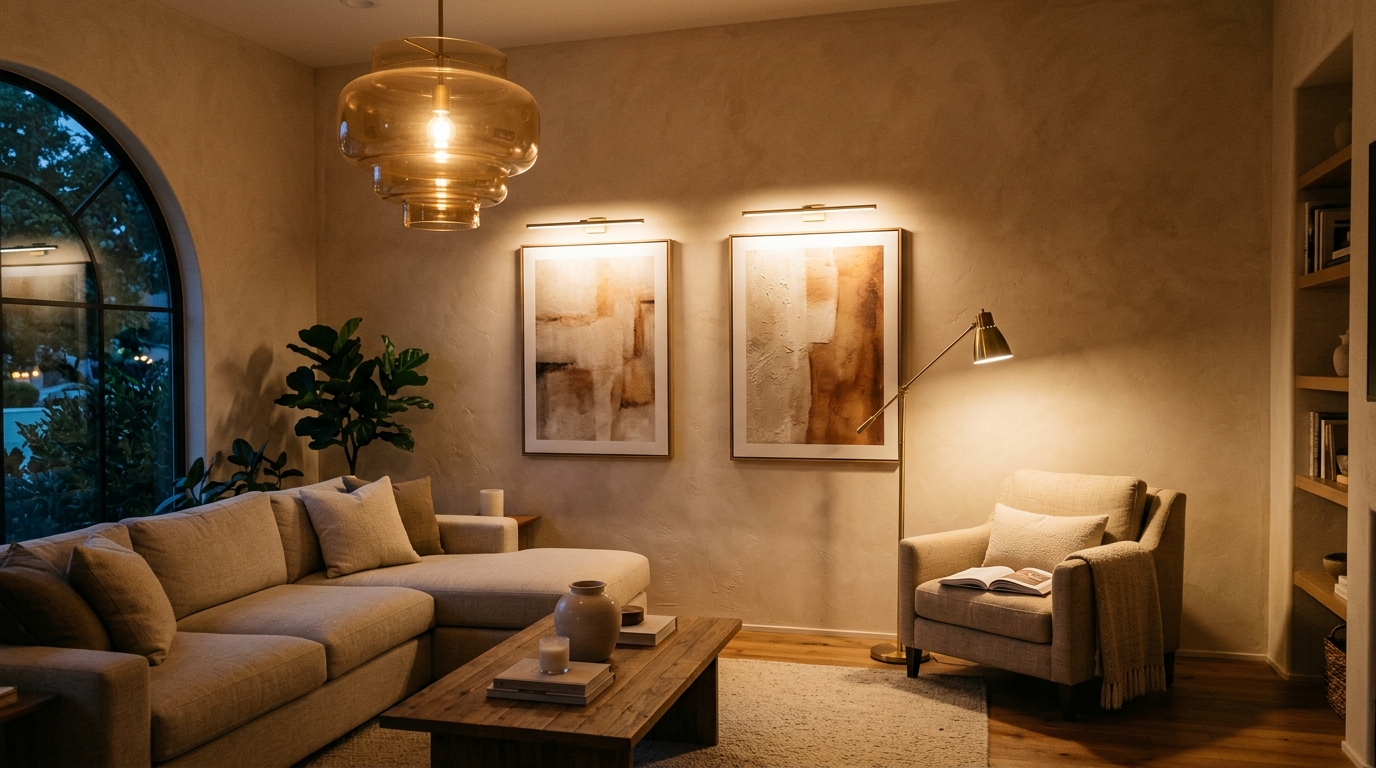
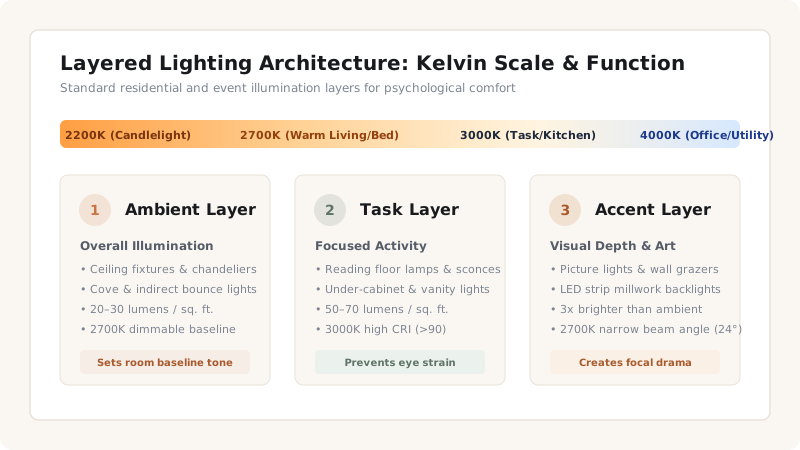
To design accent lighting effectively, position narrow-beam spotlights (24°–36°) aimed at a 30-degree angle toward focal artwork and architectural textures. Ensure accent illumination is 3 times brighter than background ambient light (a 3:1 contrast ratio) to create dramatic visual depth and emotional interest.
At a Glance: Key Takeaways
- Accent lighting should be calibrated to a 3:1 contrast ratio relative to ambient background light.
- Follow the 30-Degree Rule: ceiling spotlights angled at 30° eliminate frame shadows and glass reflection.
- Wall grazing places lights 6–12 inches from textured stone/brick to highlight dimensional relief.
- Conceal warm 2400K LED strips inside bookcase millwork to illuminate books and ceramics from behind.
1. The 3:1 Contrast Ratio & The 30-Degree Rule
Accent lighting is the third and most artistic layer of interior illumination. Its sole purpose is to draw the human eye to key focal points: oil paintings, sculptural ceramics, textured fireplace stone, and bespoke millwork.
The core rules of accent lighting:
- The 3:1 Contrast Ratio: To make an object feel special and highlighted, the light hitting it must be at least 3 times brighter than the surrounding ambient room light (e.g., 60 foot-candles on the painting vs 20 foot-candles in the room).
- The 30-Degree Art Angle: Mount ceiling directional gimbal fixtures at a 30-degree angle from vertical. An angle greater than 45° casts severe shadows beneath picture frames, while an angle less than 20° creates blinding light bounce directly into viewers' eyes.
- Wall Grazing vs Wall Washing: Wall grazing mounts lights 6–12 inches from textured stone to exaggerate shadows; wall washing mounts lights 24–36 inches away to smooth out flat drywall.
Accent Lighting Techniques & Applications
Use this reference table to calculate exact physical dimensions, ratios, and specifications before purchasing:
| Technique | Distance from Wall | Beam Angle | Best Application | Visual Effect |
|---|---|---|---|---|
| Picture Light (Mounted to Frame) | Attached 6–8" above art | Wide linear spread | Framed canvas / oil paintings | Intimate gallery focal point |
| Ceiling Directional Spot | 24–36" from wall (30° angle) | 24° Narrow beam | Large statement art & sculptures | Zero glare museum spotlight |
| Wall Grazing | 6–12" from textured wall | 15°–24° Tight beam | Stone, exposed brick, slat wood | Dramatic textural relief shadows |
| Millwork LED Backlight | Recessed in shelf rear rebate | 120° Diffuse strip | Bookcases & display shelving | Floating ethereal depth |
Accent Lighting Constraints
Every successful decoration project must account for physical and environmental constraints:
UV and Heat Damage to Fine Art
Halogen bulbs emit infrared heat and UV radiation that fades oil pigments and degrades canvas. Only use conservation-grade high-CRI LED fixtures that emit zero UV/IR.
Exposed Wiring on Picture Lights
Dangling picture light cords ruin clean wall aesthetics. Wire a discrete recessed outlet box behind the artwork or use rechargeable magnetic LED picture lights.
LED Hotspot Dots in Millwork
Reflected LED diodes in glossy cabinetry look unrefined. Always install LED tape inside aluminum extrusions with opal frosted diffusers.
How to Light Artwork with a Ceiling Spotlight
Execute this professional sequence to achieve flawless results without backtracking:
Hang Artwork at 57–60" Eye Level
Center the artwork so its vertical midpoint rests exactly 58 inches from the finished floor.
Calculate Ceiling Light Position (30° Angle)
For an 8-ft ceiling with artwork centered at 58", mount the ceiling spotlight 24–30 inches away from the wall.
Select 24-Degree Narrow Beam Bulb
Install a 2700K LED spot with a 24° beam angle to frame the canvas without spilling onto surrounding drywall.
Aim at the Center of the Art Piece
Rotate the gimbal so the hotspot lands on the focal center of the painting.
Adjust Dimmer for 3:1 Contrast
Calibrate dimmer so the artwork glows with 3x the intensity of surrounding ambient wall light.
Common Mistakes & Countermeasures
Avoid these costly errors that compromise aesthetics, ergonomics, and budget:
Placing Ceiling Spotlights Too Close to the Wall
Project Execution Checklist
Track your physical progress. Checkboxes persist automatically on this device:
Frequently Asked Questions
Are battery-operated picture lights worth buying?
Yes! Modern rechargeable wireless LED picture lights attach magnetically to wall brackets, offer 2700K high-CRI illumination with remote dimming and timers, and require zero hardwiring.
What color temperature is best for highlighting artwork?
2700K to 3000K warm white with a Color Rendering Index (CRI) of 95+ is the international museum standard for vibrant, authentic color reproduction.