
Mughal and Rajasthani jali screens function as sophisticated passive solar and thermodynamic regulators. By constricting air currents through small perforated stone channels, screens exploit the Venturi effect to accelerate airflow into palace courtyards, accelerating sweat evaporation and lowering occupant skin temperatures by 3°C to 5°C. Simultaneously, the three-dimensional stone thickness blocks direct solar radiation while creating dynamic, ever-changing penumbral shadow patterns that transform interior spaces into contemplative sanctuaries.
At a Glance: Key Takeaways
- Venturi Acceleration: Fluid constriction through pierced apertures accelerates dry air velocities across courtyard fountains.
- Thermal Mass Time Lag: Thick sandstone and marble slabs absorb daytime solar energy and release it slowly into night breezes.
- Daylight Glare Mitigation: Reduces 80,000 lux exterior solar glare to a soothing 300 to 500 lux diffuse interior daylighting.
- Penumbral Shadow Geometry: Point-source solar paths project crisp geometric shadow vectors across marble floors.
- Courtyard Microclimate Coupling: Jalis positioned on windward facades pulling cool air across shallow marble water channels.
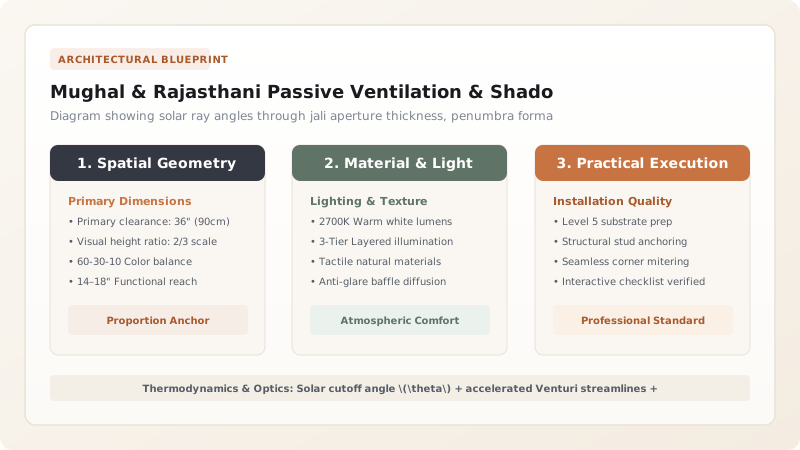
1. Fluid Mechanics: Venturi Compression & Evaporative Cooling
In the arid climates of Rajasthan and the northern plains of India, summer outdoor temperatures routinely reach 45°C. Mughal palace architects engineered jali screens to work in synergy with courtyards, water chutes (chadar), and shallow fountains.
As wind hits the exterior facade, a high-pressure zone builds. Passing through the narrow apertures of the jali (where porosity is typically calibrated between 28% and 42%), the air velocity increases significantly according to the Venturi principle:
When this accelerated dry breeze passes directly over indoor marble water channels, evaporation accelerates rapidly. The latent heat of vaporization cools the airstream, delivering cool, humidified air into the palace interior without any mechanical assistance.
2. Thermal Mass Time Lag & Diurnal Modulation
Unlike thin glass window panes that transmit radiant heat immediately into a building, stone possesses high volumetric heat capacity (\(C_v \approx 2.1 \times 10^6\text{ J/m}^3\cdot\text{K}\) for sandstone). A 40mm thick sandstone jali acts as a thermal flywheel.
During peak solar radiation (11:00 AM to 3:00 PM), the stone absorbs sensible heat, keeping the incoming air cooler than the outdoor peak. During cool desert nights, the stored heat radiates into the ambient atmosphere, maintaining comfortable nighttime interior temperatures.
3. Daylight Glare Attenuation & Penumbral Shadow Geometry
In sub-tropical India, unshaded direct daylight can reach 100,000 lux, causing debilitating visual glare and cataract development. The depth-to-width ratio of jali apertures acts as an array of microscopic louvers.
Direct solar rays at steep summer angles are completely intercepted by the top and bottom chamfers of the stone. The light admitted into the interior is 100% diffuse, reflected from the stone's matte carved surfaces, illuminating interiors to an ideal 300 to 500 lux.
Furthermore, because the sun is not an infinitesimal point source but an optical disk with a 0.53° angular diameter, light passing through the jali creates a delicate penumbra (half-shadow) that softens shadow edges, producing the poetic filigree atmosphere celebrated in Mughal poetry.
Jali Geometry vs Environmental Performance Metrics
Use this reference table to calculate exact physical dimensions, ratios, and specifications before purchasing:
| Aperture Dimensions (mm) | Screen Porosity (%) | Solar Heat Gain Coefficient | Airflow Velocity Multiplier |
|---|---|---|---|
| 15mm × 15mm (Fine Lattice) | 25% - 30% | 0.18 (Maximum Solar Shading) | 2.2x Acceleration |
| 25mm × 25mm (Standard Mughal) | 32% - 38% | 0.24 (Optimal Daylight & Breeze) | 1.6x Acceleration |
| 40mm × 40mm (Open Rajput) | 40% - 48% | 0.32 (High Airflow for Humid Monsoons) | 1.2x Acceleration |
| Vertical Splayed Apertures | 35% Directional | 0.20 (Directs Airflow to Floor Level) | 1.8x Ground Jet |
Acoustic & Environmental Constraints
Every successful decoration project must account for physical and environmental constraints:
Dust Ingress During Sandstorms
In arid desert environments (Thar Desert), high air velocities through apertures draw in fine airborne sand, requiring secondary sliding louvers.
Lack of Acoustic Insulation
Perforated screens cannot attenuate urban traffic noise without secondary interior double glazing.
Protocol for Sizing and Orienting Jali Screens in Modern Sustainable Buildings
Execute this professional sequence to achieve flawless results without backtracking:
Solar Heliodon & Azimuth Simulation
Calculate annual solar trajectory for building location; map sun angles to determine cutoff depths for jali apertures.
Computational Fluid Dynamics (CFD) Airflow Modeling
Simulate summer wind vectors to position jali screens on windward facades opposite thermal chimneys on leeward roofs.
Porosity & Glare Calibration
Set screen porosity to 30%–35% on south and west facades, expanding to 45% on north facades to optimize daylight factors.
Aperture Chamfer Optimization
Engineer 45° internal chamfers to redirect incoming airflow downward toward occupied living heights.
Water Feature Integration
Position shallow reflective water basins or evaporative misting stones within the immediate intake zone behind the screen.
Operable Acoustic & Thermal Glazing Offset
Install operable double-glazed secondary windows 150mm behind the stone screen to seal the envelope during winter cold snaps.
Common Mistakes & Countermeasures
Avoid these costly errors that compromise aesthetics, ergonomics, and budget:
Using laser-cut thin aluminum sheet metal (3mm) to simulate a traditional jali
Placing jalis on walls without a corresponding leeward exhaust opening
Project Execution Checklist
Track your physical progress. Checkboxes persist automatically on this device:
Frequently Asked Questions
How does a jali keep an interior cool even when the outdoor air is hot?
The stone itself cools down during the night. During the day, as hot outdoor air passes through the stone apertures, heat is absorbed by the cool thermal mass of the stone. When paired with indoor fountains, evaporative cooling extracts additional heat before the breeze reaches occupants.
Can jali designs be used in cold climates?
In temperate or cold climates, stone jalis are utilized as external solar shading screens mounted outside a primary insulated glass curtain wall, reducing summer air-conditioning loads while admitting low winter sun.


