
Geometric and Floral Pierced Stone Carving represents the pinnacle of subtractive lapidary engineering. Artisans construct complex multi-fold girih geometries (8-fold, 10-fold, 12-fold decagram star patterns) directly onto stone slabs using compasses and Euclidean drafting. Masons drill precision pilot holes through the center of every void, thread manual wire saws through the stone to fret away the waste core, and refine sinuous floral petals and chamfered aperture rims using specialized miniature chisels and water hones.
At a Glance: Key Takeaways
- Girih Geometric Drafting: Compass-and-straightedge polygon networks generating non-periodic quasicrystalline star patterns.
- Precision Pilot Drilling: Hand-powered bow drills and diamond drills boring through 35mm stone without rear blowout.
- Tensioned Wire Saw Fretting: Diamond-impregnated or steel wire saws cutting complex curved aperture profiles cleanly.
- Undercut Chisel Sculpting: Miniature cold chisels (cheni) sculpting multi-layered overlapping botanical tendrils.
- Water-Honed Finishing: Progressive wet-sanding with carborundum and water stones achieving silky, reflection-free stone surfaces.
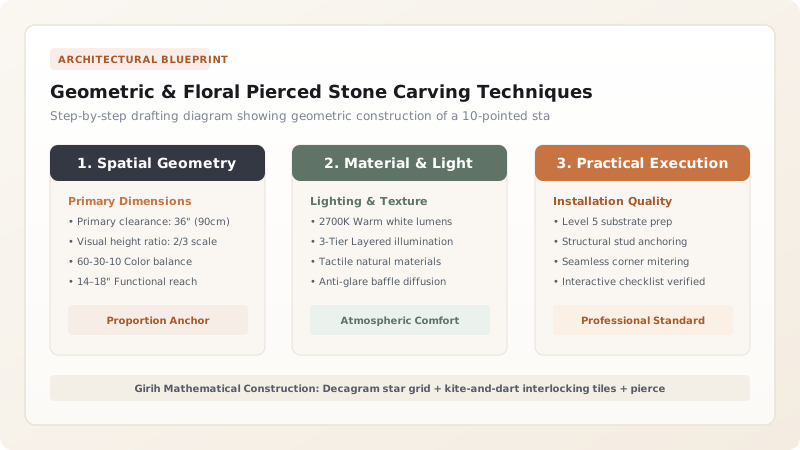
1. Girih Tile Mathematics & Non-Periodic Star Geometries
The mathematical foundation of geometric jali design is the Girih system (from the Persian girih, meaning knot). Master masons utilized a set of five geometric tiles—the regular decagon, elongated hexagon, bowtie, rhombus, and regular pentagon—to construct complex tessellations without calculation errors.
By subdividing these base tiles with strapwork lines intersecting at 72° and 144°, carvers generated 8-fold, 10-fold, and 12-fold star decagrams. In advanced Mughal screens (such as the cenotaph enclosure at the Taj Mahal), these patterns anticipate 20th-century Penrose quasicrystalline tiling, displaying self-similarity across varying scales.
2. The Piercing Workflow: Pilot Holes & Wire-Saw Fretting
Transforming a solid 40mm stone slab into a delicate lace screen requires a strict sequence of subtractive operations:
- Slab Flattening: The slab is honed flat and coated with a thin wash of lime or chalk to create a high-contrast drawing ground.
- Pilot Hole Boring: A bow-drill or slow-speed core drill cuts a 4mm to 6mm hole through the centroid of every void. Crucially, masons drill from both sides toward the center to prevent catastrophic spalling (blowout) when the bit exits the stone.
- Wire-Saw Threading: A hardened steel wire saw coated with abrasive water-slurry (or modern diamond wire) is fed through the pilot hole. Two artisans pull the wire back and forth, cutting precisely along the drafted strapwork contours.
3. Three-Dimensional Undercutting & Chamfer Sculpting
In high-status Mughal screens, apertures are not merely straight cylindrical holes; they feature two-way chamfered profiles that meet at a sharp knife-edge (arête) at the slab's center plane.
For floral screens (such as the tomb of Salim Chishti in Fatehpur Sikri), carvers introduce deep undercuts, sculpting overlapping leaves and twisted flower stems in full three dimensions. The carver uses an array of miniature steel chisels (cheni) struck by lightweight tamarind-wood mallets (thapi), removing fractions of a millimeter of stone with each tap.
Stone Carving Tooling & Processing Specifications
Use this reference table to calculate exact physical dimensions, ratios, and specifications before purchasing:
| Process Stage | Traditional Tool | Modern Conservation Equivalent | Feed / Cutting Rate |
|---|---|---|---|
| Surface Leveling | Heavy flat chisel + Iron hammer | Rotary planetary diamond planer | 0.5 m²/hr |
| Aperture Pilot Boring | Bow drill (Kamani) + Emery paste | Diamond core drill with water flush | 15 holes/hr (40mm deep) |
| Openwork Fretting | Tensioned steel bow wire saw | Pneumatic diamond reciprocating saw | 50mm linear cut/min |
| Profile Undercutting | Pointed mini-chisels (Cheni) | Micro-pneumatic carving pens (1.5 bar) | Artisanal manual sculpting |
| Final Edge Polishing | Water reed + Pumice powder | Diamond flexible sanding pads (400–1200 grit) | Smooth satin finish |
Craft & Material Constraints
Every successful decoration project must account for physical and environmental constraints:
Extreme Slab Fragility
Monolithic marble slabs (2m x 1m x 35mm) must be handled on padded vacuum tilt-tables; a single flex will snap the stone.
Hand Tooling Time
A single high-grade 1m² pierced floral marble jali requires between 200 and 350 hours of master craftsman labor.
Protocol for Replicating a Broken Geometric Jali Screen
Execute this professional sequence to achieve flawless results without backtracking:
Photogrammetric Pattern Mapping
Capture 2D ortho-rectified photographic survey of original screen; digitize underlying geometric vector linework.
Stone Slab Density & Flaw Audit
Inspect new Makrana marble or Sikri sandstone slab using ultrasonic pulse velocity to verify absence of internal shear cracks.
Strapwork Offset Layout
Transfer digital vectors onto stone face using plotting film; scribe lines into stone using hardened carbide scriber.
Dual-Sided Pilot Boring
Bore pilot holes from front and back meeting at center plane, keeping drill perpendicular to slab face within 0.5°.
Perimeter Waste Removal
Saw out internal apertures; maintain 6mm minimum web thickness along all structural strapwork bridges.
Knife-Edge Chamfer Dressing
Chisel 45° chamfers from both faces inward; hone aperture walls with fine abrasive water stones to remove saw chatter marks.
Common Mistakes & Countermeasures
Avoid these costly errors that compromise aesthetics, ergonomics, and budget:
Drilling pilot holes entirely from one side of the stone slab
Carving intricate undercuts before roughing out all primary apertures
Project Execution Checklist
Track your physical progress. Checkboxes persist automatically on this device:
Frequently Asked Questions
How did Mughal masons carve jalis without modern power tools?
They utilized foot-powered bow drills, steel wire saws fed with wet river abrasive slurry (quartz sand and crushed emery), and hardened forged-steel chisels quenched in cold oil to maintain razor edges on abrasive sandstone and marble.
Can broken ribs on historic jali screens be repaired?
Yes. Conservators use invisible internal titanium or carbon-fiber micro-dowels (1.5mm diameter) bonded with conservation-grade, UV-stable epoxy resins (such as Araldite 2020) and surface-toned with matching stone dust.


