
Preserving historic Indian jalis carved from Makrana marble and Sikri sandstone requires specialized diagnostic and chemical interventions. Exposure to industrial atmospheric pollutants (sulfur dioxide and nitrogen oxides) reacts with calcium carbonate in marble to form brittle black gypsum crusts and yellow discoloration. In sandstone, moisture cycling causes iron mineral leaching and contour scaling. Conservation combines non-destructive multani mitti (Fuller's earth) poulticing, micro-pinning of fractured ribs with titanium dowels, and lime-pozzolan grouting.
At a Glance: Key Takeaways
- Sulfation of Calcite Marble: Atmospheric SO₂ converts calcium carbonate into gypsum (CaSO₄·2H₂O), expanding by 124% and spalling stone.
- Yellowing & Particulate Deposition: Carbonaceous soot and unburned hydrocarbons embedding in porous marble grain boundaries.
- Traditional Multani Mitti Poultices: Magnesium aluminum silicate clay absorbing oil, grease, and surface dirt without chemical etching.
- Titanium Micro-Pinning: 1.5mm–3mm titanium or carbon fiber rods repairing fractured filigree ribs invisibly.
- Salt Desalination: Cellulose pulp compresses extracting damaging nitrate and sulfate salts from sandstone frames.
1. Sulfation Pathology & Gypsum Crust Formation
Historic monuments across northern India (most notably the Taj Mahal and Agra Fort) have experienced severe environmental degradation from industrial emissions. Sulfur dioxide (\(\text{SO}_2\)) dissolved in rainwater forms sulfurous and sulfuric acids:
This reaction transforms pristine calcite marble into gypsum (calcium sulfate dihydrate). Because gypsum has a lower density and occupies 124% more volume than calcite, crystallization within grain boundaries creates micro-fissures, flaking, and black crust accumulation that encapsulates dirt and airborne soot.
2. Traditional Multani Mitti (Fuller's Earth) Poulticing
To safely decontaminate historic marble without etching the delicate polished surface, the Archaeological Survey of India (ASI) utilizes traditional Multani Mitti (Fuller's earth) poulticing.
Multani mitti is a natural smectite clay composed primarily of montmorillonite / magnesium aluminum phyllosilicates. Mixed with deionized water into a smooth paste (approx. 3mm to 5mm thick), the clay is spread across the intricate jali surfaces and covered with plastic wrap. As the clay dries slowly over 24 to 48 hours, its massive specific surface area (up to 120 m²/g) generates immense capillary suction, drawing out hydrocarbons, soot, atmospheric grease, and soluble salts from deep within marble pores without scratching the stone.
3. Structural Micro-Pinning of Fractured Filigree Ribs
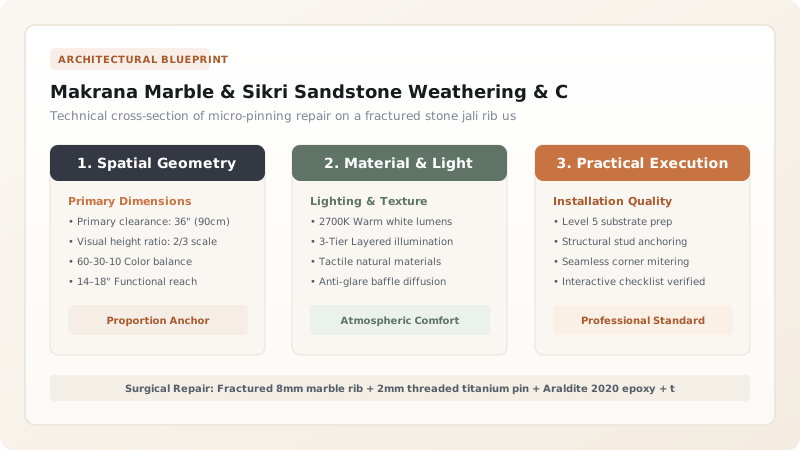
Due to vandalism, thermal stress, or seismic movement, thin jali ribs (often only 5mm to 10mm wide) frequently suffer shear fractures. Traditional repairs using iron cramps caused catastrophic rust jacking that split the stone entirely.
Modern conservation utilizes titanium micro-pinning:
- Precision Micro-Drilling: Holes (1.5mm to 2.5mm diameter) are bored into both halves of the fractured rib using slow-speed water-cooled diamond bits.
- Grade 5 Titanium Rods: Threaded titanium pins are inserted across the break, offering supreme tensile strength, low weight, and absolute immunity to corrosion.
- Optically Clear Structural Epoxy: Bonded with low-viscosity, non-yellowing epoxy (such as Araldite 2020), with the exterior hairline joint pointed with slaked lime and matching crushed stone dust.
Stone Degradation Pathology & Conservation Chemistry
Use this reference table to calculate exact physical dimensions, ratios, and specifications before purchasing:
| Pathology Symptom | Substrate Stone | Chemical Degradation Mechanism | Conservation Intervention |
|---|---|---|---|
| Black Gypsum Crust | Makrana Marble | Reaction with atmospheric SO₂ creating gypsum skin | Ammonium carbonate poulticing or Nd:YAG laser cleaning |
| Yellow Surface Staining | Makrana Marble | Deposition of airborne hydrocarbons and particulate carbon | Multani mitti (Fuller's earth) deionized water pack |
| Contour Scaling & Delamination | Sikri Red Sandstone | Sub-florescence salt crystallization bursting clay cement | Cellulose pulp desalination + Ethyl silicate (TEOS) consolidation |
| Fractured Lattice Ribs | Marble or Sandstone | Mechanical impact, seismic shear, or thermal stress | Internal titanium micro-pinning + Araldite 2020 epoxy bonding |
Heritage & Ethical Constraints
Every successful decoration project must account for physical and environmental constraints:
Venice Charter Reversibility
All adhesives, consolidants, and grouts used in conservation must be reversible or retreatable without damaging original fabric.
Color Matching of Replacements
Makrana quarries have strict extraction quotas; sourcing authentic matched-vein marble requires certified provenance.
Protocol for Cleaning and Consolidating a Weathered Sandstone Jali
Execute this professional sequence to achieve flawless results without backtracking:
Condition Assessment & Sounding
Gently tap stone ribs with wooden stylus to map hollow, delaminated zones; document fractures with macro-photography.
Loose Soil Dry Cleaning
Brush away loose dust and bird droppings using soft sable hair brushes and variable-suction HEPA vacuums.
Fuller's Earth Poultice Pack
Apply 4mm layer of Multani mitti mixed with deionized water; allow to dry slowly over 36 hours until clay cracks and flakes.
Gentle Rinsing with Deionized Water
Remove dried clay flakes; rinse residual dust with deionized water spray (< 1.5 bar) and pat dry with microfiber cloths.
Micro-Pinning Fractured Elements
Align broken ribs; bore 2mm pilot holes, insert threaded titanium pins, and bond with conservation epoxy.
Breathable Consolidation & Color Toning
Apply ethyl silicate to friable sandstone zones; retouch repair joints with natural earth pigments in lime water.
Common Mistakes & Countermeasures
Avoid these costly errors that compromise aesthetics, ergonomics, and budget:
Cleaning yellowed marble jalis with hydrochloric or oxalic acid solutions
Using iron or ordinary mild steel pins to repair broken stone jalis
Project Execution Checklist
Track your physical progress. Checkboxes persist automatically on this device:
Frequently Asked Questions
How often is the Taj Mahal cleaned with Multani Mitti?
The Archaeological Survey of India carries out periodic phased cleaning of the Taj Mahal's marble facades and jali screens every 5 to 7 years, treating sections methodically with Fuller's earth mud packs to safely draw out yellow atmospheric pollutants.
Can missing sections of an antique jali screen be re-carved?
Yes. Under international heritage conservation ethics, missing or structurally compromised elements may be reproduced in matching stone by traditional artisans, provided the new intervention is discreetly dated or recorded in conservation archives to avoid historical falsification.


