
Waxed cotton braided cord and brass axle pulley re-stringing is the heritage method of restoring the suspension cables in double-hung sliding sash windows. Utilizing a flexible lead 'mouse' weighted line to thread Size No. 8 solid braided waxed cotton cord over restored brass axle pulleys and down through hollow weight pockets, the cord is tied to counterweights with self-tightening figure-eight knots and nailed into routed sash stile side grooves with copper clout nails.
At a Glance: Key Takeaways
- Lead Mouse Gravity Feeding: 50mm curved lead weight on fine twine dropping through the pulley throat to retrieve cords through the pocket.
- Size No. 8 Solid Braided Cotton: Pre-stretched high-tensile cotton with synthetic filament core, rated to 2.2 kN breaking strength.
- Phosphor Bronze Bushings: Oil-impregnated sintered bronze bearings eliminating squeaks and metal-on-metal axle wear.
- Wax Impregnation Barrier: Paraffin and beeswax coating repelling damp air and lubricating cord fibers against friction wear.
- Copper Clout Nail Anchoring: Large-headed non-corrosive copper nails driven into sash side cord channels for permanent grip.
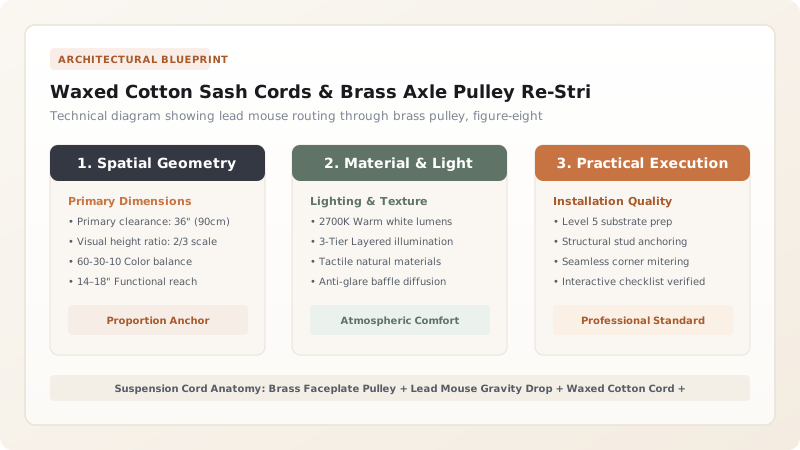
1. Pulley Mechanics: Solid Brass Axles & Sintered Bronze Bushings
The operational smoothness of a sash window depends heavily on the condition of its Axle Pulleys. Historic Georgian and Victorian pulleys feature solid cast brass faceplates with 45mm to 60mm diameter wheels.
Over a century of service, three primary mechanical failures occur:
- Axle Pin Grooving: Steel axle pins wear oval-shaped grooves into soft cast brass wheels, causing wheels to tilt, wobble, and jam against the faceplate casting.
- Paint Encrustation: Layers of oil and latex paint seep into the axle bearing, freezing the wheel solid. When frozen, the sash cord drags across a stationary wheel, wearing flat spots into the cord and snapping it within months.
- Phosphor Bronze Rebushing: High-end restorers extract the pulleys, press out worn steel pins, and install Oil-Impregnated Sintered Phosphor Bronze Bushings (SAE 841) with hardened stainless steel axles. Sintered bronze contains 18% interconnected porosity vacuum-impregnated with synthetic lubricating oil, delivering frictionless, squeak-free operation for 50+ years without external oiling. Review counterweight sizing in counterweight sizing mathematics.

2. Cord Materiality: Solid Braided Cotton vs Twisted Rope & Chains
Selecting the correct suspension cord is critical to long-term reliability. Standard twisted utility ropes untwist under load, causing weights to spin, twist cords together, and jam inside the pocket box.
Heritage sash windows require Waxed Solid Braided Cotton Cord:
- Solid Interlocking Braid: Woven in a continuous 16-carrier interlocked circular braid. The cord cannot untwist under load, ensuring weights hang straight.
- High-Tenacity Core: Modern heritage cords feature an internal multi-filament polyester or aramid core surrounded by a 100% natural cotton outer sheath. This combines the traditional tactile appearance of cotton with zero creep elongation and a breaking strength exceeding \(2,200\text{ N}\) (500 lbs).
- Paraffin Wax Impregnation: The cord is hot-wax dipped during manufacture. Wax acts as an internal fiber lubricant, reducing internal yarn friction as the cord flexes over the pulley, while providing permanent water repellency against condensation. Master putty craft in linseed oil glazing putty.
3. The Craft: Lead Mouse Threading & Sash Stile Anchoring
Re-stringing without taking down the entire timber window casing requires the traditional Lead Mouse Technique:
- The Mouse Tool: A 50mm curved piece of lead shaped like a chili pepper, tied to a 2-meter length of strong nylon mason's twine.
- Gravity Drop: The mouse is pushed over the top of the pulley wheel. Gravity carries the heavy, flexible lead slug down through the dark cavity until it emerges at the open pocket door at the bottom of the jamb.
- Pulling the Cord: The new sash cord is tied to the twine and drawn up over the pulley. The cord is tied to the counterweight using a Figure-Eight Loop or Bowline Knot, leaving the weight suspended 50mm above the floor when the sash is closed.
- Anchoring to Sash Stile: The cord is pulled down into the routed side groove of the wooden sash and secured with three \(25\text{ mm}\) Large-Head Copper Clout Nails driven into the timber at staggered angles. Review overall restoration in the sash restoration hub.
Sash Suspension Line Material Comparison
Use this reference table to calculate exact physical dimensions, ratios, and specifications before purchasing:
| Suspension Line | Waxed Solid Braided Cotton | Solid Brass Sash Chain | Polypropylene Twisted Rope |
|---|---|---|---|
| Authenticity Period | Georgian, Victorian, Edwardian | Late Victorian, High-End Monumental | Modern cheap DIY repair |
| Breaking Strength | 2.2 kN - 2.8 kN (500 - 630 lbs) | 4.5 kN+ (1,000+ lbs heavy duty) | 0.9 kN (stretches and fails) |
| Elongation Under Load | Virtually zero (pre-stretched core) | Zero stretch | High stretch (weights hit floor) |
| Operating Noise | Whisper-quiet (soft textile) | Metallic clinking sound in pocket | Squeaking over pulleys |
| Conservation Approval | 100% Approved by Landmark Boards | Approved for heavy commercial sashes | Strictly prohibited in historic restorations |
Re-Stringing Physical & Mechanical Constraints
Every successful decoration project must account for physical and environmental constraints:
Mouse Getting Stuck on Brick Ties
In masonry cavity walls, mortar snots or metal wall ties protruding into the weight box can snag the lead mouse. A heavier 100g flexible brass ball-chain mouse must be used to snake around obstructions.
Cord Jumping the Pulley Wheel
If the sash cord diameter is too small for the pulley wheel groove (e.g., 5mm cord on an 8mm groove), the cord can slip off the wheel and jam between the wheel rim and the brass faceplate casting. Cord size must match wheel groove radius exactly.
Nailing Too Deep into Sash Glass Rabbet
Driving 30mm nails into the side cord groove of a slim sash can penetrate straight into the glass rabbet, cracking the historic window pane from the side. Fastener length must never exceed 20mm in slim 35mm sashes.
Sash Cord Re-Stringing Step-by-Step Procedure
Execute this professional sequence to achieve flawless results without backtracking:
Staff Bead Removal & Lower Sash Egress
Gently pry off interior staff beads using broad putty knife; cut snapped cord remnants; lift lower sash out and set on padded bench.
Pocket Access Panel Opening
Unscrew pocket cover screws in lower jamb; pry pocket door out carefully to expose lower and upper counterweights.
Lead Mouse Gravity Threading
Insert lead mouse over top of brass pulley wheel; feed twine until mouse drops into open pocket door at bottom; tie sash cord to twine and pull through.
Counterweight Knotting & Height Calibration
Pass cord through weight eyelet; tie secure figure-eight stopper knot; pull weight up until it hangs 75mm below pulley when sash is raised.
Sash Stile Groove Alignment & Clout Nailing
Lay cord into routed side channel of sash; tension cord; drive three staggered 20mm copper clout nails through cord into timber groove.
Pocket Closure & Glide Verification
Replace timber pocket access cover; reinstall parting bead and staff bead; test smooth, silent sash glide from fully open to fully closed.
Common Mistakes & Countermeasures
Avoid these costly errors that compromise aesthetics, ergonomics, and budget:
Using Twisted Polypropylene Hardware Rope
Cutting Cord Length Too Short
Driving Clout Nails Straight in a Line
Project Execution Checklist
Track your physical progress. Checkboxes persist automatically on this device:
Frequently Asked Questions
What size sash cord should I use?
Sash cord is standardized by number: No. 6 (6mm diameter) for small sashes under 10 kg; No. 8 (8mm diameter)—the universal residential standard—for sashes between 10 kg and 25 kg; and No. 10 (10mm diameter) for large monumental sashes exceeding 30 kg.
Why were copper clout nails traditionally used instead of steel nails?
Copper nails never rust. Steel nails in damp window environments rust and corrode, staining the wood with black iron oxide and weakening the timber stile. Copper clout nails have wide, flat heads that clamp the braided cotton cord fibers firmly without tearing them.
How often do waxed cotton sash cords need to be replaced?
High-quality waxed braided cotton cords running over smooth, unpainted brass pulleys have an average working life of 30 to 50 years. In dry, well-maintained buildings, original Victorian cords over 80 years old are frequently found still fully functional.


