
Cast iron and lead counterweight sizing mathematics is the calculation required to achieve perfect gravitational equilibrium in double-hung sash windows. By weighing the fully glazed and painted sash on a calibrated scale, dividing by two (for two side cords), and adding intentional dynamic offsets (+0.5 kg for bottom sash closure hold-down, -0.5 kg for top sash lift closure), the sash remains stationary at any opening height without sliding down or creeping open.
At a Glance: Key Takeaways
- Equilibrium Formula: Sizing individual side counterweights to exactly 50% of the total glazed sash mass.
- Differential Bias Sizing: Top sash weighted 500g light to stay closed; bottom sash weighted 500g heavy to hold down.
- Density Ratio Advantage: Lead (11.34 g/cm³) is 57% denser than cast iron (7.2 g/cm³), allowing twice the weight in narrow pockets.
- Travel Clearance Verification: Total weight length must be shorter than the vertical drop between pulley axle and box bottom.
- Modular Lead Add-On Slugs: Cylindrical lead donuts sliding over cord lines to fine-tune balance without replacing cast weights.
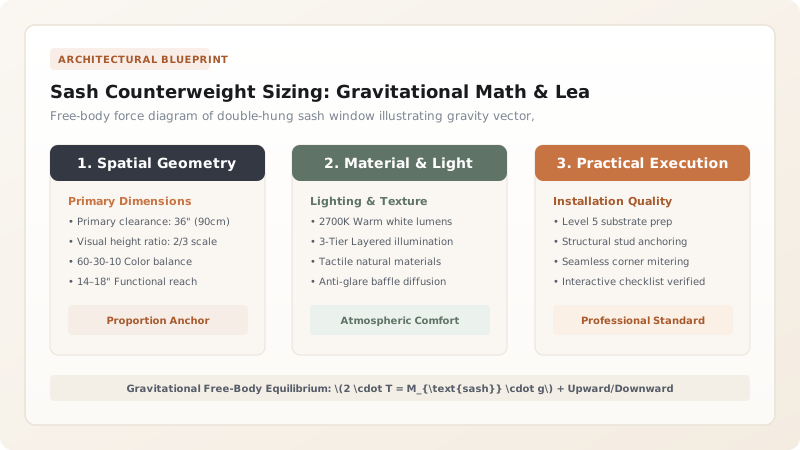
1. Classical Mechanics: Free-Body Diagrams & Equilibrium Equations
A sash window suspended by two flexible cords over frictionless pulleys is modeled as a twin-counterweight mechanical system. The sum of vertical forces on a sash of mass \(M_s\) must equal zero for static equilibrium:
Where \(T\) is the cord tension generated by each counterweight of mass \(m_w\) (\(T = m_w \cdot g\)). In an ideal system without friction, the mass of each counterweight is exactly half the sash mass: \(m_w = M_s / 2\).
However, practical installations possess sliding friction \(F_f\) between the timber sash stiles and the wooden parting and staff beads (typically \(F_f \approx 4\text{ to } 8\text{ N}\)). This friction creates a Deadband Range where the sash stays stationary even if the weight is slightly out of balance. To ensure the window operates reliably:
- Top (Upper) Sash Formula: \(m_{\text{top}} = (M_{\text{top}} / 2) - 0.25\text{ kg}\). The slight weight deficit ensures the upper sash remains firmly seated against the head frame under gravity, preventing drafts.
- Bottom (Lower) Sash Formula: \(m_{\text{bottom}} = (M_{\text{bottom}} / 2) + 0.25\text{ kg}\). The slight excess weight ensures the bottom sash closes firmly against the sill and resists wind rattling. Review overall window systems in the sash restoration hub.

2. Material Physics: Volumetric Density of Lead vs Cast Iron
When historic single-glazed sashes (3mm glass) are retrofitted with modern double glazing or acoustic laminate, the sash weight increases by \(80\% \text{ to } 120\%\). Fitting this extra weight into the fixed dimensions of an existing timber weight box is a major spatial challenge:
- Cast Iron Density: \(\rho_{\text{iron}} \approx 7.20\text{ g/cm}^3\) (\(450\text{ lbs/cu ft}\)). A 10 kg cast iron weight requires a volume of \(1,388\text{ cm}^3\). In a standard 45mm x 45mm pocket, the weight would need to be \(685\text{ mm}\) (27 inches) long, which will strike the bottom of the box before the window opens fully!
- Cast Lead Density: \(\rho_{\text{lead}} \approx 11.34\text{ g/cm}^3\) (\(708\text{ lbs/cu ft}\)). Lead is \(57.5\%\) denser than iron. The same 10 kg mass occupies only \(881\text{ cm}^3\), reducing the required length to barely \(435\text{ mm}\).
- Travel Clearance Rule: The total length of the counterweight plus the suspension knot must never exceed the distance from the pulley axle down to the top of the pocket sill when the sash is in its highest position: \(L_{\text{weight}} \le H_{\text{box}} - H_{\text{travel}} - 100\text{ mm}\). Learn re-stringing techniques in waxed cotton cord re-stringing.
3. Field Calibration: Add-On Lead Slugs & Pocket Weight Tuning
Rather than casting new custom weights from scratch, master restorers utilize Modular Lead Add-On Weights (Slugs/Donuts):
- Center-Bore Donuts: Cylindrical cast lead discs weighing 0.5 kg, 1.0 kg, and 2.0 kg featuring a 12mm central hole. These slide directly over the sash cord above the primary cast iron weight, resting on its shoulder.
- Segmental Interlocking Weights: Stackable lead ingots with male/female dove-tail lugs that lock together, allowing weights to be adjusted by 250-gram increments directly through the narrow 'mouse hole' pocket door without removing the sash from the frame. Connect to traditional glazing in linseed oil glazing putty.
Counterweight Material Specification Comparison
Use this reference table to calculate exact physical dimensions, ratios, and specifications before purchasing:
| Specification Feature | Cast Iron Sash Weights | Cast Lead Cylindrical Weights | Lead Sheet Rolled Cores |
|---|---|---|---|
| Material Density (g/cm³) | 7.15 - 7.30 g/cm³ | 11.30 - 11.35 g/cm³ | 11.20 - 11.30 g/cm³ |
| Required Pocket Clearance | Requires 55mm - 65mm square pocket | Fits compact 38mm - 45mm round pocket | Custom hand-rolled to fit irregular pockets |
| Corrosion Resistance | High (develops stable black oxide) | Exceptional (forms lead carbonate patina) | Exceptional |
| Fabrication Flexibility | Fixed foundry casting (cannot alter) | Can be cut with hand saw on site | Can be trimmed with utility knife |
| Cost per Kilogram | Low ($3 - $5 / kg) | Medium-High ($10 - $16 / kg) | High ($14 - $20 / kg) |
Weight Box Spatial & Mechanical Constraints
Every successful decoration project must account for physical and environmental constraints:
Weights Clashing Inside Pocket Box
Inside the hollow weight box, the upper sash weight and lower sash weight must pass each other as sashes move. If weights exceed 45mm diameter in a 100mm cavity, they will collide and jam. A wooden separating divider strip ('parting slip') suspended from the pulley stile is mandatory to prevent clashing.
Debris Accumulation at Bottom of Pocket
Over 100 years, crumbling lime mortar, fallen brick dust, and old broken cord knots accumulate at the bottom of the weight box, raising the floor level by 150mm. This causes counterweights to bottom out prematurely. The cavity must be vacuumed clean down to the stone sill.
Toxic Lead Dust Handling
Cutting or handling old lead counterweights generates toxic heavy-metal dust. Restorers must wear nitrile gloves and P100 particulate respirators, and never melt lead on site without dedicated industrial fume extraction.
Sash Counterweight Calculation & Tuning Protocol
Execute this professional sequence to achieve flawless results without backtracking:
Sash Extraction & Digital Weighing
Unhook sashes from cords; weigh both fully glazed upper and lower sashes on a calibrated digital hanging scale; record exact weights to nearest 50 grams.
Equilibrium Math Calculation
Divide bottom sash mass by 2 and add 0.25 kg for bottom weights; divide top sash mass by 2 and subtract 0.25 kg for top weights.
Pocket Cavity Clearance Check
Measure total travel drop from pulley axle to bottom sill; measure pocket cross-section; verify weight length provides minimum 75mm clearance at full travel.
Weight Selection & Lead Slug Staging
Select primary cast iron weights; add calibrated cylindrical lead donuts to achieve target calculated mass on digital bench scale.
Parting Slip Inspection
Inspect wooden parting slip hanging inside box; confirm divider isolates upper and lower weights so they cannot touch when passing.
In-Situ Floating Test
Tie off cords; hang sashes; move lower sash to quarter, half, and three-quarter open positions; verify sash remains completely stationary without creeping.
Common Mistakes & Countermeasures
Avoid these costly errors that compromise aesthetics, ergonomics, and budget:
Estimating Sash Weight by Guesswork
Forgetting the Wooden Parting Slip
Making Counterweights Too Long
Project Execution Checklist
Track your physical progress. Checkboxes persist automatically on this device:
Frequently Asked Questions
Why does my sash window slowly slide down by itself when opened?
The counterweights are too light for the sash. This commonly happens after windows are repaired with thicker glass or painted with multiple coats of heavy paint without adding corresponding weight. Adding 500g to 1kg of lead donut slugs to each side counterweight restores neutral balance.
Can you use lead shot (pellets) instead of solid lead weights?
Yes! When pocket space is irregularly shaped or obstructed by brick ties, restorers often use heavy-duty canvas or vinyl weight tubes filled with lead shot. Lead shot flows like a liquid, adapting to irregular cavities while delivering maximum mass.
How does weather affect sash window counterweight balance?
In humid summer weather, timber sashes absorb moisture and swell slightly, increasing sliding friction against the beads. In dry winter weather, timber shrinks, reducing friction. Properly sized counterweights account for this by keeping weights within the narrow deadband zone where friction stabilizes the window year-round.


