
Sloping turf fosse drainage and sub-soil perforated gravel pipes comprise the subterranean civil drainage system required to keep a ha-ha sunken ditch dry, stable, and walkable. By pairing a 1:3 or 1:4 pasture slope with an invert French drain consisting of a 150mm perforated HDPE pipe encased in washed gravel and wrapped in non-woven geotextile with a minimum 1% longitudinal gradient, landscape engineers evacuate massive storm runoff without creating a stagnant, muddy ditch.
At a Glance: Key Takeaways
- 1:3 to 1:4 Turf Slope Geometry: Ensures agricultural mowing machinery and livestock can safely navigate the outer pasture bank without sliding.
- French Drain Invert System: A continuous subterranean gravel trench capturing both surface runoff from the turf slope and subsurface seepage from the wall.
- 150mm Perforated Twin-Wall Pipe: Heavy-duty smooth-bore HDPE pipe with slotted perforations resisting soil crushing under heavy tractor axle loads.
- Non-Woven Geotextile Envelope: 150 g/m² needle-punched membrane preventing pasture silt from clogging the gravel pore spaces.
- Longitudinal Slope Gradient (1:100): Minimum 1% continuous fall directing collected water by gravity to streams, parkland lakes, or soakaway ponds.
- Inline Silt Catch Basins: Cast concrete or masonry inspection pits located every 50 meters to trap washed debris and facilitate pipe jetting.
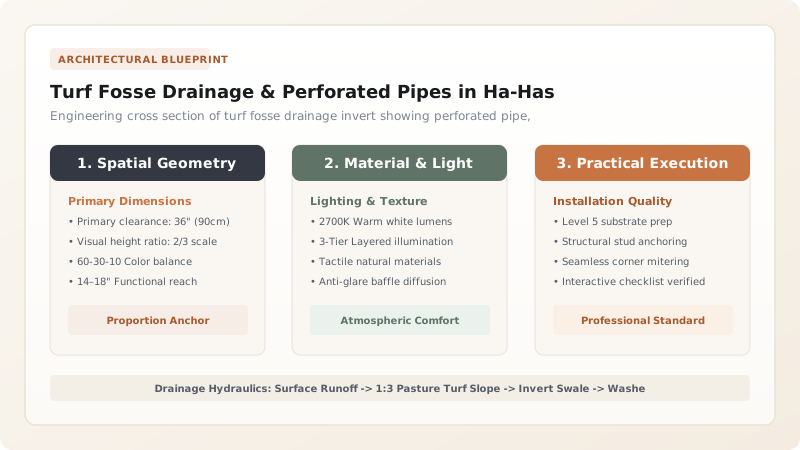
1. Fosse Geometry: Slope Stability and Agricultural Grazing
The fosse is the excavated sloping outer bank of the ha-ha that rises from the base of the stone retaining wall back up to the natural parkland grade. If this slope is cut too steeply (e.g., \(1:1.5\) or \(1:2\)), two catastrophic problems arise:
- Slope Slumping: Saturated clay soils lose internal shear resistance, causing rotational slope failures that dump earth into the ditch.
- Livestock Injury: Cattle and sheep trying to graze down steep banks slip, break limbs, and churn topsoil into mud.
Landscape engineers mandate a maximum slope of \(1:3\) (\(18.4^\circ\)) to \(1:4\) (\(14^\circ\)). This shallow gradient provides complete geotechnical slope stability, allows commercial rotary mowers to cut grass safely, and lets sheep graze right down to the ditch floor.
2. Subterranean Hydraulics: Sizing Invert Collector Pipes
Because the ha-ha forms an artificial depression across the topography, it collects overland surface sheet flow from both the house lawn and the upper parkland. The peak runoff discharge (\(Q_{\text{peak}}\)) is calculated via the Rational Method:
Where \(C\) is the turf runoff coefficient (\(\approx 0.25\text{ to }0.35\)), \(I\) is rainfall intensity (\(\text{mm/hr}\)), and \(A\) is the catchment watershed area in hectares. For a 500-meter long ha-ha draining a 4-hectare parkland catchment during a 25-year storm, peak discharge can exceed \(45\text{ L/s}\). This requires a continuous \(150\text{ mm}\) to \(200\text{ mm}\) perforated corrugated HDPE pipe laid at a minimum \(1\%\) fall (\(1:100\)).
3. Silt Management: Catch Pits and Jetting Access
Overland runoff carrying grass cuttings, sheep manure, and fine silt particles will clog unmaintained gravel trenches over time. Sustainable ha-ha engineering incorporates inline silt catch pits:
- Constructed of \(450\text{ mm}\) diameter precast concrete rings or brick sumps installed every \(50\text{ to }75\text{ meters}\).
- Features a \(300\text{ mm}\) deep sump below the pipe invert to trap settled sediments.
- Covered with heavy-duty cast iron or turf-covered composite lids flush with the ditch invert for easy annual vacuum pump cleaning. Learn about estate sightlines in unbroken estate horizon sightline geometry and grazing barriers.
Ha-Ha Drainage Methodologies Comparison
Use this reference table to calculate exact physical dimensions, ratios, and specifications before purchasing:
| Drainage System | Stormwater Capacity | Risk of Standing Mud | Pasture Soil Stability | Maintenance Frequency | Installation Cost |
|---|---|---|---|---|---|
| Perforated Pipe French Drain + Catch Pits | High (40+ L/s) | Virtually Zero (Rapid Evacuation) | Supreme (Fully Protected) | Low (Annual Silt Clear) | Moderate-High |
| Simple Open Gravel Invert Trench | Moderate (15–20 L/s) | Low | Good | Medium (Weed Growth in Gravel) | Low-Moderate |
| Natural Graded Earthen Swale (No Pipe) | Low (Relies on Surface Flow) | High (Muddy Bog in Winter) | Poor (Hoof Trampling) | High (Frequent Re-Grading) | Very Low |
| Paved Stone Gutter with Grates | Very High | Zero | Good | Low (Leaves Jam Grates) | High (Unnatural Appearance) |
Practical Constraints
Every successful decoration project must account for physical and environmental constraints:
Outfall Elevation Limitations on Low-Lying Sites
On extremely flat estate parklands, the base of a 1.8-meter deep ha-ha ditch may sit below the elevation of nearby natural watercourses. Without a gravity outfall, the pipe will back up with stagnant water. In such cases, the drain must discharge into a constructed retention pond or a low-wattage automated solar pump sump discharging to higher swales.
Tree Root Infiltration into Perforated Drainage Lines
Willow, alder, and oak roots naturally track the high humidity of subterranean ha-ha drain pipes, penetrating perforation slots and expanding into dense fibrous root plugs that choke flow. Drainage runs passing within 15 meters of water-loving trees must switch to non-perforated solid-wall pipe with elastomeric gasketed joints.
Execution Blueprint & Craftsmanship Sequence
Execute this professional sequence to achieve flawless results without backtracking:
Longitudinal Gradient Survey & Invert Profiling
Survey the ditch alignment using an optical level or laser. Establish a continuous 1% fall (10mm per meter) toward the designated stormwater outfall pond or stream.
French Drain Invert Trench Excavation
Excavate a 350mm wide x 400mm deep trench along the lower junction where the stone wall meets the turf slope. Compact the trench bed firmly.
Geotextile Lining & Bedding Gravel Placement
Line the trench with a 150 g/m² non-woven needle-punched polypropylene geotextile, leaving 300mm excess fabric on either side. Spread a 75mm bedding layer of washed 20mm rounded pea gravel.
Perforated Drainage Pipe Laying & Jointing
Lay a 150mm perforated HDPE twin-wall pipe with perforation slots facing upward and to the sides. Connect pipe lengths using push-fit couplers.
Gravel Envelope Backfill & Geotextile Swaddling
Backfill around and over the pipe with clean 20mm gravel to within 100mm of finished turf grade. Fold the geotextile wings over the top with a 200mm overlap to seal the gravel core.
Permeable Sandy Topsoil & Turf Reinstatement
Top with 100mm of free-draining sandy loam topsoil. Lay washed meadow turf rolls over the trench, tamping flat to match the slope grade seamlessly.
Common Mistakes & Countermeasures
Avoid these costly errors that compromise aesthetics, ergonomics, and budget:
Using Perforated Land Drain Without Geotextile Wrap
Laying Drainage Pipes Flat (0% Slope)
Project Execution Checklist
Track your physical progress. Checkboxes persist automatically on this device:
Frequently Asked Questions
How often do ha-ha French drains require maintenance?
With proper geotextile wrapping and inline catch pits, the subsurface pipe system requires minimal maintenance. Silt sumps in the catch pits should be cleaned annually with a shovel or vacuum tanker, and pipes should be pressure-jetted every 5 to 10 years.
Can the bottom of a ha-ha fosse be paved with cobbles instead of turf?
Yes. In areas with high water tables or concentrated storm runoff, historic estates paved the invert with a 600mm wide dry-laid granite or limestone cobble gutter. This prevents erosion while remaining invisible from the house.


