
Low-lux 2200K zero-UV display lighting is a specialized architectural illumination system engineered to eliminate photochemical 'light-strike' (goût de lumière) in stored fine wines. By employing museum-grade LEDs that filter all ultraviolet radiation (0% UV below 400nm) and dramatically attenuate high-energy visible violet/blue light between 400nm and 450nm, while maintaining low illumination levels (< 50 lux on bottle faces) and generating zero radiated infrared heat, it preserves wine chemistry while providing rich visual presentation.
At a Glance: Key Takeaways
- Photochemical Light-Strike Prevention: Eliminates high-energy photons below 450nm that excite riboflavin and break amino acid sulfur bonds in wine.
- Candlelight 2200K CCT: Warm, luxurious color temperature mimicking incandescent candlelight without emitting damaging infrared heat.
- Museum-Grade Color Fidelity: Ultra-high Color Rendering Index (CRI Ra >= 95, R9 > 90) ensuring authentic presentation of wine labels and cabinetry timber.
- Zero Infrared Heat Emission: Solid-state LEDs heat-sinked externally, radiating 0 W/m² of thermal heat downward onto resting bottles.
- Intelligent Presence Automation: Occupancy sensors and automated astronomical timeclocks keeping the cellar in pitch-black darkness 98% of the time.
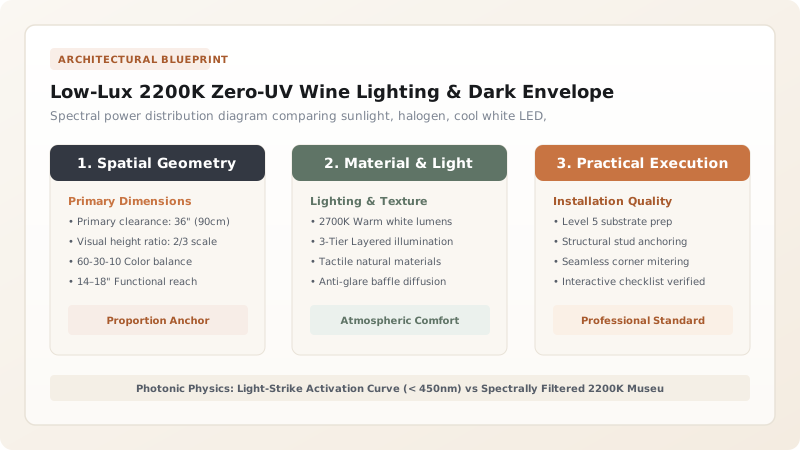
1. Photochemistry: Light-Strike Reactions & Photon Energy Equations
Light is a stream of electromagnetic photons whose individual energy \(E\) is inversely proportional to wavelength \(\lambda\), governed by the Planck-Einstein Relation:
Where \(h\) is Planck's constant and \(c\) is the speed of light. Short-wavelength ultraviolet (200–400 nm) and high-energy visible blue light (400–450 nm) carry substantial energy (\(E > 2.8\text{ eV}\)).
When high-energy photons penetrate wine glass (even tinted green or brown glass), they interact with naturally occurring Riboflavin (Vitamin B2). The photo-excited riboflavin reacts with sulfur-containing amino acids (such as methionine and cysteine), causing photolysis and generating foul volatile sulfur compounds:
- Dimethyl Disulfide (DMDS): Imparts aroma of rotting cabbage and wet wool.
- Methanethiol: Smells of cooked cauliflower and putrid drain water.
- Threshold of Detection: Humans can detect light-strike defects at concentrations as low as \(0.1\text{ to } 0.5\text{ parts per billion (ppb)}\)! Champagne and delicate white wines in clear flint glass can suffer irreversible damage in fewer than 60 minutes of exposure to standard commercial fluorescent or cool white LED lighting. Learn joinery integration in our guide to vibration-dampened walnut racks.

2. Optical Engineering: 2200K Spectral Tuning & Zero-UV Diodes
To eliminate light-strike risk while providing a warm, inviting ambiance for sommelier degustation, lighting must be custom engineered:
- Zero UV Radiation (<400 nm): High-purity phosphor-converted LEDs that emit 0.00 \(\mu\text{W/lumen}\) of ultraviolet energy, preventing the breakdown of wine phenolic compounds and cork polymers.
- Blue-Attenuated 2200K Color Temperature: By tuning the phosphor chemistry, the blue excitation peak (typically at 450nm in commercial LEDs) is heavily suppressed, shifting the dominant spectral emission into the safe amber and warm red spectrum (580–660 nm).
- High Color Rendering (CRI 98+): Standard warm LEDs often look muddy and yellow. Museum-grade diodes achieve a Color Rendering Index of \(R_a \ge 98\) and deep red fidelity (\(R_9 \ge 92\)), allowing collectors to read fine vintage typography on labels and appreciate the deep purple hues of aged Cabernet. Review overall tasting suite architecture in our sommelier tasting rooms hub.
3. Illuminance Thresholds & Presence Automation
Regardless of how safe a light spectrum is, total photon dosage is cumulative over years of aging: Total Exposure = Illuminance (Lux) × Time (Hours).
- Target Display Illuminance: Light levels directly impinging on bottle glass are calibrated between \(30\text{ and } 50\text{ lux}\) during viewing, dimming to \(10\text{ lux}\) during social tasting.
- Astronomical & PIR Occupancy Control: Passive infrared (PIR) motion sensors ensure lighting illuminates only when a sommelier enters the space. When unoccupied, the lighting fades to 0% (absolute pitch darkness) within 90 seconds.
- Concealed Aluminum Heatsinking: High-output LEDs generate heat at the diode back-plate. LED tape is mounted inside heavy extruded aluminum profiles routed into cabinetry backing, dissipating heat upward away from bottles into the ceiling plenum. Contrast with panic room security lighting in secret safe rooms.
Wine Cellar Display Lighting Source Comparison
Use this reference table to calculate exact physical dimensions, ratios, and specifications before purchasing:
| Lighting Technology | Standard Halogen Spotlights | Commercial Cool White LED (4000K) | Specialized 2200K Zero-UV Museum LED |
|---|---|---|---|
| UV Emission (< 400nm) | High (emits UV-A and UV-B) | Low (trace amounts) | Absolute Zero (0.00 μW/lm) |
| Blue Light Hazard (400-450nm) | Low to Moderate | Extremely High (dangerous blue spike) | Suppressed by > 85% |
| Infrared Thermal Radiation | Severe (acts as radiant heater) | None in light beam | None in light beam |
| Light-Strike Risk to Wine | High (heat + UV) | Extremely High (photochemical light-strike) | Zero (scientifically protected) |
| Visual Ambiance | Warm, harsh glare | Cold, clinical, sterile | Rich, golden candlelight ambiance |
| Color Rendering (CRI) | 100 (high CRI but hot) | 70 - 80 (distorts colors) | 95 - 98 (museum color fidelity) |
Electrical & Optical Installation Constraints
Every successful decoration project must account for physical and environmental constraints:
Low-Voltage Voltage Drop Across Long Runs
Operating 24V DC LED strips over continuous runs exceeding 5 meters causes visible voltage drop (dimming towards the end of the run). Power must be injected into both ends of the tape using 16 AWG twisted shielded wire.
Driver Heat Generation in Sealed Enclosures
Placing 24V LED power supplies (transformers) inside the insulated wine cellar adds parasitic thermal load and shortens driver life. All drivers must be located in an exterior climate-controlled utility cabinet.
Flicker-Free Pulse Width Modulation (PWM) Dimming
Low-frequency PWM dimming creates invisible stroboscopic flicker that disrupts photography and causes eye fatigue during wine tasting. Drivers must operate at high frequencies (> 3,000 Hz) with logarithmic dimming down to 0.1%.
Zero-UV Wine Lighting Installation & Commissioning
Execute this professional sequence to achieve flawless results without backtracking:
Lighting Circuit & Driver Enclosure Planning
Design 24V low-voltage zoning; install centralized remote driver enclosure in adjacent utility room with dedicated ventilation.
Aluminum Extrusion Channel Routing
Route 15mm x 15mm recesses into the underside of black walnut wine shelves; friction-fit anodized black aluminum extrusion channels with thermal heatsink tape.
Zero-UV 2200K LED Tape Adhesion
Adhere museum-grade 2200K CRI 98 LED ribbon into channel; solder marine-grade silicone lead wires with heat-shrink moisture sleeving.
Frosted Opal Lens Diffuser Snapping
Snap frosted PMMA opal diffuser lenses over channels to eliminate diode dotting and ensure perfectly uniform laminar glow.
PIR Sensor & DALI/DMX Controller Programming
Mount concealed ceiling PIR occupancy sensor; program smooth 3-second fade-up on entry and 90-second fade-to-black on exit.
Spectroradiometer & Lux Verification
Measure light levels with calibrated lux meter to verify bottle face illuminance is under 50 lux; inspect spectrum with portable spectrometer to confirm zero UV.
Common Mistakes & Countermeasures
Avoid these costly errors that compromise aesthetics, ergonomics, and budget:
Installing Drivers Inside the Wine Cellar
Using Cheap 6000K Daylight LED Strips
Directing High-Intensity Spotlights Directly at Wine Racks
Project Execution Checklist
Track your physical progress. Checkboxes persist automatically on this device:
Frequently Asked Questions
Does amber or green glass protect wine from light-strike?
Amber (brown) glass offers the highest natural protection, filtering out nearly 90% of wavelengths below 450nm. Traditional dark green glass, however, transmits up to 30% of blue-light wavelengths and offers poor protection. Clear flint glass (commonly used for rosé and white wines) provides virtually 0% protection, making museum-grade zero-UV lighting mandatory.
Can LED lighting generate heat that warms up the wine bottles?
Unlike incandescent or halogen bulbs (which radiate intense infrared heat directly into the light beam), LEDs radiate virtually zero infrared forward. Their heat is generated conducted backward into the diode baseplate. By mounting LED tape in aluminum channels routed into cabinetry backing, this heat is dissipated safely away from resting bottles.
Why is 2200K chosen over standard warm white 2700K or 3000K?
2200K closely mimics the golden glow of real candlelight or firelight. Crucially, its spectral distribution contains significantly less blue wavelength energy than 2700K or 3000K light, maximizing photochemical safety while creating an extraordinarily warm, opulent ambiance tailored for fine wine degustation.


