
A custom sommelier tasting room is a multi-zoned viticultural architectural suite combining an ambient hospitality salon with a hermetically sealed, climate-controlled preservation vault. Engineered with continuous Class 1 vapor retarders (permeance < 0.1 perm), closed-cell polyurethane thermal insulation (R-30 walls), low-velocity ducted split refrigeration delivering 12°C–14°C at 65%–75% RH without laminar air blast, vibration-isolated solid black walnut racking, and 2200K zero-UV lighting, it ensures museum-grade wine preservation alongside sensory tasting ergonomics.
At a Glance: Key Takeaways
- Continuous Vapor Envelope: 6-mil reinforced polyethylene or closed-cell spray foam envelope preventing vapor pressure drive from condensing in wall cavities.
- Low-Velocity Ducted Air: Modulating EC fan motors and linear slot diffusers maintaining laminar airflow below 0.15 m/s to prevent label desiccation.
- Vibration-Dampened Millwork: Solid American black walnut joinery fitted with neoprene isolation grommets to shield wine from mechanical harmonic vibrations.
- Zero-UV Spectrally Tuned Optics: 2200K high-CRI (98+) LED arrays filtering all wavelengths below 450nm to prevent photochemical light-strike oxidation.
- Dual-Zone Tasting Ergonomics: Seamless architectural transition between 13°C preservation cellar and 20°C ambient decanting and degustation salon.
In-Depth Guides in this Directory
Explore specialized subtopic blueprints, technical dimensions, and execution checklists:
Vibration-Dampened Walnut Wine Racks: Cradle Geometry & Acoustics
Joinery engineering guide for custom wine racking: solid black walnut cradle CNC milling, neoprene vibration isolation pucks, acoustic harmonic dampening, and non-off-gassing finishes.
Ducted Wine Cellar Split Refrigeration & Psychrometrics
HVAC engineering guide for ducted split wine cellar refrigeration: sensible heat ratio calculation, high-surface evaporator coils, linear slot diffuser aerodynamics, and RH stability.
Low-Lux 2200K Zero-UV Wine Lighting & Dark Envelopes
Architectural optics guide for wine display lighting: photochemical light-strike reaction physics, 2200K warm LED spectra, zero-UV filtration, and infrared thermal mitigation.
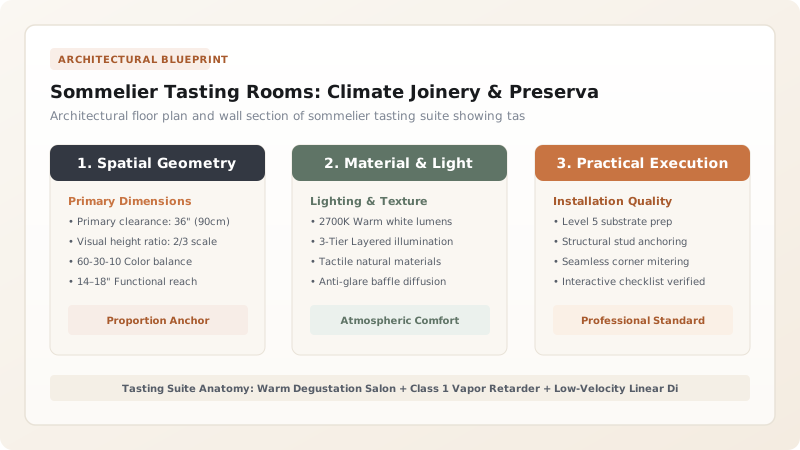
1. Building Envelope Physics: Vapor Retarders & Thermal Isolation
Unlike standard domestic living areas, a wine preservation vault operates at continuous high humidity (\(65\% \text{ to } 75\%\text{ RH}\)) and low temperature (\(12^\circ\text{C} \text{ to } 14^\circ\text{C}\)). This creates a massive Vapor Pressure Differential between the conditioned cellar and surrounding warm residential rooms.
Water vapor naturally migrates from high vapor pressure (warm humid room) toward low vapor pressure (cold cellar interior). The vapor flux \(W\) across wall assembly is calculated by Fick's Law of Diffusion:
Where \(M\) is the moisture permeance and \(\Delta p_v\) is vapor pressure gradient. If the vapor retarder is breached, moisture penetrates framing cavities, hits the cold drywall dew point, and condenses into liquid water—destroying insulation and breeding toxic mold.
The construction standard mandates a continuous Class 1 Vapor Retarder (permeance < 0.1 perm) applied to the warm exterior side of the cellar envelope, backed by \(80\text{ to } 100\text{ mm}\) of closed-cell polyurethane spray foam (R-28 to R-32). Thermally broken structural steel or thermally isolated hardwood studs eliminate thermal bridging. Explore subterranean passive alternatives in our subterranean spiral wine cellar pods hub.

2. Psychrometrics & HVAC: Low-Velocity Ducted Split Refrigeration
Standard comfort cooling air conditioners blast high-velocity air at 4°C coil temperatures, which aggressively strips moisture from the air and dehydrates natural corks within months. Sommelier cellars require dedicated Viticultural Split Refrigeration Systems:
- Oversized Evaporator Surface Area: Running with a low temperature differential (\(\Delta T = 3^\circ\text{C} \text{ to } 5^\circ\text{C}\)) across large-fin-spacing coils (4 to 6 fins per inch). This cools air gently without dropping coil temperature below dew point, eliminating dehumidification.
- Low-Velocity Laminar Diffusion: Supply air is delivered through continuous architectural linear slot diffusers at face velocities under \(0.15\text{ m/s}\) (30 FPM), preventing label fluttering and draft turbulence.
- Remote Condenser Placement: The condensing unit is installed in an exterior plant room or utility space up to 30 meters away, linked by insulated copper refrigerant lines (R448A or R513A) to guarantee absolute interior acoustic silence (<28 dBA). Detailed psychrometric math in our guide to low-velocity split refrigeration.
3. Joinery Craftsmanship: Vibration Dampening & Dark Envelopes
Fine aged wines are susceptible to kinetic degradation from micro-vibrations generated by HVAC fans, building foot traffic, or subwoofers. In custom sommelier joinery:
- Neoprene Subframe Isolation: Black walnut rack carcases are mounted on 50 Durometer neoprene elastomeric isolation pucks, decoupling the woodwork from building slab vibration.
- Anatomical Bottle Cradles: Individual bottle cradles are CNC-carved from solid quarter-sawn American black walnut (Juglans nigra), finished with non-off-gassing water-based polyurethanes or food-grade mineral oils. Avoid solvent lacquers whose VOC vapors penetrate corks. Learn cradle design in our deep dive on vibration-dampened black walnut racks.
- Zero-UV Photochemical Protection: High-energy blue and ultraviolet photons (<450 nm) photo-oxidize riboflavin and sulfur compounds in wine, creating skunky 'light-strike' (goût de lumière). Cellar lighting utilizes 2200K candlelight LED ribbons with zero UV emission. Explore optical engineering in zero-UV display lighting.
Wine Cellar Enclosure & Cabinetry Specification Matrix
Use this reference table to calculate exact physical dimensions, ratios, and specifications before purchasing:
| Specification Feature | Built-In Glass Wine Wall | Dedicated Sommelier Cellar Vault | Integrated Tasting Salon Suite |
|---|---|---|---|
| Footprint Required | 1.5 to 3.0 m² (16 to 32 sq ft) | 8 to 15 m² (85 to 160 sq ft) | 20 to 50 m² (215 to 540 sq ft) |
| Bottle Capacity | 300 to 800 bottles | 1,200 to 3,500 bottles | 3,000 to 8,000+ bottles |
| Thermal Enclosure | Triple-glazed thermally broken curtain wall | R-30 spray foam walls + insulated door | Multi-zone separate tasting & storage |
| Cooling Architecture | Ductless high-wall evaporator | Ducted split system with linear diffusers | Dual redundant variable-speed chillers |
| Joinery Materiality | Powder-coated steel & acrylic pins | Solid American black walnut / white oak | Bookmatched walnut, quartzite, bronze |
| Acoustic Noise Level | 32 - 38 dBA | 24 - 28 dBA (ultra-quiet) | < 22 dBA (library silent) |
Architectural & Psychrometric Site Constraints
Every successful decoration project must account for physical and environmental constraints:
Condensation on Glass View Walls
Showcase glass walls dividing a 13°C cellar from a 23°C tasting salon will sweat with condensation if room relative humidity exceeds 50%. Requires triple-glazed argon-filled insulated glass units with warm-edge spacers and pyrolytic Low-E coatings.
Off-Gassing from Adhesives & Wood Finishes
Solvent-based stains, polyurethane varnishes, and formaldehyde-laden plywood emit volatile organic compounds (VOCs) that migrate through wine corks over time, imparting chemical taints. Only low-VOC waterborne or natural oil finishes are permitted.
Refrigerant Piping Distance & Oil Return
If the condensing unit is located more than 20 meters away or on an elevated roof, oil traps and suction line sizing must be strictly calculated to prevent compressor oil starvation and failure.
Sommelier Tasting Suite Construction Sequence
Execute this professional sequence to achieve flawless results without backtracking:
Stud Framing & Rough-In Services
Erect 2x6 timber or heavy-gauge steel stud framing. Rough in ducted HVAC supply/return boots, 24V LED low-voltage wiring, and drain lines for decanting sinks.
Continuous Vapor Barrier & Spray Foam
Install 6-mil polyethylene vapor barrier on warm exterior face. Spray 90mm closed-cell polyurethane foam across all wall and ceiling cavities; seal every electrical penetration with silicone.
Moisture-Resistant Drywall & Mineral Paint
Hang 16mm cement board or green water-resistant gypsum board. Tape with fiberglass mesh and finish with zero-VOC breathable mineral silicate paint.
Ducted HVAC & Humidification Commissioning
Connect ducted split evaporator coil; pipe condensate drain with P-trap; charge system with refrigerant and calibrate modulating digital thermostat and humidity sensor.
Solid Walnut Joinery & Isolation Mounting
Install floor-level neoprene vibration pads; erect modular black walnut uprights and horizontal bottle cradle shelves using blind mortise-and-tenon joints.
Thermally Broken Glazing & Zero-UV Optics
Set structural triple-glazed thermally broken steel doors with double perimeter sweep gaskets. Terminate 2200K zero-UV LED strip reveals and verify zero light leaks.
Common Mistakes & Countermeasures
Avoid these costly errors that compromise aesthetics, ergonomics, and budget:
Placing Vapor Barrier on Cold Inside Face
Using Domestic Kitchen Cabinetry for Wine Racking
Illuminating Bottles with Halogen or Cool LEDs
Project Execution Checklist
Track your physical progress. Checkboxes persist automatically on this device:
Frequently Asked Questions
What is the difference between wine storage and wine tasting room climates?
Wine storage requires 12°C–14°C (54°F–57°F) with 65%–75% humidity to preserve corks and slow aging. A sommelier tasting salon, by contrast, is kept at comfortable human ambient room temperature (19°C–21°C / 66°F–70°F) with 45%–50% RH, providing an optimal sensory environment for wine tasting, swirling, and decanting without shivering.
Why is American black walnut preferred over other hardwoods for wine cellars?
Black walnut (Juglans nigra) possesses high natural dimensional stability, dense closed grain, and natural rot resistance, preventing warping or swelling in 70% relative humidity. Furthermore, walnut contains virtually no volatile aromatic resins or tannins that could impart aromas into wine corks, unlike aromatic cedar or untreated pine.
How is mold prevented in a room kept at 70% humidity?
Mold requires stagnant air, spores, and organic food sources to thrive. Sommelier cellars prevent mold by maintaining continuous gentle air movement (0.1 m/s), utilizing non-porous antimicrobial finishes, incorporating an in-duct ultraviolet germicidal irradiation (UVGI) air purifier in the HVAC return, and never using organic wallpaper or paper-faced drywall.


