
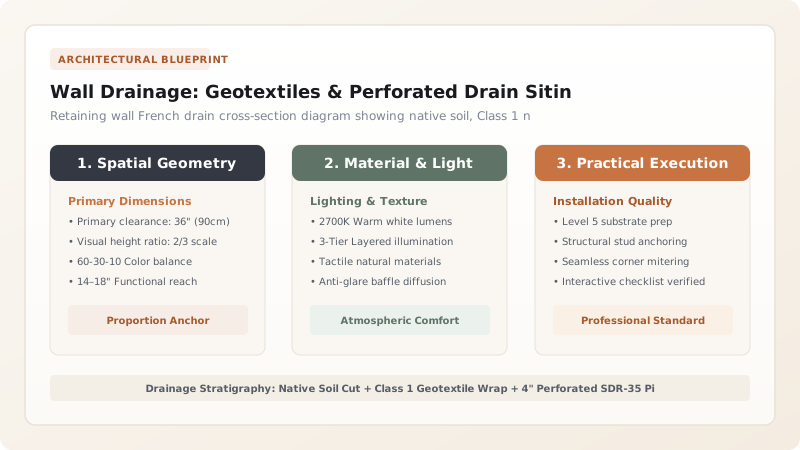
Install retaining wall subsurface drainage by laying a 4-inch rigid perforated PVC drain pipe (SDR-35) at the base of the hearting trench behind the foundation stones. Position pipe perforations facing downward (at 4 and 8 o'clock) pitched at a minimum 1% slope (1/8" per foot) to daylight, and wrap the 3/4" crushed stone envelope in Class 1 non-woven geotextile filter fabric.
At a Glance: Key Takeaways
- Class 1 Non-Woven Geotextile Filter Fabric (6–8 oz/sq yd): High water permittivity (0.5 sec⁻¹) blocks fine clay/silt while allowing water flow.
- Rigid Perforated PVC Pipe (SDR-35 / ASTM D2729): Smooth interior wall prevents silt accumulation compared to corrugated flexible pipe.
- Holes Facing Downward (4 & 8 o'Clock Position): Allows rising groundwater to enter pipe from bottom and discharge immediately.
- 1% Minimum Continuous Slope to Daylight (1/8" per Foot): Gravity drives water to daylight discharge outlets on downhill slopes.
- Critter Guard Drain Grates at Outlets: Stainless steel or brass mesh grates prevent rodents from nesting and blocking drainage pipes.
1. Soil Hydrology: Non-Woven Geotextiles & Apparent Opening Size (AOS)
Woven landscape weed fabrics are non-permeable plastic films that clog with fine clay particles within 6 months, trapping water behind the wall.
Retaining walls require Class 1 Non-Woven Needle-Punched Geotextile Fabric (6 to 8 oz/sq yd). Its random fiber matrix provides an Apparent Opening Size (AOS of 0.15mm / US Sieve No. 100) that retains microscopic soil particles while passing water at over 100 Gallons Per Minute per square foot. Learn hearting stone in gravity wall batter and hearting.

2. Drain Pipe Siting: Perforations Down & 1% Slope to Daylight
Install a 4-inch Rigid Perforated PVC Drain Pipe (SDR-35) at the bottom of the gravel hearting trench.
Turn the perforation holes downward at the 4 and 8 o'clock positions bedded on 2 inches of gravel, pitched at a 1% slope (1/8" per foot) to a gravity daylight exit. Review stone ties in through-stone tie spacing and explore dry-stack stone hub.
Drainage Pipe Materials Comparison
Use this reference table to calculate exact physical dimensions, ratios, and specifications before purchasing:
| Pipe Material | Crush Strength | Hydraulic Flow (Manning's n) | Silt Clogging Risk |
|---|---|---|---|
| Rigid Perforated PVC (SDR-35 - Optimal) | High (3,000+ lbs crush strength) | Ultra-Smooth (n = 0.009 / High velocity) | 0% Low (Smooth interior self-cleans) |
| Heavy-Duty Dual-Wall Corrugated (N-12) | Very High (Highway rated) | Smooth interior (n = 0.012) | Low |
| Thin Flexible Black Corrugated Pipe (Avoid) | Low (Crushes easily under rock) | Rough ridges (n = 0.024 / Slow flow) | FAILS: Silt settles in corrugation valleys |
| Clay Perforated Tile (Historic) | Moderate | Smooth | Moderate |
Perforations Pointing Upward Silt Choking Constraints
Every successful decoration project must account for physical and environmental constraints:
Installing Perforated Drain Pipe with Holes Pointing Upward Allowing Water to Fill Trench Before Flowing
Placing holes upward requires water level in the trench to rise 4 inches before entering the pipe, keeping the wall foundation permanently waterlogged; always install perforated pipe with holes facing DOWNWARD (4 and 8 o'clock) so rising groundwater enters the pipe immediately.
How to Install a Retaining Wall Geotextile and Drain Pipe System
Execute this professional sequence to achieve flawless results without backtracking:
Line Excavation Trench Back Wall with Geotextile Fabric
Drape Class 1 non-woven filter fabric across excavated earth bank, leaving enough slack to wrap over top gravel.
Pour 2-Inch Bedding Layer of Clean 3/4" Crushed Stone
Spread clean angular stone (ASTM No. 57) along bottom trench; level to establish continuous 1% slope.
Lay 4" Perforated SDR-35 PVC Pipe (Holes Downward)
Position rigid pipe on gravel bedding with perforations at 4 and 8 o'clock; glue fittings with PVC cement.
Verify Continuous 1% Pitch with Digital Level
Confirm pipe maintains minimum 1/8" fall per linear foot along its entire run toward daylight outlet.
Backfill Trench with 12" of Clean 3/4" Crushed Stone
Shovel clean gravel over pipe, filling hearting space up to within 6 inches of finished grade.
Fold Geotextile Fabric Over Top of Gravel Envelope
Fold excess fabric over gravel with 12" overlap; cover with topsoil and sod to prevent surface mud infiltration.
Install Stainless Steel Rodent Grate on Daylight Exit
Fit stainless mesh critter guard on pipe discharge outlet to prevent animal nesting.
Common Mistakes & Countermeasures
Avoid these costly errors that compromise aesthetics, ergonomics, and budget:
Using Woven Black Plastic Weed Fabric as Drainage Geotextile
Project Execution Checklist
Track your physical progress. Checkboxes persist automatically on this device:
Frequently Asked Questions
Where should the retaining wall drain pipe discharge?
The pipe should daylight on a downhill slope away from building foundations, connect into a dedicated municipal storm sewer, or terminate in a gravel-filled dry well / French drain basin located at least 10 feet from structures.


