
Mount heavy interior steel glass doors using commercial-grade concealed pivot systems: use recessed hydraulic floor springs (such as Dorma BTS80) for full dampening control or in-door concealed pivot systems (like FritsJurgens System M+). Set the pivot centerpoint 70mm to 100mm from the jamb, maintaining strict 4mm perimeter clearances.
At a Glance: Key Takeaways
- 150kg–300kg Load Capacity: Transfers heavy steel door weight directly into the floor slab, avoiding hinge sag on wall studs.
- 90° Hold-Open Detents: Locks doors conveniently in the open position during social gatherings and daily circulation.
- Dual-Speed Hydraulic Regulation: Dedicated valve screws control initial closing sweep speed and final soft-latching latch speed.
- 70mm–100mm Pivot Setback: Offsetting the pivot pin creates an elegant architectural swing motion with rear heel clearance.
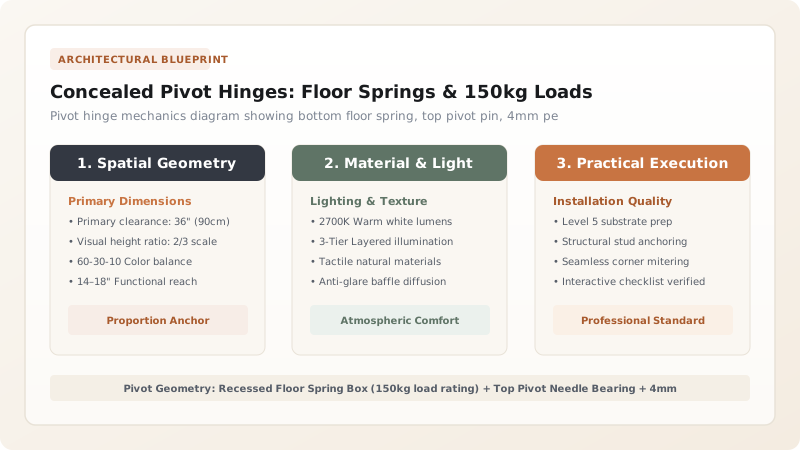
1. Biomechanics: Vertical Point Load vs Lateral Cantilever Torque
A standard \(2.7\text{m} \times 1.0\text{m}\) Crittall steel glass door glazed with 10.8mm acoustic laminate weighs between 80kg and 120kg (175 to 265 lbs). Hanging this mass on traditional wall-mounted butt hinges creates extreme lateral cantilever torque that pulls wall studs out of plumb over time.
Concealed Floor Spring Pivots transfer 100% of vertical door weight directly downward into the floor slab. The top pivot serves merely as a lateral stabilizing guide pin, resulting in buttery smooth, fingertip operation that never sags over decades of heavy daily use.

2. Pivot Offset Geometry & The 4mm Perimeter Reveal Standard
Setting the pivot axis requires precise geometric calculation. When the pivot pin is offset 80mm from the side jamb, the rear edge of the door swings inward as the front swings outward.
To prevent the rear heel edge from binding against the steel side frame during rotation, the rear vertical stile must maintain a strict 4mm to 5mm clearance gap with a softened chamfered edge. For dramatic entryway styling, explore antique foxed mirror wall paneling on adjacent reception surfaces.
Floor Springs vs In-Door Concealed Pivot Systems
Use this reference table to calculate exact physical dimensions, ratios, and specifications before purchasing:
| Pivot System Type | Installation Method | Max Door Weight | Best Interior Application |
|---|---|---|---|
| Recessed Floor Spring (Dorma BTS80) | Chiseled floor cement box (60mm deep) | 300 kg (Heavy) | Concrete subfloors / High-traffic commercial & residential |
| In-Door Pivot (FritsJurgens System M+) | Mechanism inside bottom steel tube | 160 - 500 kg | Timber joist floors / Over underfloor heating (8mm anchor) |
| Surface-Mounted Mini Pivot | Screw-fixed shallow base plate | 75 kg (Light) | Lightweight single-lite residential doors only |
| Standard Wall Butt Hinges (Avoid) | Screwed to side jamb | 60 kg (Sag prone) | Light hollow wood doors ONLY |
Underfloor Heating Core-Drill Piercing Constraints
Every successful decoration project must account for physical and environmental constraints:
Core-Drilling into Hydronic Underfloor Heating Pipes
Chiseling a 60mm floor box can puncture underfloor heating lines; use a thermal imaging camera to map heating loops before drilling, or specify FritsJurgens System M+ which requires only 8mm surface floor anchor pins.
How to Install and Calibrate a Hydraulic Floor Spring
Execute this professional sequence to achieve flawless results without backtracking:
Mortise Cement Box into Floor
Set floor spring cement box level in floor slab, aligning spindle centerline 80mm from side jamb.
Install Adjustable Top Pivot in Header
Fix top pivot socket into ceiling track with retractable needle bearing pin.
Drop Door onto Floor Spindle
Lower bottom door shoe onto tapered floor spindle and extend top pin into upper door bushing.
Align Perimeter 4mm Reveals
Turn alignment screws on cement box to center door with uniform 4mm perimeter gaps.
Adjust Hydraulic Sweep & Latch Speeds
Turn Valve 1 to set closing speed (3 to 5 seconds) and Valve 2 for smooth soft-latching.
Common Mistakes & Countermeasures
Avoid these costly errors that compromise aesthetics, ergonomics, and budget:
Overtightening Hydraulic Speed Valve Screws
Project Execution Checklist
Track your physical progress. Checkboxes persist automatically on this device:
Frequently Asked Questions
Can a pivot door swing in both directions (double action)?
Yes! Floor springs can be set for 360-degree double-action swing (opening both inward and outward) with center detents, or fitted with a physical perimeter door stop for single-action swing.


