
Achieve high acoustic privacy in steel partition walls by specifying 10.8mm or 12.8mm Acoustic Laminated Glass (two lites of float glass bonded with a 0.76mm acoustic polyvinyl butyral / PVB interlayer). This achieves a Weighted Sound Reduction Index of Rw 38 to 42 dB, reducing loud speech to an inaudible whisper.
At a Glance: Key Takeaways
- Weighted Sound Reduction (Rw 38–42 dB): Decibel reduction scale where each 10 dB increase represents a 50% perceived sound drop.
- Elimination of the Coincidence Dip: Viscoelastic PVB damping eliminates high-frequency sound transmission at 2,000 Hz.
- Acoustic Drop Seals for Doors: Automatic mechanical drop seals seal the 6mm bottom door threshold gap when closed.
- Silicone Wet-Glaze Perimeter: Eliminates acoustic flanking leakage around the perimeter steel frame.
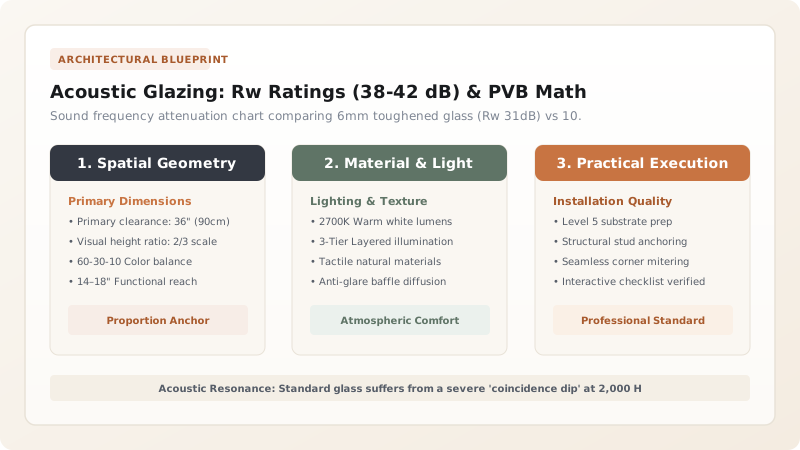
1. Acoustic Physics: Mass Law vs The Coincidence Frequency Dip
Standard monolithic glass follows the acoustic Mass Law: doubling the glass thickness increases sound isolation by only \(3\text{ to }4\text{ dB}\). However, single-pane glass suffers from a catastrophic acoustic flaw called the Coincidence Frequency Dip (typically between \(1,600\text{ Hz and }2,500\text{ Hz}\)), exactly where human speech consonants reside.
Acoustic Laminated Glass sandwiches a specialized 0.76mm acoustic-grade PVB core between two glass sheets. The viscoelastic core converts vibrational acoustic energy into microscopic friction heat, flattening the coincidence dip and achieving an outstanding Rw 38 to 42 dB sound attenuation across home offices, nurseries, and libraries.

2. Acoustic Flanking Leakage: The 1% Gap Principle
An acoustic partition wall is only as quiet as its weakest leak. In acoustic engineering, a 1% unsealed air gap around a perimeter frame degrades a 40 dB sound wall down to barely 20 dB.
To preserve acoustic integrity, steel frames must be sealed with non-hardening acoustic silicone sealant along drywall interfaces, and doors must feature twin continuous Santoprene rubber compression gaskets paired with perimeter rebate stops.
Glass Specification vs Acoustic Sound Reduction Ratings
Use this reference table to calculate exact physical dimensions, ratios, and specifications before purchasing:
| Glass Specification | Total Thickness | Sound Reduction (Rw) | Acoustic Privacy Level |
|---|---|---|---|
| 6mm Monolithic Toughened | 6mm | Rw 31 dB | Low (Speech is clearly audible) |
| 10mm Monolithic Toughened | 10mm | Rw 34 dB | Moderate (Muffled speech discernible) |
| 10.8mm Acoustic Laminated (Optimal) | 10.8mm (5+0.76+5) | Rw 38 dB | High (Normal conversation completely inaudible) |
| 12.8mm Acoustic Laminated | 12.8mm (6+0.76+6) | Rw 40 dB | Very High (Executive conference room privacy) |
| 24mm Acoustic Double Glazing (IGU) | 24mm (6+12A+6) | Rw 42 - 44 dB | Maximum (Recording studio & home cinema) |
Hollow Partition Wall Flanking Constraints
Every successful decoration project must account for physical and environmental constraints:
Sound Leaking Through Hollow Drywall Header Cavities
If a steel partition anchors to a hollow drywall ceiling, sound travels over the top via the hollow ceiling cavity; pack the ceiling stud bay with 4-inch dense 60kg/m³ mineral wool insulation directly above the partition track.
How to Achieve an Rw 40 dB Acoustic Partition
Execute this professional sequence to achieve flawless results without backtracking:
Specify 10.8mm Acoustic Laminated Glass
Order glass with dual 5mm clear float lites and certified 0.76mm acoustic PVB membrane.
Apply Acoustic Foam Tape to Steel Perimeter
Stick closed-cell acoustic isolating tape along the back of the steel jambs before mounting to drywall.
Pump Acoustic Sealant into Gaps
Fill perimeter wall expansion joints with continuous acoustic silicone sealant on both sides.
Install Automatic Mechanical Drop Seal
Mortise an acoustic drop seal into the bottom of the door leaf calibrated to drop 6mm onto the floor threshold.
Fit Dual Magnetic Compression Gaskets
Install Santoprene rubber seals along door rebate stops to form an airtight perimeter seal when closed.
Common Mistakes & Countermeasures
Avoid these costly errors that compromise aesthetics, ergonomics, and budget:
Using Standard Monolithic Toughened Glass for Home Office Partitions
Project Execution Checklist
Track your physical progress. Checkboxes persist automatically on this device:
Frequently Asked Questions
Is acoustic laminated glass also impact safety glass?
Yes! Acoustic laminated glass complies fully with Category II safety glazing standards (ANSI Z97.1 / EN 12600 Class 1B1). If broken, glass shards remain bonded to the tough PVB interlayer, preventing injury.


