
Florentine Scagliola relies on a specialized chemical system: low-temperature calcined selenite (CaSO4·0.5H2O) gauged with a warm 4%–6% animal hide glue solution (colletta di carniccio). The dissolved collagen polypeptides adsorb onto the growing gypsum crystal faces, mechanically retarding needle crystallization from 12 minutes to over 3 hours, imparting extraordinary plasticity that allows kneading, folding, and marbleizing.
At a Glance: Key Takeaways
- Mineral Source: Laminated crystalline selenite gypsum (specchio d'asino) with low iron (<0.1%) impurities.
- Calcination Protocol: Controlled indirect wood or electric kiln roasting at 130°C–140°C for 6 to 8 hours.
- Protein Glue Type: Colla di carniccio (fleshings hide glue) with Bloom gram strength of 180–220.
- Gauging Solution Ratio: 40 to 60 grams dry hide glue granules per 1,000 ml distilled water held at 52°C.
- Setting Kinetics: Retardation plateau extending initial set to 180 minutes and final set to 24 hours.
- Refractive Index: Pure selenite gypsum (n=1.52) closely matches calcite, producing genuine marble translucency.
Selenite Mineralogy: Why Common Gypsum Fails
Common gypsum rock quarried for commercial drywall is an opaque, massive aggregate containing clay, calcite, and sand impurities that scatter light, creating flat, chalky white plasters. True Florentine Scagliola demands selenite (calcium sulfate dihydrate, CaSO4·2H2O)—the transparent, cleavable crystalline variety historically called specchio d'asino (donkey's mirror) or lapis specularis.
When roasted between 130°C and 140°C, selenite releases three-quarters of its chemically bound water without disrupting its sheet-like crystal geometry, yielding beta-hemihydrate. Because the milled particles are micro-crystalline crystal platelets rather than amorphous dust, they transmit and refract angled light, perfectly mimicking the vitreous optical depth of Carrara and Siena marbles.
The Biochemistry of Colletta: Collagen Crystal Poisoning
When calcined selenite is mixed with pure water, dihydrate crystals immediately nucleate as interlocking needle-like prisms (acicular growth), locking into a rigid solid within 10 to 15 minutes. To create a sculptable dough, Scagliola masters formulate colletta—a warm aqueous solution of animal collagen.
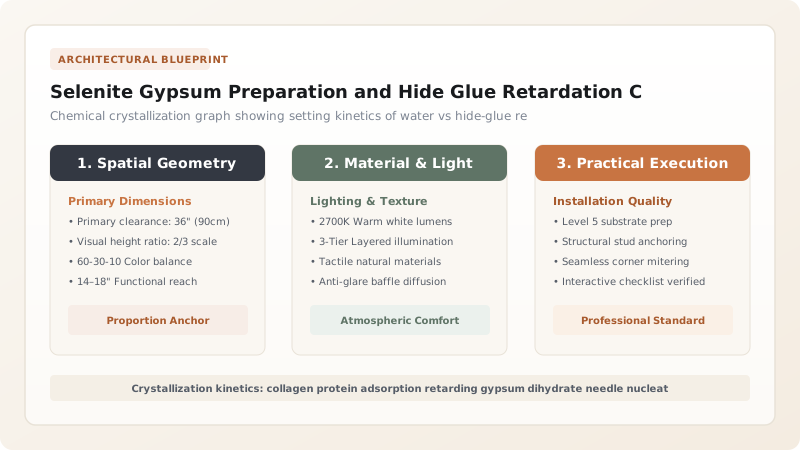
Extracted from rabbit skins or cattle hide fleshings (colla di carniccio), the collagen polypeptide chains carry active carboxyl and amino functional groups. These polar molecules adsorb directly onto the microscopic nucleation sites of the growing calcium sulfate dihydrate crystals. By physically blocking additional calcium and sulfate ions from attaching to the crystal faces, the glue 'poisons' rapid crystal growth. Setting is safely retarded for up to 4 hours, transforming brittle plaster into a dense, malleable modelling dough.
Dough Rheology: Kneading, Beating, and Air Void Expulsion
Once gauged with warm colletta, Scagliola behaves like bread dough. The artisan places the paste onto a smooth marble kneading slab and works it vigorously with fists and wooden paddles. This intense shear deformation performs two vital physical functions:
First, it eliminates entrapped microscopic air bubbles that would otherwise cause unsightly pinholes on the finished polished surface. Second, it uniformly disperses mineral pigments throughout the matrix. Once kneaded, the dough can be sliced, twisted with contrasting colored ribbons, rolled into marbled loaves (pagnotte), and pressed into casting molds without risk of cracking.
Glue Concentration vs Working Window in Scagliola Formulations
Use this reference table to calculate exact physical dimensions, ratios, and specifications before purchasing:
| Colletta Concentration | Glue / Water Ratio | Open Working Window | Final Cured Hardness | Recommended Task |
|---|---|---|---|---|
| Light Retardation (2%) | 20 g / 1,000 ml | 45 to 60 minutes | Very High (Shore D 85) | Backing cores and structural leveling beds |
| Standard Paste (4%) | 40 g / 1,000 ml | 120 to 180 minutes | High (Shore D 80) | Base casting slabs and marbled field doughs |
| Fine Intarsia (6%) | 60 g / 1,000 ml | 240 to 300 minutes | Medium-High (Shore D 76) | Delicate pictorial inlay pastes & syringe piping |
| Excessive Glue (>8%) | 80 g / 1,000 ml | Over 8 hours | Low (rubbery; gummy) | REJECT: Shrinks severely and fails to cure hard |
Practical Constraints
Every successful decoration project must account for physical and environmental constraints:
Animal glue solutions spoiling and growing mold bacteria if stored at room temperature for over 48 hours
Mitigation: Prepare fresh colletta daily in clean glass jars and add 2 drops of clove essential oil (eugenol) as a natural biocide.
Execution Blueprint & Craftsmanship Sequence
Execute this professional sequence to achieve flawless results without backtracking:
Select Clean Transparent Selenite Crystals
Examine raw selenite sheets for transparency, splitting along natural cleavage planes to eliminate dirt veins.
Roast Selenite in Monitored Oven at 135°C
Bake crystals for 7 hours until they turn milky white and easily crush between fingers; avoid exceeding 145°C.
Pulverize and Sieve to Sub-100 Micron Powder
Grind roasted selenite in a roller mill, passing powder through a 120-mesh brass wire screen.
Hydrate Rabbit-Skin Glue in Cold Distilled Water
Soak 45 grams of dried glue granules in 1 liter of cold water for 12 hours until fully swelled.
Melt Glue in Water Bath at Strictly 55°C
Warm glue pot in double boiler (bagnomaria), measuring temperature with thermometer to prevent overheating.
Gauge Selenite Powder with Warm Colletta
Add powder to warm glue liquor on marble slab, kneading vigorously with fists for 15 minutes to expel air voids.
Common Mistakes & Countermeasures
Avoid these costly errors that compromise aesthetics, ergonomics, and budget:
Boiling the animal hide glue solution above 70°C during preparation
Using cold tap water to mix Scagliola instead of warm colletta solution
Project Execution Checklist
Track your physical progress. Checkboxes persist automatically on this device:
Frequently Asked Questions
Can modern synthetic retarders like citric acid replace animal hide glue?
No. While citric acid delays the setting of gypsum, it produces a brittle, chalky body that cannot be kneaded into dough and lacks the translucent optical depth provided by animal collagen.
What is the shelf life of raw calcined selenite powder?
If sealed in airtight plastic-lined barrels in a dry room, calcined selenite powder remains fully reactive for 12 to 18 months without absorbing atmospheric moisture.


