
Finishing and conserving Florentine Scagliola is an exhaustive hand-honing ritual. After curing, excess inlay paste is cut flush using natural volcanic pumice and water, followed by progressive honing with fine slate and hone stones (coti). To achieve vitreous optical depth without peeling, the dried panel is saturated with boiled bone oil (olio d'ossa), sealed with microcrystalline beeswax, and burnished with agate or flannel cloths.
At a Glance: Key Takeaways
- Honing Abrasives: Natural Lipari volcanic pumice blocks, soft water sandstone, and fine Bavarian hone slate.
- Lubrication Medium: Pure distilled water or dilute soapy water; strictly zero dry power sanding.
- Deep Impregnation Oil: Boiled bone oil (olio d'ossa) or clarified walnut oil penetrating crystalline pores.
- Surface Protective Seal: Purified unbleached beeswax blended with carnauba and natural gum mastic.
- Burnishing Tools: Dense dog-tooth agate stones, hard boxwood rubbing blocks, and warm wool flannel.
- Conservation Interventions: Re-attaching lifting flakes with warm sturgeon glue and non-invasive agar gel cleaning.
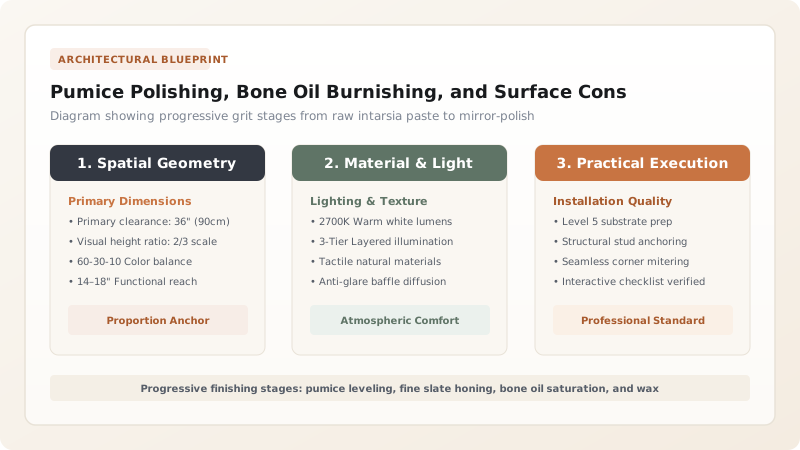
The 4-Stage Wet Stone Honing Protocol
When colored Scagliola inlays cure, they stand slightly proud of the base slab. Leveling the surface cannot be done with sandpaper, which clogs instantly and creates uneven hollows. Classical Florentine masters employ a sequential four-stage natural stone honing protocol:
- Stage 1 (Coarse Leveling): Natural volcanic pumice stone blocks dressed flat and lubricated with abundant water, worked in figure-eight patterns to cut excess paste flush.
- Stage 2 (Intermediate Honing): Fine Lombard water sandstone (pietra coti) to remove coarse pumice scratch patterns.
- Stage 3 (Micro-Finishing): Dense Bavarian hone slate (pietra d'Allemagna) producing an ultra-smooth satin surface.
- Stage 4 (Slurry Clarification): Squeezing the fine slurry back into microscopic micro-pores (stuccatura) and letting it cure before a final polish pass.
Bone Oil (Olio d'Ossa) Chemistry and Optical Depth
Once stone-honed and completely dried over 14 days, the Scagliola appears matte and pale. To awaken the vibrant colors of the mineral pigments, artisans apply olio d'ossa (bone oil)—a clear, non-yellowing animal lipid historically boiled from ox knuckle bones, or cold-pressed virgin walnut oil.
Because the oil has an ultra-low molecular viscosity and a refractive index matching gypsum, it penetrates 2mm into the crystalline matrix. The oil expels trapped air between the selenite platelets, instantly transforming dull chalky pastels into deep, luminous jewel tones: malachite glows emerald green, and lapis lazuli turns royal imperial blue.
Beeswax Burnishing and Conservation of Historic Panels
The final protective armor is a paste of purified yellow beeswax, carnauba wax, and a small fraction of natural Venice turpentine resin dissolved in mineral spirits. Applied thinly, it is allowed to haze and is then vigorously buffed with warm wool flannel or an agate burnisher, creating an impermeable hydrophobic barrier.
For museum conservators restoring antique Scagliola, aggressive solvents or water washes are strictly banned. Conservators clean surface grime using rigid agar-agar gel poultices that lift dirt without wetting the gypsum substrate, and consolidate friable or delaminating historic intarsia flakes using micro-injections of warm 3% sturgeon glue.
Honing Media and Stone Progressions for Classical Scagliola
Use this reference table to calculate exact physical dimensions, ratios, and specifications before purchasing:
| Stage | Abrasive Medium | Equivalent Grit | Lubricant | Physical Objective |
|---|---|---|---|---|
| Rough Leveling | Natural Volcanic Pumice Block | 120 – 180 grit | Flowing clean water | Cuts excess inlay flush with background |
| Intermediate Hone | Pietra Coti Sandstone | 320 – 400 grit | Water with 1% Castile soap | Eliminates pumice scratch marks |
| Fine Satin Hone | Bavarian Hone Slate | 800 – 1200 grit | Clean distilled water | Prepares crystalline surface for oil uptake |
| Bone Oil Saturation | Clarified Olio d'Ossa / Walnut | N/A (liquid chemical) | Direct oil saturation | Expels air; awakens mineral refractive depth |
| Final Burnish | Carnauba-Beeswax Paste | N/A (solid polish) | Dry wool flannel & agate | Hard, water-repellent mirror luster |
Practical Constraints
Every successful decoration project must account for physical and environmental constraints:
Modern environmental regulations restricting animal bone oil rendering odors
Mitigation: Substitute pure clarified pharmaceutical-grade walnut oil or cold-pressed poppyseed oil with identical refractive properties.
Execution Blueprint & Craftsmanship Sequence
Execute this professional sequence to achieve flawless results without backtracking:
Dress Pumice Blocks on Flat Granite Slab
Rub volcanic pumice stone against abrasive silicon carbide paper on a granite flat to ensure 100% coplanar bearing face.
Wet-Hone Surface in Continuous Figure-8 Motions
Flood Scagliola panel with clean water and stroke pumice block in figure-eight patterns, washing away paste slurry frequently.
Perform Slurry Pore Filling (Stuccatura)
Collect fine hone stone slurry and rub into surface micro-fissures with palm of hand; allow to dry 48 hours.
Final Hone with Fine Bavarian Slate Block
Smooth panel with dense slate hone under light pressure until surface feels like cold, glassy marble.
Saturate Dry Panel with Warm Bone Oil
Warm clarified bone oil to 40°C and apply with cotton pad; allow 2 hours for deep capillary absorption, wiping excess.
Buff with Beeswax and Agate Burnisher
Apply thin coat of beeswax-carnauba polish; buff vigorously with wool flannel and dog-tooth agate burnisher to glassy shine.
Common Mistakes & Countermeasures
Avoid these costly errors that compromise aesthetics, ergonomics, and budget:
Applying bone oil to a damp Scagliola slab before it has completely dried
Using modern polyurethane clear coat or automotive lacquer on Scagliola
Project Execution Checklist
Track your physical progress. Checkboxes persist automatically on this device:
Frequently Asked Questions
How do you maintain a Scagliola tabletop in daily domestic use?
Wipe with a barely damp microfiber cloth and dry immediately; never use acidic cleaners, bleach, or ammonia. Apply a thin coat of pure beeswax once every two years and buff with a soft flannel cloth.
What causes white cloudy patches on antique Scagliola tabletops?
White clouds (sbiancamento) occur when moisture penetrates through microscopic fissures in the wax seal, hydrating the gypsum crystals. Conservators gently warm the area with low-heat infrared lamps and re-saturate with bone oil.


