
Florentine Scagliola is an elite Renaissance and Baroque architectural decorative art perfected in 16th- and 17th-century Tuscany to replicate and surpass precious polychrome pietre dure marble inlays. Using finely calcined translucent selenite gypsum flakes (scaglie), warm animal hide glue (colletta), and natural mineral earth pigments, artisans cast marbleized base slabs, chisel intricate negative intarsia patterns, press contrasting colored paste into the voids, and hone the surface with pumice stones and bone oil to an impenetrable vitreous gloss.
At a Glance: Key Takeaways
- Core Raw Mineral: High-purity crystalline selenite gypsum (specchio d'asino / donkey's mirror).
- Organic Binder System: Animal hide glue or bone gelatin (colla di carniccio) providing slow setting and crystalline plasticity.
- Artistic Typologies: Imitation brecciated marble slabs (marmo finto) and pictorial pictorial intarsia inlay.
- Intarsia Excavation: Direct chisel and gouge carving of negative cavities (3mm–5mm deep) into cured base plaster.
- Finishing Process: Multi-stage water honing with progressive pumice and slate stones, sealed with boiled bone oil and beeswax.
- Historic Prestige: Medici grand ducal collections, Tuscan church altars, and European palace tabletops.
In-Depth Guides in this Directory
Explore specialized subtopic blueprints, technical dimensions, and execution checklists:
Selenite Gypsum Preparation and Hide Glue Retardation Chemistry
Technical chemistry guide to Florentine Scagliola: selenite mineral calcination, colletta hide glue formulation, and crystallization kinetics.
Chisel Intarsia and Pigmented Paste Inlay Techniques
Master artisan guide to Scagliola intarsia inlay: spolvero design transfer, skew chisel carving, mineral oxide coloring, and paste compression.
Pumice Polishing, Bone Oil Burnishing, and Surface Conservation
Comprehensive conservation and polishing guide for Scagliola: wet natural stone honing, bone oil saturation, beeswax burnishing, and antique restoration.
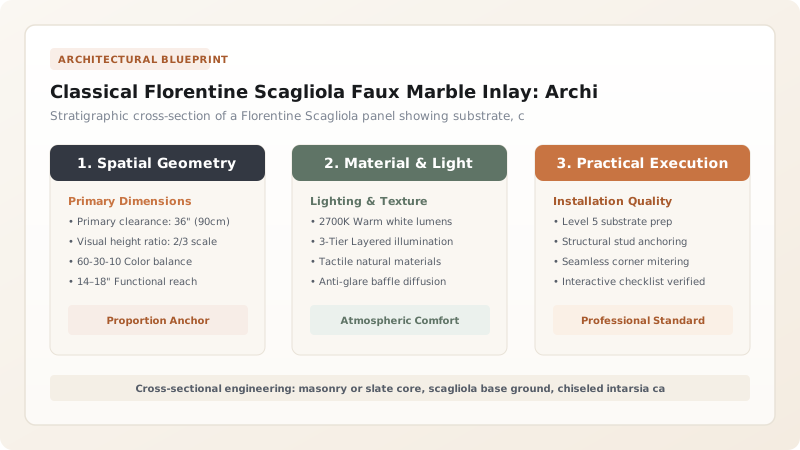
Historical Genesis: Surpassing Pietre Dure in Medici Florence
In late Renaissance Florence, the Grand Dukes of Tuscany established the Opificio delle Pietre Dure, creating breathtaking tabletops from sliced jasper, chalcedony, and lapis lazuli. However, hardstone intarsia was extraordinarily slow, costly, and limited by natural stone fault lines.
Master plasterers in Carpi and Florence developed Scagliola (derived from the Italian scaglia, meaning chip or flake) as an ingenious architectural evolution. Rather than cutting brittle gemstones with wire bow saws, artists manipulated crystalline selenite gypsum into malleable doughs tinted with mineral oxides. Scagliola allowed continuous, seamless pictorial scenes, floral arabesques, and trompe l'œil landscapes to be executed across massive tabletops and palatial columns that defied natural geology.
Selenite Gypsum Physics and Animal Hide Glue Retardation
The chemical foundation of genuine Scagliola is not ordinary white plaster; it is translucent, laminated crystalline selenite gypsum (CaSO4·2H2O) mined from the Apennine Mountains. The transparent crystal sheets are calcined in wood kilns at low heat (120°C–140°C) and pulverized into a luminous, glassy powder that retains optical depth when rehydrated.
Crucially, the water used to mix Scagliola is infused with warm animal hide glue or rabbit-skin collagen (colletta). The protein molecules coat the gypsum crystal nuclei, mechanically retarding hydration from 10 minutes to several hours. This extended setting window allows the craftsman to knead the plaster like baker's dough, fold together swirling veins of colored pastes, and manipulate delicate color gradations without flash setting.
Intarsia Inlay Chiseling and Multi-Stage Stone Honing
To create pictorial Scagliola panels, a smooth monochrome or faux-marble slab is cast and allowed to dry for several weeks. The master artist transfers an intricate paper cartoon (spolvero) onto the surface and uses specialized steel gouges and skew chisels to hollow out negative recesses to a depth of 3mm to 5mm, leaving vertical or slightly undercut edges.
Secondary colored Scagliola pastes—tinted with real powdered lapis lazuli, malachite, terra di Siena, and charcoal—are firmly pressed into the chiseled voids with spatulas. After curing, the panel undergoes rigorous wet-honing using progressively finer abrasive natural stones (water-grit sandstone, volcanic pumice, and smooth Bavarian slate), followed by hand-rubbing with bone oil and unbleached beeswax to produce a glassy, mirror-like finish.
Material Comparison: Florentine Scagliola vs True Pietre Dure vs Modern Corian
Use this reference table to calculate exact physical dimensions, ratios, and specifications before purchasing:
| Technical Feature | Classical Florentine Scagliola | True Pietra Dura (Hardstone) | Modern Solid Surface (Corian) |
|---|---|---|---|
| Primary Composition | Calcined selenite gypsum & hide glue | Natural semi-precious sliced minerals | Acrylic / polyester resin with alumina trihydrate |
| Workability | Kneaded dough & chisel carving | Diamond wire bow saw cutting | CNC routing & chemical seam adhesives |
| Optical Depth | Translucent crystalline refractive glow | Vitreous natural gemstone luster | Flat, opaque plastic appearance |
| Flexural Elasticity | Moderate (absorbs subtle table flex) | Extremely brittle; zero flex tolerance | High flexural strength |
| Reversibility / Repair | 100% historically reversible with glue | Requires replacement stone slices | Requires melting or synthetic filling |
Practical Constraints
Every successful decoration project must account for physical and environmental constraints:
Sensitivity of gypsum and animal glue matrix to liquid water and high ambient humidity (>75% RH)
Mitigation: Seal surfaces thoroughly with penetrating boiled bone oil and multiple microcrystalline wax coats; maintain climate control.
Execution Blueprint & Craftsmanship Sequence
Execute this professional sequence to achieve flawless results without backtracking:
Calcine and Sift Apennine Selenite Gypsum
Roast crystalline selenite sheets at 130°C until milky white; pulverize in stone mill and sift through 120-mesh brass sieve.
Formulate Warm Animal Hide Glue Liquors
Dissolve 40g rabbit-skin glue per liter of distilled warm water (55°C) to serve as setting retarder and crystal binder.
Knead and Tint Colored Scagliola Paste Doughs
Mix selenite powder with warm glue water and mineral earth oxides (ochre, burnt umber, malachite) to stiff dough consistency.
Cast Base Slab and Transfer Spolvero Cartoon
Cast level background slab onto rigid slate or masonry core; cure 14 days and pounce charcoal design through perforated paper.
Chisel Negative Intarsia Cavities to 4mm Depth
Excavate design areas with razor-sharp skew chisels and flat scrapers, creating clean vertical sidewalls to hold inlay.
Inlay Colored Pastes, Wet-Hone, and Burnish
Press colored pastes into voids. Once cured, hone flush with wet pumice stones, sealing with bone oil and hand-buffed beeswax.
Common Mistakes & Countermeasures
Avoid these costly errors that compromise aesthetics, ergonomics, and budget:
Using commercial plaster of Paris mixed with tap water containing chlorine and sulfates
Overheating the animal hide glue solution above 65°C during preparation
Using modern electric orbital sanders with dry sandpaper to level Scagliola
Project Execution Checklist
Track your physical progress. Checkboxes persist automatically on this device:
Frequently Asked Questions
How can you distinguish antique Scagliola from genuine marble?
Scagliola feels noticeably warmer to the human touch than cold natural stone because gypsum has much lower thermal conductivity; under a jeweler's loupe, Scagliola reveals tiny air pores and microscopic brush-like pigment strokes.
Can damaged or chipped Scagliola tabletops be repaired?
Yes. Because Scagliola is bound with reversible animal glue, damaged areas can be re-excavated, moistened with warm glue water, infilled with fresh matched paste, and re-honed flush with pumice.


