
In French academic Beaux-Arts architecture, no decorative element commands greater theatrical presence than the **Monumental Cartouche**. Mounted prominently above the grand piano nobile entrance portal or commanding the central pediment tympanum, the cartouche is a tour-de-force of three-dimensional stone sculpture: an oval or baroque-curved armorial shield (*escutcheon*) enveloped by rolling scrolls (*volutes*), cascading garlands of laurel or pomegranate swags, and sweeping, deeply undercut **acanthus foliage**.
At a Glance: Key Takeaways
- Confirm carving block is flawless 'Select Buff' Indiana limestone.
- Verify full-scale 1:1 plaster maquette is approved prior to stone carving.
- Ensure leaf lobes achieve minimum 3.0" deep undercut shadow depth.
- Confirm central escutcheon incorporates a 1.5" to 2.5" convex crown.
- Verify dual Grade 316 stainless tie-back rods anchor back to structure.
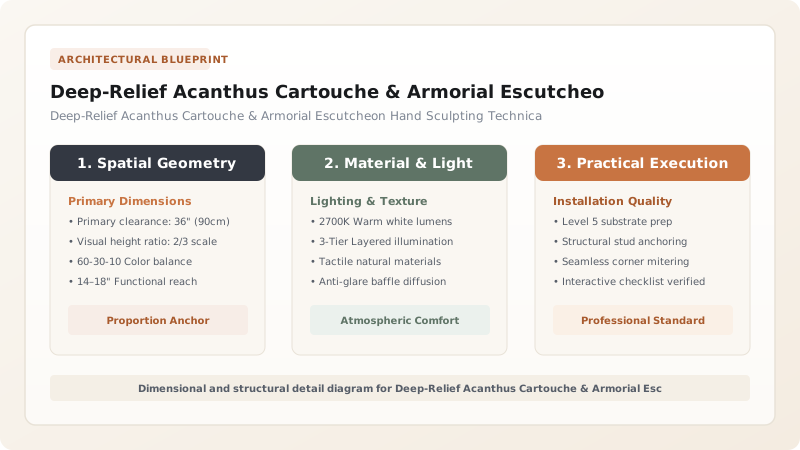
Architectural Principles & Structural Foundations
In French academic Beaux-Arts architecture, no decorative element commands greater theatrical presence than the Monumental Cartouche. Mounted prominently above the grand piano nobile entrance portal or commanding the central pediment tympanum, the cartouche is a tour-de-force of three-dimensional stone sculpture: an oval or baroque-curved armorial shield (escutcheon) enveloped by rolling scrolls (volutes), cascading garlands of laurel or pomegranate swags, and sweeping, deeply undercut acanthus foliage.
Unlike machine-routed or flat CNC relief work, authentic Beaux-Arts cartouches project dramatically—often 8.0 to 14.0 inches from the background ashlar wall. This monumental projection creates profound chiaroscuro—an interplay of razor-sharp highlights and deep, velvety black shadow voids that gives the facade life and sculptural vitality when illuminated by low-angle sunlight.
Executing such monumental stone sculpture requires master carving techniques: translating 3D clay sketches via the classical pointing machine, roughing with high-speed diamond blades, and finishing with pneumatic carbide chisels.
MONUMENTAL BEAUX-ARTS CARTOUCHE ANATOMY
                      /=================\
                     /  Garland Crest    \
             +------+---------------------+------+
            /   Rolling Foliated Scroll (Volute)  \
           |                                      |
           |         +-----------------+         |
           |         |  Convex Baroque |         |
           |         | Armorial Shield |         | <--- Acanthus Leaf
           |         |   (Escutcheon)  |         |      Undercut 4"
           |         +-----------------+         |      Deep Void
            \                                 *  /
             +------+---------------------+------+
                     \  Pendant Floral   /
                      \=================/
The Sculptural Process: From Clay Maquette to Stone
A master carver never begins directly on raw limestone. The journey involves rigorous classical stages:
- Clay Maquette (1:3 & 1:1 Scale): The sculptor models the cartouche in oil-based clay (plastilina). This allows rapid adjustments of muscular curvature, scroll rolls, and asymmetric botanical flourishes. A rigid plaster cast is made from the final clay model.
- The Classical Pointing Machine: The sculptor fixes a brass-and-steel pointing machine to three brass datum pins embedded in the plaster cast. By adjusting needle arms, hundreds of spatial coordinates (X, Y, Z depths) are transferred to matching datum pins drilled into the raw Indiana limestone block.
- Roughing Out (Bozzetto Stage): The sculptor uses pneumatic stone-cutters and diamond circular blades to plunge cuts down to within 1/2-inch of the transferred coordinate points, removing excess stone in large spalls.
- Pneumatic Carving (Intaglio & Rilievo): Using variable-speed pneumatic stone carving hammers (Bantam or Trow & Holden hammers) fitted with tungsten-carbide toothed chisels (gradine), the carver defines the convex shield curvature, rolling scroll rolls, and leaf stems.
- Deep Undercutting & Tooth Chiseling: The acanthus leaf lobes are undercut using narrow flat chisels, fishtails, and diamond riffler files. The carver hollows out 3.0- to 4.5-inch deep voids beneath the leaf tips, completely detaching them from the back wall plane so that air and light circulate behind the stone foliage.
Classical Acanthus Botany: *Spinosus* vs. *Mollis*
The choice of botanical foliage establishes the emotional register of the Beaux-Arts facade: - Acanthus Spinosus (Sharp Acanthus): Characterized by deeply notched, pointed, triangular leaf lobes with crisp central ribs. Imparts a fierce, energetic, and majestic classical Roman character. - Acanthus Mollis (Smooth Acanthus): Features rounded, voluptuous, fleshy lobes that roll outward in soft, convex billows. Evokes the luxurious, aristocratic sensuality of the French Louis XIV and Louis XV royal styles. - The Central Escutcheon: The central shield is never carved flat. It must be sculpted with a subtle parabolic convex crown (rising 1.5 to 2.5 inches higher in the center than at the edges), catching ambient daylight and preventing the cartouche from appearing sunken or deflated.
Facade Anchoring: Supporting Massive Cantilever Loads
A monumental limestone cartouche measuring 6 feet tall by 5 feet wide with a 12-inch relief projection weighs between 2,500 and 4,000 lbs. Because its center of gravity hangs forward of the structural wall face: - Concealed Top Tension Tie-Backs: Two or more heavy Grade 316 stainless steel threaded rods (3/4" or 1" diameter) must be anchored into the top rear of the cartouche block and bolted through structural steel floor beams or concrete columns behind the facade. - Base Bed Shear Pins: The bottom bed of the cartouche must be supported on two solid Grade 316 stainless dowels (1.0-inch diameter) embedded 4 inches into the stone and 4 inches into the heavy limestone lintel below. - Lead Soffit Flashing: The projecting top crown of the cartouche must be protected by a custom-dressed sheet-lead wash cap tucked into an upper reglet joint, preventing water from penetrating behind the carving.
Explore stone sourcing in Indiana Limestone Quarry Grade Selection & Diamond Kerf Sawing, see surrounding wall treatments in Rusticated Quoin Channeling & Keystone Entablatures, or return to our Beaux-Arts Limestone Facades & Cartouches Hub.
Deep-Relief Acanthus Cartouche & Armorial Escutcheon Hand Sculpting Engineering Specifications
Use this reference table to calculate exact physical dimensions, ratios, and specifications before purchasing:
| Technical Parameter | Specification Standard | Tolerance & Execution Notes |
|---|---|---|
| Cartouche Total Projection | 10.0 to 14.0 inches forward of ashlar face | Delivers authentic Gilded Age monumental depth. |
| Acanthus Undercut Depth | 3.0 to 4.5 inches clear behind leaf tips | Carved using narrow diamond rifflers and pneumatic fishtail chisels. |
| Escutcheon Convex Crown Height | 1.5 to 2.5 inches parabolic rise | Eliminates optical flattening across the central shield surface. |
| Top Tie-Back Rod Caliper | 3/4"-10 or 1"-8 Grade 316 Stainless Steel | Epoxied into blind holes in the top bed of the cartouche. |
Project Execution & Craftsmanship Sequence
Execute this professional sequence to achieve flawless results without backtracking:
Phase 1: Full-Scale Plaster Maquette Modeling
Model the cartouche in clay at 1:1 scale. Adjust leaf undercuts, escutcheon curvature, and swags. Cast permanent plaster reference maquette.
Phase 2: Coordinate Pointing & Rough Mass Extraction
Mount pointing machine to transfer key depth points to Select Buff Indiana limestone block. Drill relief depth holes and saw away waste mass.
Phase 3: Pneumatic Carving & Botanical Undercutting
Carve scroll volutes and central shield with pneumatic toothed chisels. Undercut acanthus leaves to 4" depth, finishing surfaces with rasps.
Phase 4: Hoisting, Dual Doweling & Structural Tie-Back
Cradle carved cartouche in heavy nylon rigging straps. Hoist into place, seat on Grade 316 base dowels, torque top stainless tie-back rods, and dress lead flashing.
Common Mistakes & Countermeasures
Avoid these costly errors that compromise aesthetics, ergonomics, and budget:
Using flat 2D CNC routing without hand undercutting
Carving the central escutcheon shield completely flat
Omitting lead wash flashing over the top of the projecting cartouche
Project Execution Checklist
Track your physical progress. Checkboxes persist automatically on this device:
Frequently Asked Questions
Can personal family crests or monograms be carved into the central shield?
Yes. The central convex escutcheon was historically designed to receive custom heraldic armorial bearings, bas-relief family monograms, or estate founding dates carved in classical Roman serif lettering.
How long does it take a master stone sculptor to carve a Beaux-Arts cartouche?
A monumental 5x6-foot cartouche featuring deep-relief acanthus leaves, scroll volutes, and floral swags requires approximately 180 to 280 hours of highly skilled hand-chiseling by a master architectural stone carver.
Is the cartouche carved in a single monolithic stone block?
Yes. High-end monumental cartouches are hand-carved from a single continuous monolithic limestone block weighing up to 2 tons. For monumental multi-story cartouches exceeding 10 feet in width, the assembly is divided across 3 to 5 interlocking segmental blocks with disguised joint lines hidden behind acanthus leaves.


