
Bamboo is a certified carbon-negative building material when harvested selectively from managed Moso forests (where root systems remain intact to prevent erosion). For healthy indoor air quality, strictly specify bamboo panels manufactured with No Added Urea-Formaldehyde (NAUF) low-VOC resins.
At a Glance: Key Takeaways
- Carbon-Negative Lifecycle: Bamboo sequesters more carbon during its 5-year growth than is emitted during shipping.
- Zero Deforestation: Harvesting the mature culm leaves the subterranean root rhizome alive to sprout new shoots naturally.
- NAUF Certification: No Added Urea-Formaldehyde resins eliminate toxic off-gassing in interior homes.
- LEED v4 Credits: Contributes points toward LEED Certified building projects for Rapidly Renewable Materials.
- FSC-Certified Sourcing: Look for Forest Stewardship Council (FSC 100%) certified bamboo forests.
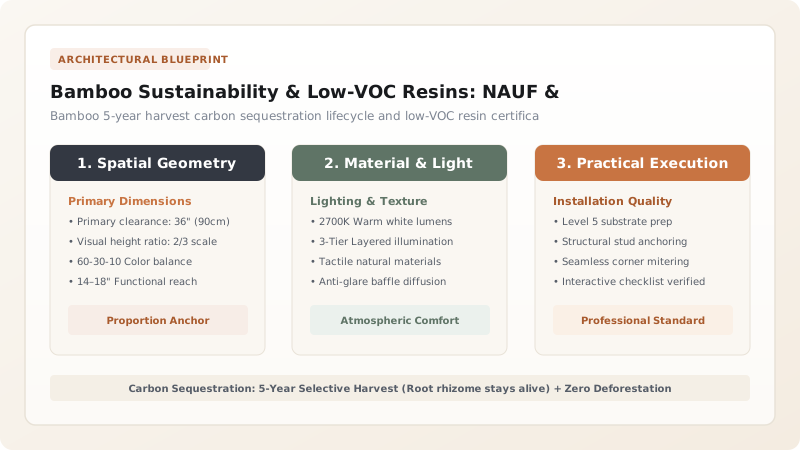
1. Environmental Ecology: Carbon Sequestration & The Rhizome Root System
When an oak or teak tree is harvested for lumber, the entire tree is killed, releasing stored carbon and causing severe topsoil erosion. In contrast, Moso Bamboo (*Phyllostachys edulis*) is an interconnected perennial grass network connected by a subterranean rhizome root system.
When foresters selectively harvest a 5-year-old culm, the root system remains completely alive and undisturbed, shooting up fresh bamboo shoots the very next spring without replanting. A single bamboo root system can produce timber continuously for over 70 years while absorbing 12 tons of carbon dioxide per hectare annually.

Bamboo Eco-Certifications & Resin Standards
Use this reference table to calculate exact physical dimensions, ratios, and specifications before purchasing:
| Certification Standard | Resin Type Used | Formaldehyde Emission Level | LEED Credit Contribution |
|---|---|---|---|
| NAUF / NAF Certified (Optimal) | Soy-Based / Polyurethane MDI | Zero Formaldehyde (0.00 ppm) | Contributes to LEED v4 EQ Credit (Low-Emitting) |
| CARB Phase 2 / ULEF | Ultra-Low Emitting Formaldehyde | < 0.04 ppm (Clean Air Standard) | Complies with strict California Air Quality standards |
| FSC 100% Certified Forest | Sustainably Managed Forest | Non-chemical forestry standard | Contributes to LEED MR Credit (Sustainably Sourced) |
| Uncertified Generic Bamboo | Urea-Formaldehyde Glue | High Off-Gassing (> 0.15 ppm) | DISQUALIFIED (Toxic off-gassing hazard) |
Cheap Formaldehyde Adhesive Off-Gassing Constraints
Every successful decoration project must account for physical and environmental constraints:
Cheap Imported Bamboo Cabinets Emitting Toxic Chemical Smells
Uncertified budget bamboo uses toxic urea-formaldehyde adhesives that off-gas for years, triggering asthma and headaches; strictly require supplier documentation certifying 'NAUF (No Added Urea-Formaldehyde)' or 'GREENGUARD Gold' compliance.
How to Specify Sustainable Bamboo for Architectural Projects
Execute this professional sequence to achieve flawless results without backtracking:
Specify Moso Bamboo Species
Ensure architectural spec sheets specify mature 5-year Phyllostachys edulis (Moso).
Mandate NAUF / NAF Adhesive
Require millwork submittals to prove No Added Urea-Formaldehyde (NAUF) bonding resins.
Verify FSC Chain of Custody
Confirm the supplier holds valid FSC Chain of Custody certification.
Select Plant-Based Zero-VOC Finish
Pair sustainable bamboo with 0% VOC natural plant-based oils (like Rubio Monocoat).
Common Mistakes & Countermeasures
Avoid these costly errors that compromise aesthetics, ergonomics, and budget:
Assuming All Bamboo is Automatically Eco-Friendly Without Checking Resins
Project Execution Checklist
Track your physical progress. Checkboxes persist automatically on this device:
Frequently Asked Questions
Does harvesting bamboo deprive giant pandas of food?
No! Commercial architectural bamboo is harvested exclusively from Moso Bamboo (*Phyllostachys edulis*), which grows at high elevations and is not a food source for giant pandas (pandas consume dwarf bamboo species like *Fargesia* and *Arundinaria* in protected wildlife reserves).


